

ELLY GRIMM
• Leader & Times
Monday marked the first meeting of the year for the USD 480 school board, and the evening saw the board re-elect Brad Carr and Sarah Thompson as Board President and Vice President, respectively.
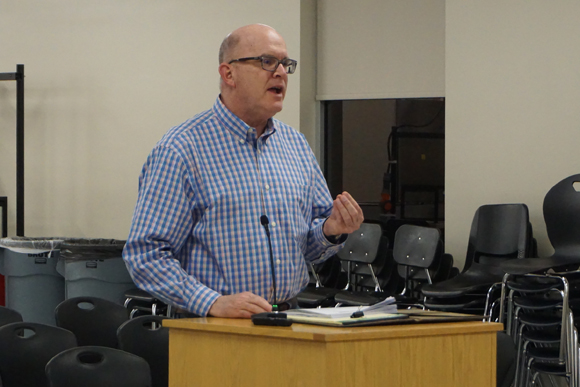
Monday evening also saw the USD 480 school board spend much of the meeting hearing about the fiscal year’s audit. Craig Hay from Hay, Rice & Associates led the discussion.
“At the beginning of the Financial Statement, that includes the audit report, and you'll see it says 'Unmodified Opinion of the Regulatory Basis of Accounting,' and that tells you there was nothing major that came to our attention or anything that was materially misstated,” Hay said. “The Regulatory Basis of Accounting is a modified cash basis of accounting, and each year, at the board's organizational meeting, the board adopts a resolution that allows for the utilization of this basis of accounting. It's a modified cash basis where you present beginning cash, receipts, expenditures and ending cash. Going a little further, also included is the basic financial statement that lists each of the funds, the beginning cash for each of those funds, the receipts, disbursements, and ending unencumbered cash for each of those funds. The district started the year with nearly $35.8 million and ended the year with nearly $44.8 million, and those increases are isolated in about four or five funds – Capital Outlay, Debt Service, Special Education, and ESSER III. The board will notice there's a large negative balance in the ESSER III – that was federal money, and we spent the money in anticipation of getting reimbursed for those funds, and that did happen within this fiscal year.”
Hay then continued diving into the audit.
“Jumping in even further, there are multiple notes to the financial statement that provides some extra 'narrative,' so to speak, and extra information about different aspects of the financial statement. One of those is the debt footnote, and talks about different debt issues – there are for General Obligation bonds as well as a couple of leases, and that footnote presents the terms of that debt as well as the beginning principal balance and the interest paid on each of those debt issues,” Hay said. “The district is below $100 million in debt now. Going even further, there's a schedule of actual expenditures to the adopted budget, and the district did not exceed the budget in any of the funds. The board will also see the individual fund pages and get more detail in terms of revenue and expenses while comparing it to the budget if it's a budgeted fund. Later on in this information is all of the agency funds, which allows for certain monies to be administered at the building level – those are the student and activity funds, and the aforementioned schedules provide an accounting of all those various activity funds, which are administered at the building level.”
Hay then went into more detail about federal funds.
“As you all might know, any government entity that spends more than $750,000 of federal money must have what we refer to as a single audit, or federal funds audit, and what we do is we identify the major programs, identify the controls, test those controls, and then we perform compliance testing for those major programs,” Hay said. “As is seen in the information, there is a list of each of the federal programs and the funds expended by each of them. One of the district's major programs was the Food Services cluster (which is disbursed by the USDA), and that came in at nearly $3.2 million, which is how much federal money was spent. Another major program was the Title 1 low income, as was the Special Education cluster, and then the ESSER cluster, which used about $970,000. All of those were the federal programs we tested controls and tested compliance. Going even further into everything, we did identify a problem in the Special Education fund – we have to identify a lot of data when it comes to these programs, and on the particular page where that's mentioned, you'll see a note at the bottom that identifies a lot of data on that particular program. When we test a major program, we'll select a sample of individuals who were paid through that federal program and then look to see if there was adequate time and effort in terms of reporting. In testing the Special Education program, we identified some employees who did not have appropriate time and effort reporting, and then through the process of trying to locate that time and effort reporting, it was discovered those employees should not have been paid out of the Special Education program. That was an issue that was identified, and we're required to report that in the federal funds portion of the audit.”
Hay then talked about the audit’s management letter.
“With the Activity Funds, the district has continued to make improvements in the controls and accounting for activity funds and they should continue to take the appropriate steps to strengthen controls,” Hay said. “The following are some issues that we identified at the activity fund level the district needs to evaluate, such as some instances in which there was inadequate segregation of duties, and there were also instances in which adjusting journal entries were not approved and did not have adequate support. This is something you see just about every year, and it’s something you’ll probably continue to see simply because there are so many different students and so many different activities, and there are constant adjustments and changes that get made as time goes on. Something else we found is bank reconciliations are being prepared but the bank statement did not reconcile to the clerk's cash summary at year end, so controls regarding the bank reconciliations should be reviewed and strengthened to ensure the district's cash balances are reported accurately. Something else we noticed was the outstanding purchase orders on the clerk's cash summary did not reconcile to the outstanding purchase order detail, so improvements have been made since the prior year, but controls regarding outstanding purchase orders should be reviewed and strengthened to ensure that unencumbered cash and expenditures are accounted for accurately.”
In other new business, the board unanimously approved the appointment of Nila Newton, Jarod Bellar and Dane Richardson to the health insurance committee for USD 480 and early graduation applications for Adrian Barragan, Erik Bernal Casas, Oscar Sanchez Martinez, Jayden Quinonez, and Lesly Ortiz Romero. Also approved were the changes to the Employee Handbook and Spanish Foreign Language textbook adoption in the amount of $5,525.25. The board also approved a bid from Pro Tech Spraying in the amount of $25,056.44 for weed control as well as the 2025-2026 Wellness Policy and a contract with FinalSite for the district’s Web site. Concluding the meeting’s new business was the board’s approval of Resolutions J, N, P and Q.