

ROBERT PIERCE
• Leader & Times
With the recent decision by the Seward County Commission to return to the Revenue Neutral Rate for Fiscal Year 2026, many local taxpayers could be receiving a refund on the money they have paid on this year’s property taxes.
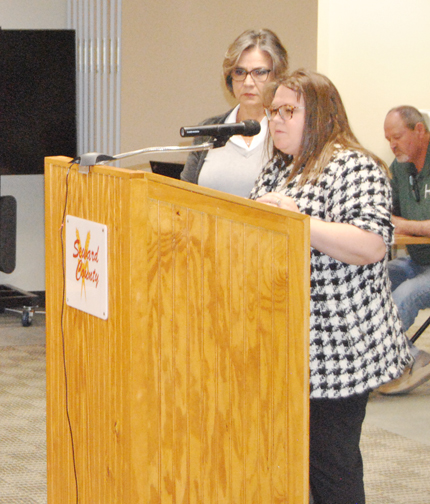
Monday, Treasurer Mary Rose and Deputy Treasurer Anabel Clinesmith talked to commissioners about creating a temporary account specifically for money designated for those refunds.
Commissioners later voted unanimously to allow for the creation of that account, and Rose said the account has been in discussion since December 2025.
Rose said as of Jan. 23, 26,689 payments were taken for the 2025 taxes, so at least that number of checks will need to be generated.
“If we do have to generate refunds, we would ask checks start with a different number, and this will allow us to be part of the process with the signature as well,” she said.
Rose and employees in her office had a Zoom meeting Jan. 29 with officials from CIC, the county’s software company about the ins and outs and possible glitches of the RNR process, as well as a conversation with bank officials on opening the account.
Rose said a county official outside the treasurer’s office would also need to be designated to sign checks.
“Currently in the treasurer’s office, myself, my deputy treasurer and my treasurer clerk are the three who sign off on the treasurer’s check,” she said. “We have a second signature that is required for checks and balances, and that second signature on those checks will not be able to come from my office. Therefore, at this time, I would like direction as to who we would like to appoint to do that second signature on these checks.”
Rose estimated the account would only be open for 180 days.
“We are anticipating for it to write the checks, hold the checks, and after 180 days, if it is not cashed, we will send that over to the state treasurer as unclaimed funds and get that off of our books,” she said.
Clinesmith said the account would make the process more simplified and efficient.
“At this time, we are trying to reconcile these checks by the time we keep the records,” she said. “If someone has a question about this, it’s going to be easier for us to try to get those records and answer those questions since the customer will be holding on the phone or waiting in the office.”
Clinesmith said a substantial amount of checks will be involved, and the treasurer’s office has already reconciled a great volume of checks.
“We are talking about payroll altogether in one account, accounts payable, the direct deposits and wires,” she said. “We’re just trying to keep it separate, and that way will be more clear and easier to keep it more under control and easier for me to reconcile.”
Rose said a similar process is currently in place in her office.
“It’s nothing new,” she said. “We would send it over the unclaimed funds to the Kansas state treasurer so they could do a search and reclaim their money. That’s our procedure right now in the office with checks, and we want to make sure we keep on top of that because it keeps our books clean and straight.”
Commission Chairman Steve Helm, though, asked if the checks could be handled in a similar fashion to the county’s current voucher and general fund checks.
Rose said checks from the treasurer’s office are slightly different.
“They come directly from the treasurer’s office, and it’s my understanding we still don’t have the signatures perfected on the payables yet,” she said. “We’ve been sitting on that since December. Are you talking about the automatic signatures? We got those finished. We have this done, but also for programming, I’m not sure they can do that. We can definitely ask if we can do that.”
County Clerk Stacia Long too said that idea is something that can be looked into for the refund checks.
“I know they charged us $300 to do it for payables since we had to change signatures,” she said. “I don’t know what it would be, but we can certainly look into it.”
“We’ve never had signatures generate on there, but it is something we can ask and see if it’s something that’s doable,” Rose said.
Helm confirmed with Rose the account would be part of the county’s general fund checking account, and all payments would come before the commission for approval.
“You’d get it,” Rose said. “It’s going to come out of the treasurer’s, but you’re going to get a register of the refunds. That’s going to come out, and it’ll be broke down on the register of the fund. We would see current tax refunds and interest refunds that were given out for those checks.”
“So we’ll have a giant voucher run,” Helm said.
“We would always do the last page for it, but yes,” Rose said.
Helm still said CIC needed to be contacted to see if a different process could be done with refund checks.
“Why do we want to write a check to them and it gets lost, and then they have to pay the full amount for their second half?” he asked.
Rose said conversations with the company revealed the county cannot apply the refund to the constituent’s second half payment.
“I’m just asking why we need to generate a check for a person who hasn’t paid their second half taxes,” Helm said.
“If it was a settlement or the customer came in and told us that’s how they would want it, we could do it, but the software company cannot do that,” Rose said. “It’s not an individual. It’s a magnitude of people we have to refund those checks to, and because it’s a bunch of these, we can’t change that to say Joe wants his and Jane doesn’t. It has to be across the board.”
“Have we checked with CIC to see if that’s possible?” Helm said.
“I did ask them, and they said we had to issue refund checks, and it was going to be in the abates and escapes part,” Rose said.
“It’s insane we’re going to write 20,000 or 30,000 checks we shouldn’t have to write,” Helm said.
Commission Vice Chairman Todd Stanton asked if this would be part of the direction from the Board of Tax Appeals on the county’s recent case regarding a disagreement for the appraisal of property owned by Conestoga Energy.
“I think BOTA can specify,” he said.
Rose said CIC officials said constituents owning multiple parcels under the same name should be grouped together with one check.
Helm said, though, the county will still be writing a large number of checks.
“We’re going to be exchanging checks,” he said. “Literally, we could be issuing checks to people who haven’t paid their first half.”
Rose said checks would not be issued to those who had not paid their first half.
“A new statement is drawn up,” she said. “It’s going to go in there, and it’s going to change that mill levy, and a whole new tax roll will then be generated. When we go in there to do the process of what we call an abate and escape, which is an adjustment to their taxes, it will produce a new statement for them as well with their check and the change order. There’ll be a group of ones where we can just select all, which is the amended tax bill. Those are the ones who have not paid anything.”
Helm said depending on how BOTA directs the county to do refunds, county leaders need to take a look at being able to issue a credit against second half payments as opposed to writing a check.
“When we first set up with CIC and we had the whole thing with the checks, the payables checks, the payroll checks and the county treasurer’s checks, there was a whole issue trying to get that fixed,” Rose said. “They did fix it, and it was because we use different checks in different departments that they were having issues with.”
With no checks being issued yet and a timeframe in place, Helm asked if CIC could again be contacted to see what more could be done.
As for the person designated to sign the checks, Long said suggested the commissioners themselves, and Rose said this could be done. However, Helm said this would mean signing up to 2,000 checks a day, a volume higher than he and other commissioners are willing to commit to doing.
“I’m not sure why we can’t check so the signature’s done just like our payables checks where the signature is applied to the check,” she said.
Rose said county officials could look into that. After the discussion, Stanton made the motion to allow Rose to open a special account for the purpose of issuing RNR refund checks, with the account to remain open only 180 days after the last check is issued, and the commission voted unanimously to approve the motion.