
ELLY GRIMM
• Leader & Times
Statistics show an estimated 6.9 to 7.2 million Americans aged 65 and older are living with Alzheimer's dementia in 2024-2025, a number projected to reach nearly 14 million by 2060. It is the sixth-leading cause of death in the U.S., with deaths more than doubling between 2000 and 2022. Women make up nearly two-thirds of cases, and the disease disproportionately affects African-American and Hispanic populations.
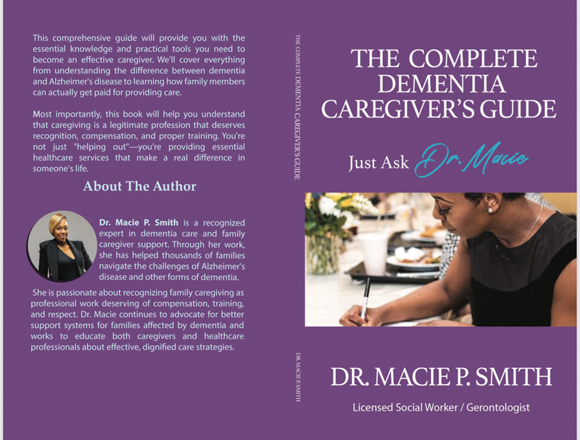
Family members are often the ones called in to help with these patients’ care at home and recently, Dr. Macie Smith released “The Complete Dementia Caregiver’s Guide” to help navigate the process. The book is available in multiple media forms and can be searched for online.
As Smith tells it, she was inspired to enter the medical field and work in gerontology several years ago.
“I am a licensed social worker and gerontologist, and I've been in the industry for more than 26 years. Throughout my entire career, I've worked with adults with intellectual developmental disabilities in the aging population,” Smith said. “What kept me in the industry, although it was the first job that gave me a start in the social work industry, I've remained here because of the outcomes that happen when you lead with compassion, care and understanding to one of our most vulnerable populations, which would be our senior population. With God's blessings, we're all going to age, and we all want respect, dignity and equality of life. When I saw I could contribute to that, not only supporting the people who have given so much of themselves, but really to also lay the groundwork and drill down into my specialty area, which is Alzheimer's and dementia caregiving.”
During her education, Smith said there was a lot to learn.
“Many of the clients I worked with started to get diagnosed with dementia or Alzheimer's disease, and at the beginning of my career, I didn't fully know the difference between the two. In fact, I didn't even know there was a difference between the two because of how I was raised – I was raised with the idea everybody who gets older will get a touch of dementia, but I eventually realized you can't get a touch of it, it's a situation of either you've got it or you don't,” Smith said. “I've always been intrigued by proving either myself wrong or proving somebody else wrong, which is what research is all about anyway. I started to do a deep dive into what Alzheimer's was, what dementia was, and I was really astonished it wasn't what I initially thought it was. So I said, 'Well, here I am with these degrees, and I don't know what this is,' so I can only imagine what lay personnel and people who are living with the disease are experiencing. Eventually, my grandmother developed a progressive type of dementia, and we didn't know what type it was. That sparked a fire in me, and the work that I did became even more meaningful. I was working for state government at the time, but I started to develop my own geriatric care management practice part time, and then I slowly moved into it full time, and that's where I am today, trying my best to impact change on various levels of the caregiving spectrum.”
The inspiration for her most recent book, Smith said, came about rather inadvertently from her husband.
“This is actually my third book – the first one I wrote was in 2019 and I actually wrote it because as I was doing community seminars and workshops, the same people were coming back every time. I felt bad because they were taking time away from their loved one and taking time away out of their day to come and hear me speak,” Smith said. “I would always tell them 'I'm going to say the same things as before,' and they say, 'We know, but that's okay because we're experiencing something new.' It was actually my husband who said to me 'Why don't you just write it down for them?' That threw me for a loop because I never thought about that. I considered myself more of a talker than a writer, and at that point, in my mind, I felt like got more of my message across when I was talking. After my husband suggested writing everything down, I basically said 'Okay, I'm going to write it down and put it together as a guidebook. It's not going be a thick book because they're family caregivers and don't have time to sit and read a big, fat book.' But I knew these people needed this information the doctors might not have – or, if they had it, there wasn't the time to give it to them. I started out with the frequently asked questions, because that was my proof of concept to see if people would even read it or if they wanted it, and they did.”
For caregivers starting their own journey, Smith offered some advice.
“The first advice I would give is to contact the Alzheimer's Association. They have a 24/7 hotline, and there's a chapter in every region of the country, so they may be able to locate a chapter near them,” Smith said. “The next step, I would recommend they reach out to their area agency on aging, which offers tangible resources such as respite vouchers so they can go and take a break and practice self-care. I would also empower family caregivers to accept the help that people are offering – people will say, 'Let me know if I can help you with anything,' so if there's truly something you need some help with, whether it's big or small, go ahead and write a list of things down, whether it's stopping for a gallon of milk at the store the next time they go or cleaning up part of the house. Don't be afraid to ask for help if you truly need it, and don't feel ashamed to take the help that ends up being offered.”
With caregiver burnout affecting many, Smith said it is important for resources to be available.
“Family caregiving, number one, is a very isolating role. A lot of times, caregivers are not being asked to go out with family and friends, because they assume that person is taking up the bulk of their time. These caregivers don't have an outlet the way they used to since their life has changed so tremendously,” Smith said. “Caregiving is also a very dangerous role, and people don't really consider it that way, because all they know is they're taking care of this person. But typically, they're taking care of this person, that person, and everybody else, but they're not taking care of themselves. We know approximately 35 percent of family caregivers actually pass away before the person they're taking care of because they're not recognizing the signs of their own health emergencies since they're focusing their mind, their thoughts, their being, on other people, and that's very, very dangerous. We know family caregiving can take 10 years off of your life, and that's what the research supports, and empirical data supports that as well. Family caregivers, who are roughly 60 percent women, need permission to put themselves first. This book is permission to say, 'You don't have to do it alone, nor do I expect you to do it alone.' And this is how you can build community and build resources and put resources in place so you don't burn out so hard and so fast. It makes me feel good that I can actually provide these caregivers with something tangible that they can refer back to, because something new is going to always come up along the journey, and they'll have this resource.”
Smith said a main goal from releasing “A Dementia Caregiver's Guide to Care: Frequently Asked Questions” is to help offer some hope for family caregivers.
“The biggest thing I want people to take away from the book is that there is hope along the journey, there is help along the journey, and there is happiness along the journey. I want people to know people with dementia can and do live well with the disease, and so can the caregiver, and there are supports available out there,” Smith said. “A lot of times you'll hear people say, 'You've got to take care of yourself before you can take care of other people.' Well, in this book, I'll tell you exactly how to do that, and I keep it real and keep it plain. I typically don't use jargon but if there is a point where I DO use some, I break it down and make it palatable. I don't want family caregivers to worry and wonder, because they're already worrying and wondering enough. 'm hoping this playbook, which is a complete comprehensive book, can help them find comfort, find peace and find community, which is really, really important, especially when it comes to the medical care. A lot of times when they get a diagnosis from the primary care physician or from a neurologist, if the family even knows to seek the assistance of a neurologist. And what's said is a lot of families don't even know a neurologist should be a part of the team. I want this book to empower the family caregivers, because a lot of times, the family is going to have way more in-person time than their medical care team will have. I wan to empower people with the information and employ them to actually execute so everyone is being taken care of as much as possible.”