
ROBERT PIERCE
• Leader & Times
Many restaurants throughout the world offer wine to go with meals, and for some, getting the right wine with the right food is an absolute necessity.
Vanessa Keating said it is more than a necessity, and there is a lot to pairing wine with food, so much so that there is actually a science to it.
“It all depends on the senses and the body from the nose in the olfactory role to the taste and even the visual of it,” she said. “When your eyes see the color blue, they automatically see calm. It’s the same thing with wine before you actually taste it.”
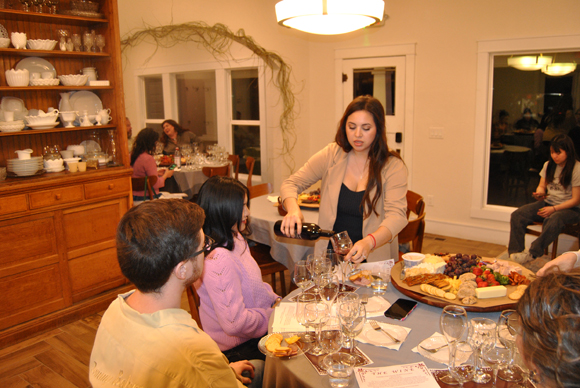
Now living in Southwest Kansas, Keating, a graduate of Washington State University’s viticulture and enology program, hosted a wine pairing workshop last Friday at Liberal’s Baker Arts Center.
While wine making and pairing may not be a big deal in this part of the Sunflower State, Keating said there is a huge viticulture for the industry in Washington state and California.
“There’s big farming for it,” she said. “They have learned with certain soils. That’s where it all starts. They get different grapes and what thrives in certain soils and different temperatures and climates in what will be produced there. In coastal regions, chardonnay is great.”
Keating grew up in the state of Washington, and with much of the land dedicated to vineyards, she built a love for science, technology, engineering and math, in particular chemistry, where she began her degree at WSU.
“I absolutely loved that,” she said.
Soon, though, Keating learned of wine science, and her academic life took a slight detour.
“It goes down from when you plant to when you’re going to pick,” she said. “Then you have to do all the viticulture process and the wine making process. That’s where all the fun stuff happens. You really can get creative with it. You can start mixing in there if you want. It’s chemistry based.”
Along with viticulture, enology makes up part of a degree program at WSU.
“Enology is the wine making part of it,” Keating said. “It’s a four-year program, and each semester, you do different stages of the wine making process.”
The wine pairing portion of the curriculum, Keating said, happens in the final two semesters of the program.
“We actually go to a winery with the class,” she said. “You learn how to pair, and you do a lot of sensory classes. That’s when you figure out this goes well with the nose. That’s when you find out about the olfactory and the five regions on the tongue and what targets each part of the tongue.”
With little knowledge of the program initially, Keating said her professor got her attention when asked if she would like to study wine science.
“I said, ‘What do you mean? We’re just going to school to drink wine?’” she said.
It did not take long for Keating to get on board with the program, however.
“I said, ‘Alright, let’s do it. It’s another degree for me, so I might as well try it,’” she said. “I fell in love with it.”
Keating said her goal with the Baker workshop was to get participants to open their eyes on different ways to open up the pallets in their mouths.
“Once you take a sip of one thing, some people don’t even like wine, and they think it’s very tart,” she said. “It can be too sweet, and it tastes like alcohol. They don’t like it.”
However, Keating said pairing certain wines with certain foods will help a person see and taste the flavors in the wine.
“It’s not just a wine grape you’re tasting,” she said. “You’re tasting blackberry, grapefruit, oak, smoke in there. None of that is added into the wine. It’s just the wine grapes. It’s how it’s all processed in fermentation.”
Though pairing the right food with the right wine may seem trivial to some, Keating said it is quite important.
“Wine has been around forever, and if you go to certain countries, it’s a big part of their culture,” she said.
After she finished her degree at WSU, Keating continued her work in wine by interning and working for the Prosser, Wash.-based 14 Hands Winery and for what is considered the primary winery in the state of Washington – Chateau Ste. Michelle Winery.
“They’re the top umbrella of everyone, and that was just a huge honor to be in there with them,” she said. “It’s the best of the best of all the wineries.”
From the moment she saw what wine making was all about, Keating said her work with in the industry was non-stop.
“They encouraged to go and find internships and view the bottling process, cellar work, cleaning out cases,” she said.
Living in Washington state, Keating said she wanted to be a winemaker, but after she met her husband, she moved with him to Southwest Kansas.
The weather in Kansas is one of a mostly dry side in Western Kansas, while Eastern Kansas tends to see more moisture. Keating said the state of Washington has a similar pattern.
“Washington state has the very rainy side of it, which is the West Coast, and on the other side, it’s dry as can be, but you still have rainfall enough that the farmers are able to still have crops,” she said.