

ELLY GRIMM
• Leader & Times
The summer is well under way, meaning people are spending more time outdoors either for work or recreation.
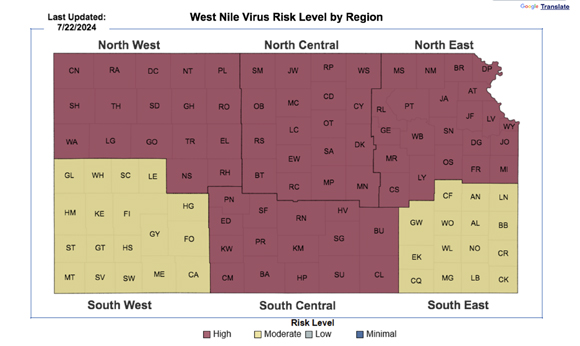
Unfortunately, the summer season also brings about many insects, including mosquitos, which can lead to contracting the West Nile Virus. According to the Kansas Department of Health and Environment (KDHE), four of the six Kansas regions are at high risk.
“West Nile Virus is most commonly spread by infected mosquitoes that have fed on infected birds. The disease was first detected in North America in 1999 and has spread across the continental U.S. and Canada. While all mosquitoes may look alike to the lay person, species of the genus Culexare the primary vectors for West Nile Virus in the U.S.,” the Kansas Department of Wildlife and Parks (KDWP) noted. “Once a person is bitten by an infected mosquito, the incubation period for the virus ranges from 3 to 15 days. However, about 80 percent of people infected by West Nile Virus do not develop any symptoms. The remainder may develop a fever and other symptoms such as head and body aches, joint pains, vomiting, diarrhea or rash. Most people recover completely, although fatigue and weakness may persist for weeks or months. Less than 1 percent of infected patients develop a serious neurological illness such as encephalitis or meningitis. Approximately 10 percent of people with such neurological complications succumb to the infection. People who have had West Nile Virus are considered immune. KDHE began surveillance for West Nile Virus in 2001, and the first human case was reported in Kansas in 2003. There were 54 cases reported in Kansas in 2014.”
Johns Hopkins Medicine also talked about the virus itself.
“West Nile Virus is spread to humans through the bite of an infected female mosquito. The mosquitoes get the virus when they bite an infected bird. Crows and jays are the most common birds linked to the virus. But at least 110 other bird species can also carry the virus,” Johns Hopkins Medicine noted. “West Nile Virus isn't spread between humans. But there have been a few cases where it has spread through organ transplants. The risk of getting the virus from an organ is unknown. Not all organ donors are tested for West Nile Virus. All blood is screened for the virus. The risk for getting West Nile Virus from blood is much lower than the risk of not having any procedure that would call for a blood transfusion.”
“High risk means that you are at a high risk of being bitten by a mosquito that could be carrying West Nile, based on a high number of mosquitoes identified and a high number of historical human cases,” the KDHE noted. “Do the following to prevent mosquito bites: people over 50 or people who are immunocompromised may want to adjust outdoor activity to avoid peak mosquito hours, which is from dusk to dawn; wear mosquito repellent; wear long sleeves and long pants when weather permits; use mosquito netting on baby carriages and playpens; and dump standing water twice weekly.”
The KDWP also gave some advice for preventing mosquito bites.
“When outdoors, use insect repellent containing an EPA-registered active ingredient on skin and clothing, including DEET, picaridin, oil of lemon eucalyptus, or IR3535. Follow the directions on the package,” the KDWP noted. “Many mosquitoes are most active at dusk and dawn. Use insect repellent and wear long sleeves and pants at these times or consider staying indoors during these hours. Make sure doors and windows have tight-fitting screens. Repair or replace screens that have tears. Try to keep doors and windows shut, especially at night. Get rid of mosquito breeding sites by emptying standing water from flower pots, buckets and barrels. Change the water in outdoor pet dishes and replace the water in bird baths twice weekly. Drill holes in tire swings so water drains out. Keep children's wading pools empty and on their sides when they aren't being used.”
For those who do contract the virus, however, there is unfortunately no specific treatment, according to the Centers for Disease Control and Prevention (CDC).
“There is no specific treatment for WNV disease; clinical management is supportive. Patients with severe meningeal symptoms often require pain control for headaches and antiemetic therapy and rehydration for associated nausea and vomiting,” the CDC noted. “Patients with encephalitis require close monitoring for the development of elevated intracranial pressure and seizures. Patients with encephalitis or poliomyelitis should be monitored for inability to protect their airway. Acute neuromuscular respiratory failure may develop rapidly, and prolonged ventilatory support may be required. Various drugs have been evaluated or empirically used for WNV disease. However, none has shown specific benefit to date. No WNV vaccines are licensed for use in humans. In the absence of a vaccine, prevention of WNV disease depends on community-level mosquito control programs to reduce vector densities, personal protective measures to decrease exposure to infected mosquitoes, and screening of blood and organ donors. Personal protective measures include use of mosquito repellents, wearing long-sleeved shirts and long pants, and limiting outdoor exposure from dusk to dawn. Using air conditioning, installing window and door screens, and reducing mosquito breeding sites around the home, can further decrease the risk for WNV exposure. Blood and some organ donations in the United States are screened for WNV infection; healthcare professionals should remain vigilant for the possible transmission of WNV through blood transfusion or organ transplantation. Any suspected WNV infections temporally associated with blood transfusion or organ transplantation should be reported promptly to the appropriate state or local health department. People with confirmed WNV infections should not donate blood for 120 days after their illness.”