



ELLY GRIMM
• Leader & Times
Wildfires fueled by high winds and dry conditions roared through the area Tuesday, ultimately destroying livestock, property and farmland.
Many emergency response agencies were on hand to help battle the blazes, including the Liberal Fire Department throughout the situation. As Liberal Fire Chief Kelly Kirk tells it, preparation for potential response began last Monday.
“We knew Tuesday was going to be a critical fire danger day due to all the forecasts and how dry it is around here. At least Monday, Chief [Andrew] Barkley and Seward County Emergency Management put out a situation report letting everybody know what was coming. We knew it was going to be a high wind, high fire danger session. Then Tuesday, over the lunch hour, Chief Barkley called and we were made aware Stevens County was responding with just about everything they had to a fire just into the Oklahoma state line that was going to get into Stevens County in pretty short order. That turned out to be the biggest fire that threatened us from the west Tuesday. I believe it originated possibly down around Texhoma – though I’m not 100 percent sure – but that was the big fire that brought the smoke into Liberal pretty much all day yesterday. With that happening with Stevens County sending all their resources to that fire, Seward County now stepped up and became a response agency into Stevens County if necessary, and that in turn triggered us as the Liberal Fire Department to step up and start assisting Seward County. And then, it was shortly after 1 p.m. when Chief Barkley called me again and tole me they had been dispatched to the fire that was threatening Tyrone, Okla., which eventually it grew and spread to the point that it led to the evacuation of that town. And folks at Tyrone by their sheriff’s deputies were told to head to Liberal, and many of those residents did.”
At that point, Kirk said, Liberal firefighters started making preparations.
“We had to have those conversations of if that fire was a threat to Liberal, what would be the best course of action for us, especially since we weren’t able to predict where it’s coming from,” Kirk said. “So one of the first things we did is we went just to the other side of the airport and patrolled everything basically from 2nd Street up to Tucker Road, and that let us get an eye on what sort of fuel there was. There was a mixture of green wheat, mowed grass, pasture land, etc, out there, so we had an idea of what we were up against if it got to Liberal on the west side of town. Several of our off-duty people who were monitoring radio traffic made their way back to the station to stand by in the event that Liberal got threatened. Had that happened, we would have staffed up every single engine we have and with multiple people and basically spread out along the west side of town to start making arrangements to protect the city when it came in,”
Things only got busier from there, Kirk continued.
“The county units that were in Oklahoma, along with Oklahoma units, were starting to make a lot of headway on the fire by Tyrone and starting to kind of get it under control. And then at some point, the National Weather Service notified us of a new heat bloom south on U.S. Hwy. 83 around U.S. Hwy. 83 and 64 Highway, which turned out to be the big fire that originated in Beaver County. At that point, everything we had here in Seward County was either fighting fire or engaged in the protection of the city itself. Through the course of the day, while all this is going on, while the county’s out doing battle with the fires out there, we were getting requests to send units to Beaver County and also the fire that originated at Ashland, which we unfortunately were unable to assist given how busy we were here. At that point, we’re aware of three large fires, and then around 4 p.m. Tuesday, the fire started on Andrew Lane. At that point, Seward County Fire was still in Oklahoma, so what happened there was Chief Barkley had been requesting a lot of resources and units from around the area and for the fire on Andrew Lane. We actually staffed a Seward County Fire truck with some of our people and sent that truck with one chief officer out to the Andrew Lane area to get started on that fire, and they were also met there by Haskell County units. Within a matter of minutes, the Andrew Lane fire had crossed the road are spreading into the river bottom, so by the time the resources were at that fire, it had spread down in the river bottom, and it was very inaccessible. That fire ended up burning all the way into Meade County, and actually destroyed two homes in Meade County.”
Many emergency units were on hand to help with all the wildfires, Kirk said, all of whom continued to remain busy.
“The Andrew Lane fire had Liberal fire units, Seward County Fire units, Haskell County, Meade County, a strike force from Johnson County up around Kansas City that was deployed by the state out to here, and a state forestry command officer who became in charge of things,” Kirk said. “They had blades and discs and tractors and lot of water out there, at least for our part, they were still out (Wednesday) mopping up that fire. They got it contained Tuesday night, but they were mopping up that fire Wednesday, and they’ve had the luxury of also being able to use crop dusters to bring water from the air. The Liberal Fire units got back to headquarters at about 1:30 a.m. Wednesday, and then the Seward County Fire Department was right back at it later Wednesday morning.”
Kirk said everyone involved with emergency management in the community was on high alert throughout the day.
“We made sure to be in a state of readiness, that’s what we’re here for, and it’s what we’re trained to do, so that training kicked in. We don’t have a lot of people, and it doesn’t take very long for our resources to get stretched very, very thin, so it’s a credit to our off-duty people how they listen and pay enough attention to know to come back to the station and be prepared,” Kirk said. “Even throughout the day, we responded in town to 10 of what are routine calls for us including a couple of fire alarms, reports of power lines down due to the wind and several medical calls. I was pretty sure for most of the day Liberal was not going to be threatened by the fires because I knew what units were taking care of the fires out west and I was keeping track. I was also in touch with Chief Barkley all day long, and he kept me informed of what their current status was, and they were doing everything they could to keep Liberal from being threatened. And they definitely deserve credit because I believe the closest the fire got to Liberal was probably about five miles to the west of town. I know there was a lot of social media chatter and people were concerned about the need to evacuate Liberal, but we got online and told people to remain aware, and we were planning to keep everyone informed. I don’t believe it ever would have led to evacuation of the city – at most, it might have led to the evacuation of a few blocks in certain neighborhoods until we were able get the fire stopped and contained.”
Among the safety concerns to keep track of was the heavy smoke, Kirk said.
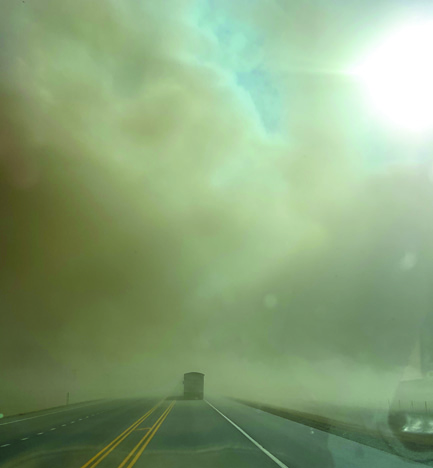
“In my career, I don’t know if I’ve ever seen as serious a smoke condition in town as we had, because those fires burning through that dry grass and pasture land were generating tremendous amounts of smoke. Ordinarily all of that would have been forced to rise and diffuse in the sky, but the wind was keeping it on the ground and moving it a long way,” Kirk said. “There’s always the concern for people who might have breathing problems or conditions like that that might have been a concern. With the fire that originated in Texas County, there was a point when it got into Seward County and started making its way towards Liberal, and that’s when we fully mobilized and got ready to defend the city if necessary, and that was as close as we came to think of might need to evacuate. But through some terrain and some green wheat and some natural breaks with roads and things like that, they were able to get so that quickly went away, and after that, it was just a matter of supporting them until they could get the fire.”
Kirk also praised the partnership between the Liberal Fire Department and the Seward County Fire Department.
“Even back to when I started in the 1990s, the county fire department and city fire department have always worked well together when it comes to response,” Kirk said “Chief Barkley and I had started talking early in the morning Tuesday, and we were still talking at 1:30 a.m. Wednesday, just communicating back and forth about what was going on, where we could move to and making sure we were staying on top everything that was happening in our county.”
And with conditions in the area being the way they are, Kirk added some fire safety advice for people.
“A bit thing is be aware of where any brush and vegetation are building up – especially if you live in rural areas, make sure you have built or mowed a fire beak around your property to give us a fighting chance when we get there. We definitely recommend keeping things mowed down, and we could sure use some moisture in this area. We advise limiting tasks that could produce heat sparks outside.”
Kirk offered praise for all the assistance given throughout the fires Tuesday.
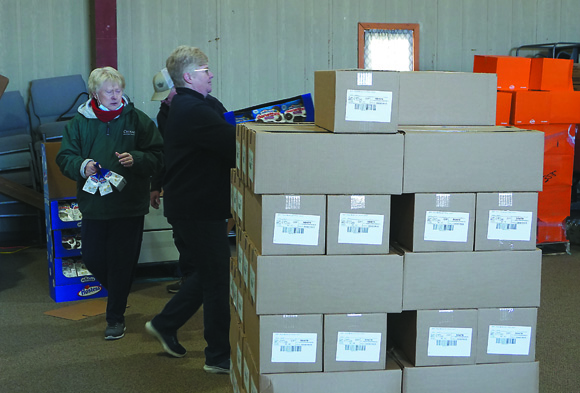
“Tuesday was an out of the ordinary day, but when it was all said and done, things were okay and in Liberal, we got lucky,” Kirk said. “I would like to say thank you to everyone who has stepped up. We have had so many people reach out to provide food for the firefighters who are working, water, drinks and other necessary supplies. I can’t say how grateful I am for all the volunteers to stepped up and help. I also have to say thanks to Chief Barkley and the Seward County Fire Department and all the surrounding departments from Stevens County, Haskell County, Meade County, that came and helped us in our time of need Tuesday.”