

ROBERT PIERCE
• Leader & Times
While millions of Americans are likely hitting stores and the Internet for Christmas shopping this time of year, the holiday season also means tax season for many property owners.
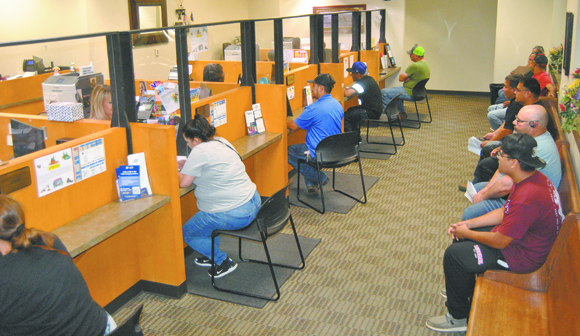
From Nov. 1 to Dec. 31, workers in the Seward County Treasurer’s office take payments for the current tax year for the next budget year.
Treasurer Mary Rose said by statute, the first half of payments is due Dec. 20, but because that date falls on a Saturday this year, the deadline has been extended to Dec. 22. She said this includes real estate, personal property and estate taxes.
The second half of these payments is due May 10, but similarly to the first half, that date likewise falls on a Saturday, so this year’s deadline has been extended to May 12, 2026.
Statements began going out Nov. 1, and Rose said all statements come with first and second stub. Full payments can be made if desired by Dec. 20 with the first stub, and property owners have the option to pay the second half by May 10 if they choose to do so with the second stub.
Rose advised taxpayers to keep their statements because they have the correct stub at the bottom to be used for the payment.
“It’s going to be easy for us to find those parcels, and two, you use that for your taxing purposes at the end of the year with your receipt,” she said. “You can attach all of that together.”
Rose said tax statements are the final procedure in the county’s tax process.
“Everything on there is finalized at that point in time,” she said. “It’s going to have on your tax statement your valuation, your assessed value.”
Rose also said taxpayers need to look at their statements, particularly the valuation, assessed value and address, closely to make sure that information is correct.
“On your statement you get from the treasurer’s office for the collections part of it, it’s going to show you where your money’s going and for how much,” she said. “It’ll be broken down on that real estate statement. I always encourage people to thoroughly look at that.”
Before statements go out, though, Rose said the county begins its budget process in June, and this includes budgets from the county’s other taxing entities.
“From there, it goes to the clerk’s office,” she said. “They do their work and what they need to do.”
The taxing process, however, starts with the appraiser’s office, where properties are assessed and given valuations. That office then sends out valuation forms to taxpayers before the clerk’s office sends out the Revenue Neutral Rate, or the mill levy rate at which the county would collect the same amount of revenue as the previous fiscal year.
“We start that in March, and we come to November, where we’re at a final calculation,” Rose said. “For my office, from the end of October through mid-January, it is full fledged in our office as far as tax records.”
Rose said the county’s entire tax process is governed by state statutes.
“We have to follow the law,” she said. “The statutes have the deadlines.”
The treasurer’s office collects motor vehicle taxes as well, with that amount coming from the Kansas Department of Revenue, and that new year will start in January 2026. Rose said some of this money goes to taxing entities for distribution.
“That property tax is divided between the state and the county, and when I say the county, I don’t mean the county individually,” Rose said. “I mean the county and the entities in that county to make it run. Depending on where that person lives and where that vehicle’s housed is where that property tax goes to.”
Rose defined her role by statute is to collect and distribute taxes.
“I’m going to collect all the taxes for all the entities,” she said. “We have 17 entities I distribute to five times a year for them to fit in to their budget they’ve requested. With that, there is no agenda.”
For those who cannot pay their taxes on schedule, Rose said payments are available through KDOR’s Kansas Homestead Refund Programs. Rose, however, said many are under the misconception that this is a program that allows them not to pay taxes, but in reality, they do have interest owed.
“It’s a refund program,” she said. “What happens is they are still liable for their taxes, and the state will refund them back the money or partial money. Any interest or fees incurred between that time they’ve applied and when we receive payment is still their responsibility. You can have those refunds sent to our office.”
Rose said taxpayers can get assistance from the county clerk’s office or their tax preparer for the program.
“There is a deadline for that, though, and I believe April is the last time they can file for that refund,” she said.
Taxpayers can also file a payment under protest.
“If their valuation went up and they have not made their payment, they can file when they come in and make their payment,” Rose said. “They have to pay the payment, and they can file a payment under protest. We have those forms available in our office. They can also get that online at kansas.gov. They can also visit the Web page for the county.”
Rose said once payments are made under protest, all documents from the transaction are copied, with one copy staying in the treasurer’s office and another going to the appraiser’s office.
“From that moment, it leaves our office to the appraiser’s office, and they would take it into their hands and do their due diligence,” she said.
The treasurer’s office likewise takes partial payments on property taxes, but not on motor vehicle taxes, which are required to be paid in full. Rose, though, said taxpayers will still incur interest, penalties and fees.
“It’s not going to stop that,” she said. “It’s going to sit there as an unpaid balance, but it does allow you to make those payments to us. It’s like an escrow payment, but we don’t do escrow. We just do partial. We apply it to the balance due.”
Rose said the treasurer’s office accepts money orders, cash, checks and credit cards for payments. She said anything not paid after May 10, especially personal property taxes, will have incurred warrant fees attached, which she estimated would be $54.
“Everything is going to make its way forward even though there’s a balance owed,” she said.
Rose said 38,000 statements are going out this year from the treasurer’s office, and this includes real estate and statements to mortgage companies.
“You have a mortgage code on there saying you make payments,” she said. “You pay your payment on your home, and in that payment is your insurance and your property tax. We send your mortgage company your statement on your behalf saying this is how much the taxes are. They’re going to see their payment go up to cover their taxes for the year. Part of that 38,000 is those mortgage codes we’re going to send out as well.”
Rose said the number of statements sent out has gone up in recent years. Part of the 38,000 also includes two huge files sent to third party companies.
“It’s a lot of work,” she said. “Every single statement, we personally go through them. We look at them. If there’s more than one address and more than one statement, we try to put it all in one envelope.”
At this time, Rose said the treasurer’s office employs nine people, all of whom handle each and every statement before it is sent out.
“It’s an all-day task,” she said. “We print them off. We go through them all. We bunch them up in batches. We do them by zip code. We started doing all of this in house back in 2023 when I came into office. Before, we did them in house in 2014, 2015, and in 2016, it was done by a third party.”
Rose started as Seward County’s treasurer in 2023, and she said she wanted to eliminate the use of third parties to review tax statements.
“I think it’s a waste of money,” she said. “We’re already getting paid to do a job. Not only has it saved the taxpayers money by doing it in house, but we’re able to physically look at your statement. We’re able to make any changes we might see.”
Also in 2023, the county switched software companies, and while this initially proved to be a nightmare for employees and the public, Rose said the treasurer’s office has been able to overcome those obstacles and move forward.
“We’re coming to the end of 2025 with the tax statements, and I think we’ve got a huge grip on it,” she said.
Tax statements were transferred to the treasurer’s office in late October, and Rose said workers began looking to see the difference taxpayers would see with the proposed 14-mill increase over the RNR approved by commissioners in September would make.
“It’s looking to be about $300 to $600 per person per parcel, but if your valuation went up, it’s higher than that,” she said. “An average is from $300 to $600 between the nine of us in the office who had houses from the whole thing.”
Rose said treasurer’s office workers sympathize with taxpayers.
“I hear your cry, but unfortunately by statute, we have to collect,” she said. “It’s important for us to let people know what their rights are. They have the payment under protest. They also have the Homestead Act with the refund they could do and the partial payments.”
Rose, though, said interest and fees cannot be stopped, as those are by statute.
“It’s important for those of whom this is hitting the pocketbook really hard across the board, and they’re going to see it on their motor vehicles as well,” she said.
Despite situations such as the current mill levy increase, Rose said she wants every taxpayers’ experience and customer service to be as pleasant and respectful as possible.
“We love to see the wonderful faces come in,” she said. “We enjoy seeing our customers come in. It’s unfortunate the office takes the brunt of it. We’re here for you. We hear you, and we’re trying to work with you.”
Rose said as a hands-on treasurer, she tries to stay in touch with every aspect of her office, and in addition to the busy atmosphere in her office, employees are likewise busy this time of year with the holiday season in full swing.
“It seems like they come so much faster, and we have everything added on to it,” she said. “We don’t just have our work life. We have our family life. It’s really busy for us. We try to stay positive and stay grateful and put one foot in front of the other and march forward with it.”
Rose said the treasurer’s office can be stressed by its great tie to the county’s financial resources.
“If you didn’t have the treasurer’s office, you wouldn’t have any money coming in,” she said. “You can’t cut off the hand that feeds you. We collect all of the money, not just externally, but internally as well. How every single inside Seward County operates is from the collections from what we take in.”
For this reason, Rose said the treasurer’s office is very essential to the county’s operation.
“You can’t disregard the treasurer’s office, nor can you sit there and say there’s an office that needs to be eliminated,” she said. “You don’t do that to the collectors who collect all the money for everything in the county.”