



EARL WATT
• Leader & Times
Political pundits across the country are trying to determine the breakdown of voters and how that led to a Democratic tsunami that gained majorities in the U.S. House and Senate as well as multiple governorships. In Kansas, Democrats also removed the supermajority advantage in the Kansas House of Representatives.
In Seward County, Democrats won two of the three Seward County Commission seats and also provided majority vote wins in all statewide offices.
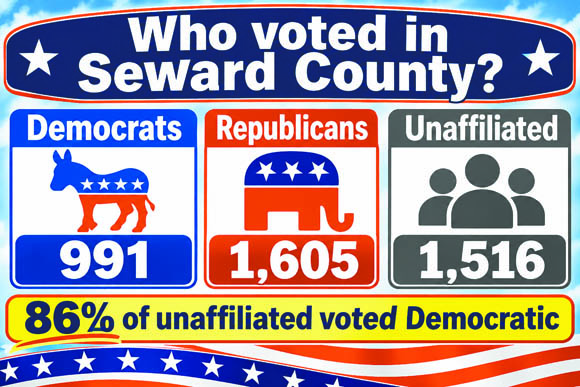
Seward County had a 36 percent voter turnout, and when applying those percentages evenly across registrations in Seward County, about 991 Democrats, 1,605 Republicans and 1,516 unaffiliated voters cast ballots.
Assuming all Democrats supported Democratic candidates and all Republicans supported Republican candidates, that means unaffiliated voters broke heavily for the Democratic candidates, around 86 percent.
An example would be the race for the U.S. Senate. In Seward County, Republican Roger Marshall received 1,740 votes, and Democrat Adam Hamilton received 2,299.
If all 1,605 Republicans voted for Marshall, only 135 independents voted for Marshall.
If all 991 Democrats voted for Hamilton, that means 1,308 independents joined the Democrats and voted for Hamilton as well.
And those numbers are generally reflected across the statewide offices form Seward County voters.
Even though Republicans outnumber Democrats by more than 600 in Seward County, the unaffiliated voters, when combined with the Democrats, can easily outvote Republicans, and for the first time in more than a century, that is what happened.
While the numbers are projected from the voter turnout evenly across each party, they could vary slightly, but it is clear those who do not associate with a party overwhelmingly abandoned Republican candidates across the board in Seward County.