


OUR OPINION
At the recent Seward County Commission meeting, Jon Handy provided his view on recanting statements made by those who opposed wind farming.
Those who spoke before him had no opportunity to fact check Handy's comments. We have printed Handy's comments, and those are available on our website. We are fact checking him here.
Handy was instrumental in acquiring wind leases and thus has a vested interest in wanting the project to pass.
At the Nov. 2 Seward County Commission meeting, Handy spoke. Handy and even some commissioners say "it's always the same small group" speaking on one side of this issue. While there are multiple appearances by Ryan Martin, he is the spokesperson for a group of those who oppose wind with about 200 citizens who oppose corporate wind development in Seward County.
As far as those who speak in favor of the project, the list is much smaller. In the last few months, it has been Handy alone. Handy has never mentioned he represents any group and therefore is a lone voice opposed to about 200.
Handy argued that the commission should give great weight to an opinion from Travis Fieser who stated that allowing public input with an advisory vote would be a bad precedent. Referring to another opinion does not a fact make.
The facts are Seward County has not held an advisory vote in 30 years, and when that vote took place on a very consequential decision on allowing corporate hog farming, there was no flood of attempts to demand public votes. Any claim this would be different is not based in fact but is more designed as a fear tactic.
Another fact is after the recent election, the three incoming commissioners have all stated they support an advisory vote. If there has been no decision made on wind, and new leadership will be sworn in soon, it makes no sense to listen to Handy's attempt to discredit public input and believe it would lead to more requests since history proves otherwise.
Handy then claimed that a vote against corporate hog farming has had an adverse affect on Seward County economically. There was no data validating that, and believing that economic benefit replaces quality of life is the very reason public input is required. The value of living at home is more than just allowing any economic proposal. According to Handy, only an elite group should make decisions based on a few seeing economic benefit while others see their quality of life diminish. Perhaps Handy would like lagoons of effluent lining county roads, but the citizens chose not to have such eyesores and odors. The people chose wisely.
Handy touted a financial contribution to the county for 10 years as a boost to the county budget. He didn't state that those funds would result in lower taxes for the rest of Seward County because the commission has made no commitment to directly lower taxes by the same rate they would increase with the temporary contributions from wind. Based on other projects, once the turbines are in place there are no permanent jobs for Seward County created, no new homes built for those workers that won't live here, and no additional customers for local stores. He also didn't share that once Seward County spends the short-term revenue, they will need to replace those funds when they expire in 10 years, and that means another massive tax increase just to replace the money that will blow away in the wind after the agreement ends.
Another citizen critical of the project, Neal Coffey, worked in the energy industry for decades, and while he did state “each and every landowner should have the opportunity to capitalize on the economic returns,” he also stated that the rights of one land owner end where another landowner's rights begin. Handy chose to leave that fact out. No one has the right to lower the value of the neighborhood in order to make a profit for themselves.
Multiple people requested setbacks to be increased, with a reasonable request of a mile. Handy only supported the position of the company and not that of the people of the county and supported the setback in the current agreement that is a quarter of what the people wanted. But Handy is not speaking for the citizens and in his defense he never claimed to. He speaks only in the interest of the wind company.
Handy pointed out Seward County Commissioner Todd Stanton stated that 99 percent of Seward County residents have not been to the area being recommended for the wind farm, and that was evidence of why those 99 percent should not be able to vote on wind farms in Seward County. But Handy failed to mention that the proposed vote on wind would determine if corporate farms would be allowed anywhere in Seward County. This seems to be another attempt at deceiving Seward County commissioners and citizens in that the vote was specific to the Thresher permit proposal. It isn't, and Handy knows that.
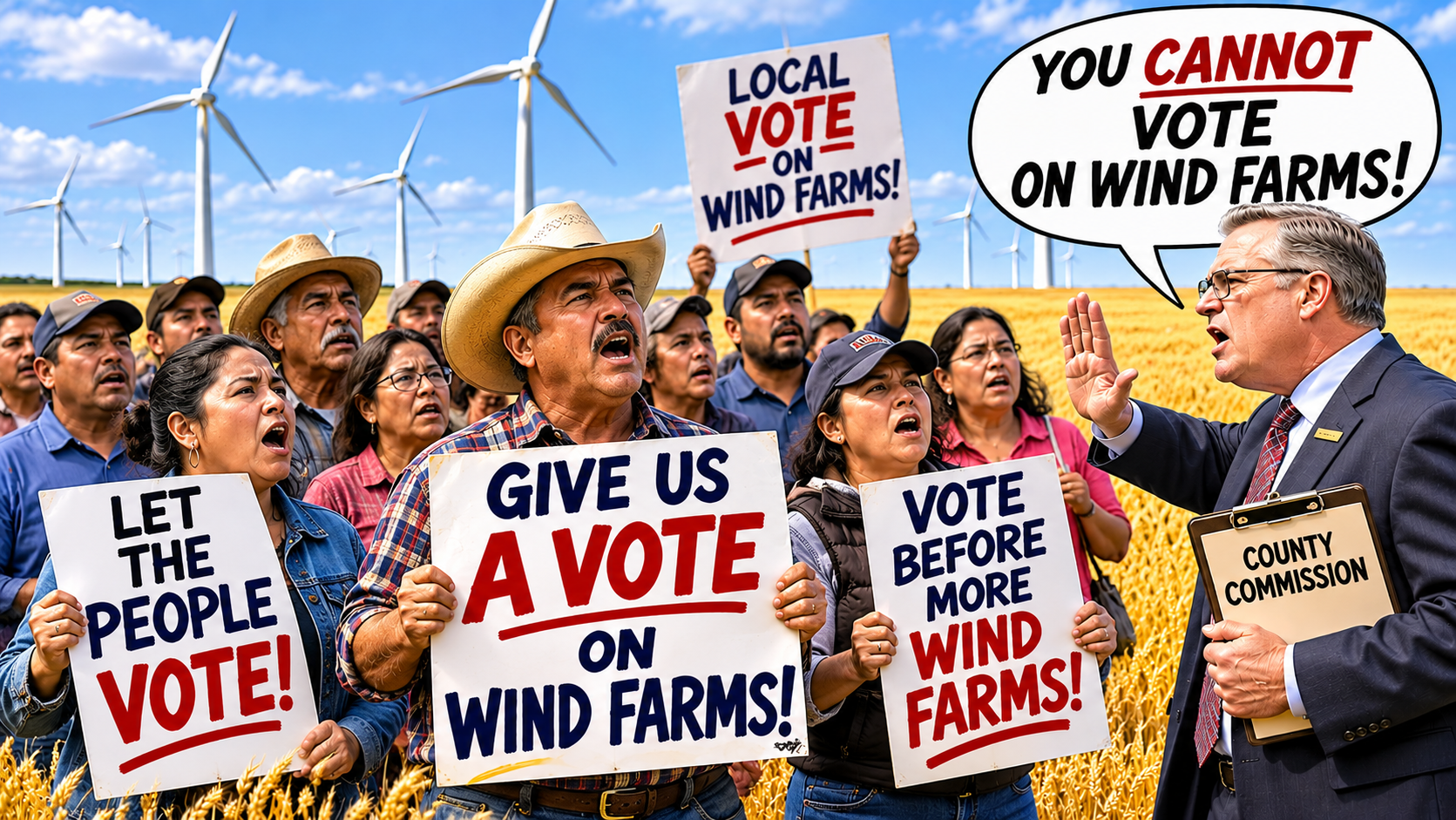
Handy defends the methods Seward County has thus far used to get public input, which has been limited to requiring attendance at Planning and Zoning meetings or offering written testimony for the most part. Martin mentioned that citizens were limited to about 12-16 minutes in three-minute limitations per speaker of oral testimony. However, the wind farm had an unlimited presentation and then company representatives spoke in addition to the corporate proposal. The vote at the advisory P&Z committee was 3-2. Handy failed to mention that anything gathered by P&Z is also advisory only or why he believes their advice, of five people, outweighs the advice of the voters of the county. To this point, not one town hall, designated public meeting or advisory vote has been scheduled.
Handy points to a bullet list provided by Seward County administration as ample opportunities to allow input despite the fact that the entire burden to gather that input was completely placed on the citizen without any outreach by staff to seek input. While commissions have changed dramatically in two years, administration has not presented any public comment requesting public hearings.
Administration would look to take control over another $400,000 per year for 10 years before demanding the local taxpayers fill that gap when the agreement expires. It is unclear if administration would know when that time period ends. The county taxed the people an extra $250,000 for six years after the DCP agreement was complete, and yet there is no record of how those wrongfully collected $1.5 million were spent. They did not go to DCP. With that record, does Handy believe another $400,000 for 10 years would be anything other than additional government spending, and when the 10 years runs out, the reason to justify another tax increase? Handy wasn't interested on how the money is spent, only in getting approval regardless of the will of the people.
Handy has a right to make his case, and he can challenge the views of those seeking public input. But his statements deserve scrutiny. There is only one reason there is obstruction to public input through an advisory vote, Handy and those who want wind farms know they don't have the votes to support it, so they will seek to approve it without input.
Handy said those who oppose wind farms "have lost." This issue is not a win or lose issue. It's about representing the will of the people of Seward County. Handy's effort to disenfranchise the public in an effort to force wind farms without determining public support is not what representative government is about.
Those who seek to silence the public have never been on the right side of history.