



ROBERT PIERCE
• Leader & Times
For about the past half century, the Seward County Sheriff’s office has relied on a reserve team of deputies to provide security at events throughout the community.
Earlier this year, that program was disbanded, and Undersheriff Ryan Roehr is looking for some part-time help at events.
“I’m requesting three part-time certified deputy positions to cover the resulting gap in event management and scene security,” he said at the county commission’s May 18 meeting.
Commissioners voted 4-1, with Chairman Steve Helm against, to allow the hiring of those positions. That vote came following a lengthy discussion with Roehr.
Roehr said these roles are designed to be largely self-sustaining through securing reimbursements from Seward County Community College and Southwestern Heights High School, as well as service fees for security on various county properties and events and from the enforcement programs Click It or Ticket or You Drink You Drive You Lose.
With the reserve program ending after deputies finish with this month’s community events, Roehr said the deputies currently in the program would be given first dibs at applying for the positions.
Commissioners, including Helm and Clay Louderback, asked why the program was discontinued after more than 50 years.
“It is just to address some major legal risks that go along with it,” Roehr said. “A lot of things have changed.”
Commission Vice Chair Todd Stanton asked about liability issues for the positions, particularly for the people who hire them.
“They’ll actually be part-time certified and go to the academy and be certified law enforcement officers through the State of Kansas,” Roehr said.
Helm asked how events would be covered in the case of multiple events. Roehr said the three part-time deputies and three full-time officers would be put in place.
At the time of disbandment, Roehr estimated the reserve program had about six to seven deputies. Commissioner Jairo Vazquez how the situation would be affected by going from that number down to three.
“It may affect us,” Roehr said. “We have had a major drop in events at the Activity Center. There’s more full-time officers who are willing to start stepping up and start taking on some of those events as well. I’m asking for three to start off with. If this works, I may come back and ask for a couple more.”
Helm had concerns about using full-time deputies as security, particularly with the cost per hour, as these workers would receive benefits from the Kansas Police and Firemen’s Retirement System (KP&F) and other benefits. Roehr said with full-time deputies, working security at events would merely be extra hours for them.
Stanton asked Roehr if the county would be fully reimbursed for the benefits package.
“The only time they wouldn’t be reimbursed, for example, we had a major scene, and we called them out,” Roehr said. “That would actually come out of our budget.”
Helm then asked about hourly rates would be calculated for overtime for deputies.
“It would be time and a half after 86 hours for law enforcement,” Administrator April Warden said.
“Plus the KP&F, which is almost 25 percent,” Helm said.
“Only your full-time employees would have that,” Warden said.
Roehr said the State of Kansas allows for two options for reimbursement.
“You can be reimbursed for overtime, or you’re reimbursed just the straight hourly,” he said.
“That doesn’t bypass hourly wage laws does it?” Helm said.
Warden said under fair labor standards, because they would be working in the same department they are employed in, deputies getting overtime would be paid that rate.
“Law enforcement doesn’t hit overtime until they have 86 hours in a pay period, but you are looking at some of them getting overtime if you need more than the three part-time people to work an event,” she said.
County Counsel Forrest Rhodes said the threshold for the Kansas Public Employees Retirement System (KPERS), under which is the KP&F fund, is independent of full time or part time.
“It’s whether they work 1,000 hours in a year,” he said.
Warden estimated part-time deputies would only get 10 to 15 hours a pay period by working events. Roehr said they would only be used for events.
“They would also have the opportunity for the other things as well like the Click It or Ticket, but it would be Southwestern Heights, the college and our events,” Roehr said.
Warden said hours would need to be tracked in order to ensure deputies would not be eligible for benefits such as KP&F.
Stanton said hiring for the part-time positions did not appear to have a financial impact on the county, adding Roehr needs the positions for his department.
Louderback said if hours are kept under the 1,000-hour threshold, benefits such as KP&F will not be required, and Stanton said those benefits are already in place for full-time deputies.
Vazquez suggested getting more part-time deputies and reducing the number of full-time deputies. Helm said the sheriff’s office recently did away with two deputies.
Commissioner John Mettlen said, though, costs for putting part-time deputies through the academy would need to be paid. Roehr said those costs would be paid by the sheriff’s office.
“Are you going to reimburse?” Helm said.
“I said not all of it would be reimbursed,” Roehr said.
“So there will be additional costs to the county,” Helm said.
During the meeting, Warden received texts from Sheriff Gene Ward, who said he does have money in his budget for the part-time deputies.
“The only thing they would pay for at the academy is the wages and individuals who would be attending the academy,” Warden said as she relayed Ward’s information.
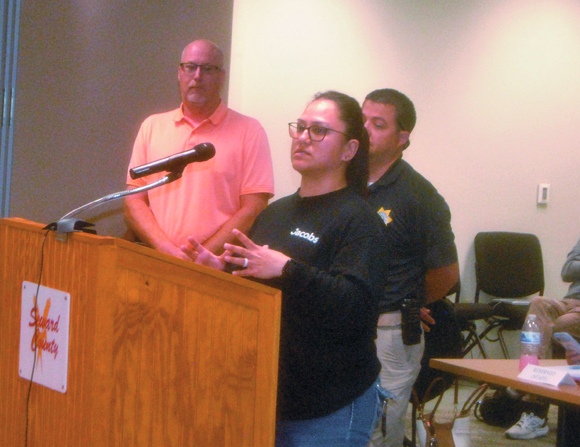
One of the soon to be former reserve deputies, Alejandra Ramirez said they were notified about the disbandment of the program just days before the May 18 meeting.
“The sheriff didn’t personally talk to all of us about it,” she said. “It was our commander and our vice commander. It just came out of nowhere. We don’t know exactly where everything was coming from.”
Ramirez said at events, three reserves are typically paired with three full-time deputies.
“We are not fully trained,” she said. “We get trained to a certain limit during our monthly meetings. We get paid for whatever we work those nights. I believe none of that money comes out of the county’s budget. It all comes out from whoever they do the contract with, and the contracts are done by the reserves commander and vice commander.”
Ramirez said she would like to have had more notice about the program’s disbandment.
“I personally think they should have spoken to us about it,” she said. “Some of these reserves who have been on there for so many years have given their life to the community, not just for the sheriff’s office, and all of a sudden, they come and tell them, ‘You guys are done.’ It wasn’t handled properly, I believe, to the standards we hold the office to.”
Fellow reserve Deputy Jim Pittman said he believes full-time deputies who work events do not get paid out of the county budget for those events.
“That deputy gets paid from that event, so that deputy should not hit overtime,”
Reading more from Ward’s texts, Warden said the sheriff has authority to keep or get rid of reserve deputies.
“There are only four reserve programs left in the entire state,” Warden said as she read Ward’s texts. “Everyone else went to part-time positions. He does not feel this came out of nowhere, as they have been talking about it for months.”