More than 5 million people have changed their financial future through Ramsey Solutions’ Financial Peace University. Created by financial expert Dave Ramsey, the nine-lesson digital course provides families and individuals with practical tools to gain control of their finances and set themselves up for long-term financial success.
FPU will be at First Southern Baptist Church, 621 N. Western Ave. in Liberal. Free childcare will be provided for birth through preschool age and a children’s program will be available for kids K-5th.
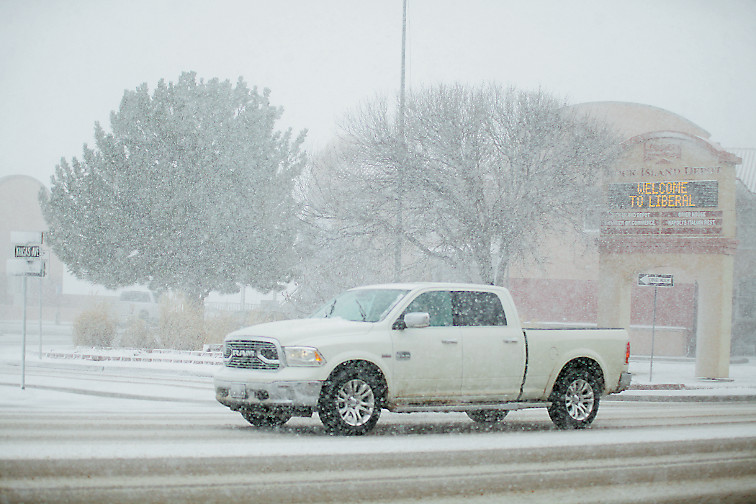
Winter has offically begun, and that means an increased potential for cold temperatures and severe winter storms.
With that in mind, Seward County Emergency Management staff wants to remind people to take some precautions to help stay safe.
“Typically, in Southwest Kansas, our bigger snowfalls happen in either February or March, so it’s usually closer to the beginning of spring when those chances increase, meaning those are the times people should be particularly careful of the weather,” Emergency Management Director Greg Standard said. “However, large snowstorms can occur in Western Kansas at literally any time, so people need to be prepared. It’s always recommended to plug any window and/or door drafts, which not only keeps everyone safe but also helps cut down on overall energy loss. It’s also important to keep your HVAC unit maintained and the filters updated so everything’s functioning the way it’s supposed to. Those are particularly important to do this time of the year, and we’d also like people to think about being prepared and take care of themselves during a winter storm event. We recommend having enough water and provisions and any needed medicines, etc., to last at least three days. In our community, we have maybe 100 responders to help more than 20,000 people, and we can’t be everywhere at once. With that in mind, the more you can have prepared on your end, the better off you’ll be, and it’ll also help our relief efforts. Around the house, have things set up so your water pipes won’t freeze – however, if they do, don’t use any type of fire to thaw things out, because that will end rather badly. If you’ve got travel plans and happen to be stranded on the road with no heat or anything, you want to be in a position where you can wait in your vehicle for help to arrive, so be sure you’re dressed warmly, and we recommend having a blanket or two in your car and an emergency kit.”
“We also recommend having one or two weather apps on your phone to follow, I know the National Weather Service does good about those updates, and Seward County has an app to keep track of for any severe weather,” Emergency Management Deputy Director Tim Newman added. “The main thing is, before you travel, check the weather, because you never know what could happen. It was just in January when that day of the blizzard, conditions were clear until about noon or so, and then the blizzard came through quickly and severely, which left some people stuck on the roads. If you take just a few basic precautions and do some looking ahead, that will save you a big headache.”
Standard added no matter what severe weather comes through, the Emergency Management staff will be ready to respond.
“When we hear of severe weather being predicted, we’ll notify our emergency personnel partners and public works partners like the Road & Bridge crews so they can plan accordingly and start treating the roads and all of that,” Standard said. “We’ll also share that information with the public through various media and advise everyone so they can be more prepared for what could come through. Our goal is always to get as much information out to the public as possible so they can know what’s coming and hopefully make good choices. Then, we’ll shift more into response mode and supply whatever support is needed, whether it’s working with state and/or federal partners or providing equipment to the local public works crews. With the blizzard that came through in January, we did have to rescue multiple people who had been stranded on the roads, so we helped them get to some sort of shelter and into safety so they could get out of the weather that night. We then worked with state and federal partners afterward for the disaster declaration, and we also worked with the utility companies to get power and everything else back to the community. Honestly though, our response could include anything and everything necessary.”
Newman added he hopes the winter remains relatively quiet.
“Best case scenario, we don’t have any severe weather that blows through and everything remains relatively calm weather-wise. However, if something does end up happening, we encourage everyone to heed the warnings that get put out and just overall be smart,” Newman said. “The easiest rescue to do is the one we don’t have to do at all. If roads get closed, stay off and stay home, because your trip is not as important as your life – yeah, it might be a bummer if you have to postpone a trip or get-together you’ve been looking forward to for a long time, but it’s not worth risking your life if the weather conditions aren’t conducive to traveling. Don’t make the emergency personnel come out and rescue you just because you felt you had to go to the store for something you probably could have done without for the next day or two.”
Overall, Standard and Newman said, taking some basic precautions will save a major headache in the long run.
“This really goes for any kind of severe weather, but any home emergency kit should include a flashlight, some type of battery-operated weather radio to keep updated on everything, a few days’ worth of food and water and other provisions, an necessary medications, warm clothing, and good shoes,” Standard said. “You never want to be walking around after any severe weather situation in just flip flops or something flimsy like that, so it’s good to have a good, sturdy pair of shoes so you can be more mobile and able to get around. Also, be ready to move to shelter – I always say if you wait until the last minute to move to where you need to go, you’ve waited way, way too long, so move to shelter early and then basically hunker down so you’re safe and secure and out of danger.”
“We also recommend having your car full of fuel and with some emergency items in there. I always tell people an emergency supply kit should be the same as if you were going camping, the necessities are basically the same,” Newman added. “And I would also like to remind people, the next CERT class will be Jan. 24 through 26, and anyone wanting to participate in that would just need to contact Norma Jean Dodge at Seward County Community College at (620) 417-1171 to register.”
As projects continue to be improved at county facilities, updates continue to be made as well by Seward County Contract Consultant Neal Coffey for county commissioners to get an idea of progress on those projects.
At the commission’s Dec. 16 meeting, commissioners approved a change order and a contract addendum for work being done on the Seward County Courthouse.
With the change order, Coffey said he initially sent the item to Melinda Baker, executive assistant to Administrator April Warden, but at that time, numbers were still in the process of developing and changing.
“We have had some change orders that have popped up, and rather than doing an individual small change order for each of these, we’ve compiled on this change order four elements,” he said.
Those elements included the main entrance area of the courthouse disbanding from its original surface, five exterior doors rubbing on carpet, an unplanned gap after the removal of entry doors and a rusted conduit providing power to the lights that illuminated the front wall. Coffey said the amount of the change order was $21,465, which, after commissioners approved the change order, brought the project’s total cost to $903,918.53.
Funding for the change order has been established in money the county received from the federal American Rescue Plan Act.
With the addendum, Coffey said pursuant to the commission’s request for the contract remodel, staff wanted to make sure funding had been set aside through the ARPA funding, and County Counsel Nathan Foreman helped develop a contract addendum to affix a not-to-exceed value at the end of the contract of $1.16 million.
“If you approve this addendum, that will not change the change order process,” Coffeysaid. “The contractor will not get carte blanche to just go and spend the money. The change order process will from the general contactor to your architect, GMCN (Architects), to make certain their change order is something that was outside of the original scope. If the architect approves the change order, it’ll come back to me, and at that time, I will present the change order to you as a body for approval. That way, you continue to control the spending on the courthouse remodel.”
As of Dec. 16, Coffey said 80 percent of the interior work on the courthouse had been completed, and he estimated about 60 to 70 percent of the exterior work was done.
As with many county facilities, solutions are being sought to drainage problems at the courthouse, and Coffey said a contemplated solution has been found there.
“We walked down the project, and it looks like we can add some dirt to the west side of that building and roll that water to the middle from the building and from the sidewalk and roll it all south,” he said. “In order to do that, we’ll be stacking some dirt up on the building. We will have to make certain we waterproof that brick we put that dirt on.”
Commissioner Presephoni Fuller asked Coffey how many more change orders would be needed on the courthouse project. Coffey began by explaining the project’s discovery phase has been completed.
“The civil work for the landscaping up front is one,” he said. “There will be one for the dirt, for the grass and any shrubbery you want to put in. That may all be compiled into this one. In this project, we did put accommodations in and under the sidewalks to pass sprinkler systems through, but there will be some sprinkler system repair because of the lines that had to be removed during the extension of the parking lot, sidewalks.”
Under the project’s current scope, Coffey said there is a four-foot strip of existing dirt between the sidewalk and building on the courthouse’s east side.
“At some point in time, some flowers and things were planted in there, but now it looks like it’s just been sterilized, and it’s just a strip of dirt,” he said. “The thinking as we were walking through is to ask the contractor to provide us with a change order to 100 percent concrete that out. There’s some drainage pipes from the roof that come underneath there. We’ll have to make sure we secure those. There’s also some sewer clean outs in there. We’ll have to make certain we secure those.”
Coffey said benches on the courthouse property were in horrible shape and removed as part of the project.
“The contemplation was to go to the landfill and buy some of the nice heavy benches they have,” he said. “That would be two benches up front, and the one over by the southeast back door is in horrible shape as well. Do we pull it out and replace it? I would recommend we do that.”
Coffey said most of the major parts of the project are now out of the way.
“We did get the concrete torn out of the Sally port area, which was a major step,” he said. “That’s 50 percent replaced. The city did come in and lower their water meters and lower their water valve boxes. Now we can straighten all that out and not have any big humps in there, so a lot of that risk has gone away. Most of the exterior painting has been primed first coat. We’ve got this end of the building we have to get into, which is in that far yard of the sheriff’s yard. That’s going to have some security concerns associated with that. We worked that out with the sheriff, but I don’t see any change orders necessary in there.”
The change order and contract addendum were both approved with unanimous votes.
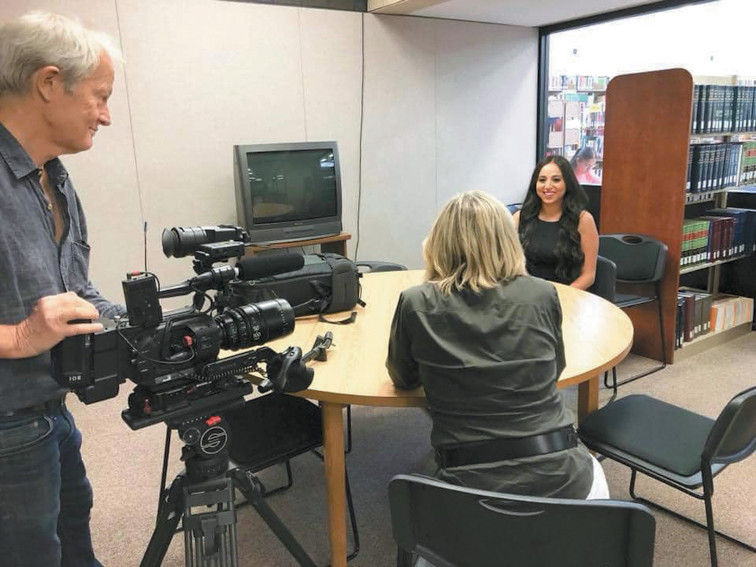
Michael Camerini prepares for a shot while Shari Robertson talks to Liberal’s Janeth Vazquez during the filming of a documentary series about Liberal during the time of a trial for three men accused of plotting to bomb a Muslim apartment building in Garden City. Courtesy photo
ELLY GRIMM
• Leader & Times
The Southwest Kansas region and many other parts of the U.S. were shocked back in 2016 when news spread about a trio of men who were arrested for conspiring to blow up a mostly Muslim apartment complex in Garden City.
The three men – Curtis Allen, Gavin Wright and Patrick Stein – would ultimately be convicted on all charges they faced back in 2019.
This story, among many others, is one that will be shared in an upcoming docuseries called “Liberal, Kansas” from filmmakers Shari Robertson and Michael Camerini.
“We’ve been making films for a really long time, and I think between the two of us, we’ve made nearly 45 films – or somewhere around that number – before this ‘Liberal, Kansas’ project,” Robertson said. “It was around the time of Donald Trump’s first inauguration in 2017 when we began to look for a story that would help us understand how so many in the country were so surprised by what had just happened and why many other people were happy at the result. We wanted to do something about why the country was divided like it was at that time and make a film that would be interesting to people on the coasts and people who were pro-Trump and anti-Trump. That was the origin of the idea.”
“But the kinds of films we make, they sort of have an ethnographic lean, so for us, they’re no good if they don’t ring true to everyone possible. We had a big ambition and a big task to make a film that showed both sides of the debate, and we were looking for a story that could be useful toward that,” Camerini added. “We didn’t want it to be necessarily about politics, because let’s face it, everyone was fed up with politics by that point. Then came the case of the three men who were convicted on domestic terrorism charges for a conspiracy to bomb a majority-Muslim apartment complex in Garden City, and that seemed like a good through-line. But we didn’t want the film to necessarily be a true-crime project, but there was definitely a connection between their lives and the lives of everyone else who were affected. These men weren’t impaired or anything like that, they were just normal men who wandered past the edge. We ended up filming more than 80 interviews with a wide variety of people throughout the community, the FBI investigators, and the suspects’ families, among many others, so we were really thorough in that regard. We really wanted to capture the essence of Liberal for people.”
Robertson and Camerini agreed the project kept them quite busy.
“We also filmed at the high school for several weeks and shot some football games and other events like the Liberal AirFair and some Liberal Bee Jays games and other community events that draw people in,” Robertson said. “We really wanted to create what it’s like to live in Liberal, because for a lot of people in other parts of the U.S., they can’t imagine what life is like in this part of the country – and not necessarily in a bad way, but because it’s simply something they haven’t experienced for themselves. We’ve made many films in many parts of the world and in many different situations. We never start a film with a script, we work more along the lines of ‘Here’s an interesting situation, let’s come to understand it.’ We shoot a large amount of footage that ultimately never makes it into the final product, which is pretty typical – we actually shot more than 300 hours of material and spent a lot of time working to understand things when we weren’t actually filming.”
“And what we want to end up with, at least to start, is a limited series, because it’s a documentary series that’s split into four parts, with each part being 90 minutes,” Camerini added. “We know that might seem a bit odd to some people, but that’s the format that truly best fits this story. Those are all pretty much done, and we’re now in post-production, which means we’re polishing everything up and adding music and extra graphics and things like that. There’s a lot of work that gets done to turn raw footage into a full-on movie, and that’s what we’re doing now. And we expect to start doing some promotion after the beginning of the new year. We plan on submitting this to some film festivals and then possibly talk to more major screeners and broadcasters. And if we can, we’ll even do a premiere in Liberal of some sort.”
The duo agreed they are proud with how the project came out.
“We’re both pretty proud of what we’ve put together with this project. I made my first film when I was 19 years old, so I’ve been at this for a while. We’ve made films in India and Central America and some other parts of the world, but I would say this was definitely a tough project because there wasn’t really a solid foundation of trust when we started working on this movie, but that definitely improved as time went on,” Camerini said. “We finished shooting, and then the COVID-19 pandemic hit, and the editing process ended up being slower than we expected, but we really think we’ve got something special put together.”
“And like we said earlier, we want our films to be appealing to everyone, but we know a project like this would be particularly appealing to the people affected by what happened and everyone we ended up talking to,” Robertson added. “We did some preliminary screenings for some people, and we think this project will appeal to people in the rural U.S. and on the coasts. One of the themes that runs through the entire series is the long backstory/development of this conspiracy ... And something we found really interesting is how there were actually quite a few people who either didn’t know anything about this story or had only heard bits and pieces here and there, there were very few people who had a full scope of everything that was going on. I felt like we were doing a puzzle and figuring out how to put everything together for people to understand.”
Like other film projects, Robertson and Camerini said there were some challenges faced while getting everything together.
“What we dealt with was pretty on par with what filmmakers typically come across during a project. We had all those interviews to go through and had to put all the different pieces together into a cohesive story. And among all of that, we had to decide what we would end up using/not using,” Camerini said. “And among all of that, the challenge is to make a film where it’s going to be true whether you’re talking about it at the local VFW bar or a more upscale setting. Those were the particular challenges we dealt with, and the world will be the judge of whether we succeeded or not in that endeavor.”
“And the hardest part is deciding what not to use, because all of the interviews turned out wonderfully in terms of the quality of the filming and all of that, but there were just so, so many stories and viewpoints shared, and you have to narrow down what will fit best,” Robertson added. “You’re always trying to be true to the people who were kind enough to let you film them, and you’re trying to make a communication that works and will get through to people. I like to think of ourselves almost akin to translators because we know someone in New York will watch this movie in a different way than someone from there in Kansas. After being out in Liberal for a year, we know what the overall vibe among everyone is. When we first set up out there, a lot of people were concerned a pair of filmmakers from New York would only want to make everyone look bad, which was absolutely NOT what we were setting out to do, and it took a bit of time for people to relax around us and realize what we were wanting to do. I remember on our last day out there, we were saying goodbye to the Leader & Times publisher, and he told us ‘You know, people around here think you work for the CIA.’”
The docuseries is currently in post-production, and the duo said they are excited for it to officially be screened on a wider basis.
“We’re really excited our composer is starting to produce work that sounds authentic. We’ve worked with this gentleman on multiple other projects of ours, but this is a whole new thing, so we’re happy to see how he’s coming along,” Camerini said. “There’s a lot of those trivial loose ends to tie up to make the project as polished as possible, and we’re making a big push for that for the next few weeks.”
“And it’s great talking to people about what we’re doing because we make the movie and we see multiple cuts, but it’s fresh for the audience every time, and you never know what the reaction will be,” Robertson added. “We love doing the Q&A sessions and hearing people’s thoughts and all of that. Documentaries can definitely spread the word message, but a lot of that also has to do with the people who actually watch it, because that word of mouth is also a big thing. In the spring, we’ll start asking for some financial support, because there is some money that needs raised as far as festival entry fees and music and graphics and things like that. But right now, we’re ready to start showing this project and start getting people interested before the official release. Overall, we’re just really happy and excited about how this has turned out, and we had a great time while we were in Liberal.”
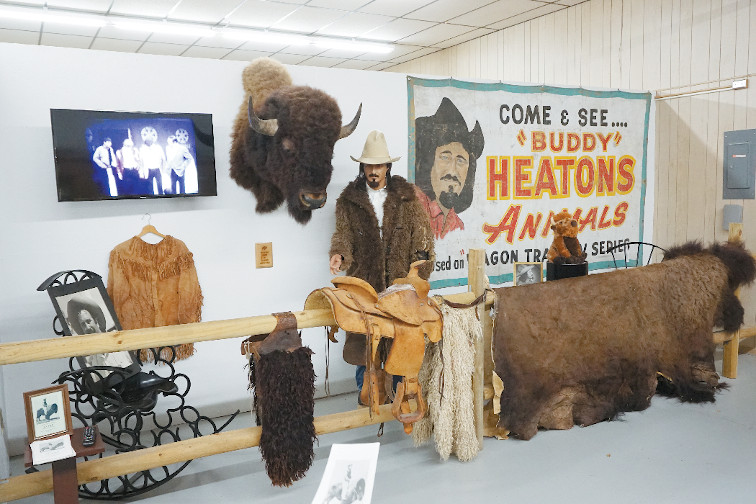
This display about Buddy Heaton has been added to the Stevens County Gas & Historical Meseum. L&T photo/Elly Grimm
ELLY GRIMM
• Leader & Times
Southwest Kansas has no shortage of notable rodeo participants and last week, one of them was officially immortalized with an exhibit at the Stevens County Gas & Historical Museum.
Last Tuesday, family, friends and community members gathered at the museum to officially open an exhibit dedicated to Harold L. “Buddy” Heaton, a rodeo clown and horse trainer who was born in Alva, Okla. and lived in Hugoton for many years.
“This has been an idea for a while now since Buddy grew up in this area and ended up being so well known, and our museum director through it would also be a good fit for what we do here,” Stevens County Historical Society Director Jan Leonard said at the exhibit’s opening. “A lot of this memorabilia was donated to the museum by his children, but the wax figure was done out of state, and the buffalo head came from a gentleman in Moscow. Along with the memorabilia, we've also got a loop of some old home movies that will be shown by the exhibit here, and there was quite a bit of time sorting through it all because there were also some home movies of birthday parties and other family events mixed in there, but that got put together and I like how it turned out. My personal favorite is the bit of video showing him riding in John F. Kennedy's inauguration parade almost right up to the viewing stand where Kennedy and his family and everyone else was sitting, and there's also some video of when he was filming in the TV show 'Wagon Train.' This is something that's great for Stevens County, and I feel like it'll draw a lot of people from the area in.”
Heaton worked for some of the sport’s greatest stock contractors – including Harry Vold, Reg Kesler, Paul Long and the Beutler Brothers – during a 33-year career as a rodeo clown that began in 1944, when he was just 15, according to his obituary, and he was inducted into the Kansas Cowboy Hall of Fame in 2005. Heaton also competed in all three roughstock events and steer wrestling in PRCA rodeos in the 1950s, and in the 1950s and 1960s, he would expand his rodeo clown act to include various animals, and he soon gained a reputation as a skilled animal trainer, most notably for his work with the Appaloosa, “High Hand,” and the American buffalo, Old Grunter, who he rode on during John F. Kennedy’s inauguration parade in 1960.
Heaton’s obituary goes on to say he and Old Grunter also appeared on the TV show “Wagon Train” in 1960, as well as the feature films “Bus Stop,” “How the West Was Won,” and “Desert Sands,” and after his career in rodeo ended, he remained active as a horse trainer for many years.
Heaton’s children, who were present at the exhibit’s opening, said the idea had been presented to them multiple years ago.
“It was about three or four years ago when Jan [Leonard] got in touch with me and asked if I had any memorabilia of my dad's because he was wanting to put together a special exhibit at the museum since he's such a huge part of Hugoton's history,” Heaton’s son, Tom, said. “I originally didn't think too much of it since my siblings and I all grew up with it, but Jan kept pestering me and pestering me, so I got my brother, Ted, on board, and then my sisters. We got the memorabilia together, and I had the old tapes, which was a bit of a chore, and I gave them to my son to take to Amarillo to be put together in a digital version. Then there was some money needed for the wax statue, which was another task, but the people who did that did a great job.”
“We even had the original jacket he was wearing when he rode in front of JFK, and we knew that would have to be included,” Heaton’s son, Ted, added. “There was a lot of surprise when we were initially asked about doing this, and there's a lot more memorabilia that could have been included with this.”
Ted and his sister, Linda Brecheisen, agreed the museum put together a great exhibit.
“It's really neat, and I'm actually a little overwhelmed, because they did a good job putting it all together, from the video display to the wax statue and everything else,” Brecheisen said. “I love how it all looks. I can't thank all the volunteers enough. There's still some memorabilia we're coming across that could be added to this, but that's something that'll be decided later. It's great seeing everyone out supporting this exhibit, I can't believe there were that many people who came out to see it opening up. I've actually lived out of town for some years now, so it's great to see this kind of community support.”
“There's actually a big canvas portrait I gave the museum of him riding the buffalo, but that hasn't been put up yet, and I think that'll look neat when it is put up,” Ted added.
Brecheisen also offered encouragement for people in the area to visit the exhibit.
“It's a great addition to the museum, and it's another great exhibit for people to look at,” Brecheisen said.
“It's something great to look at, and there's a lot of history just in this one corner of the museum, so I hope people come and look at it,” Tom added. “I can't thank the museum enough for putting this together, it's a great way to honor our dad, and I hope a lot of people come and look at it, they should enjoy it all.”