



EARL WATT
• Leader & Times
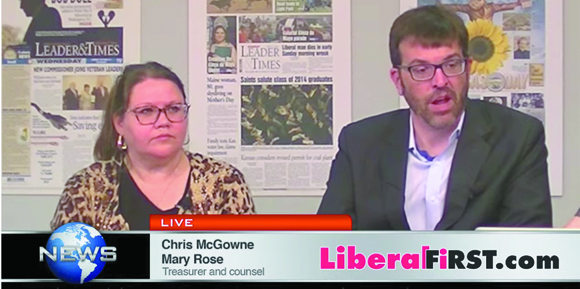
Seward County Treasurer Mary Rose followed the law and performed her statutory obligations under Kansas law. That was the message from treasurer legal counsel Chris McGowne.
During a recent Seward County Commission meeting, County Counsel Forrest Rhodes said he had requested Rose provide him with the complaints filed to protest an illegal tax. He stated his requests were ignored.
McGowne explained Rose’s actions were following the advice of her legal counsel.
Rose said when there were requests in early January for the names of those who filed their taxes under protest, the Kansas Board of Tax Appeals said the documents were protected.
But after the decision was made to return to revenue neutral and rescind the 17-mill tax increase, those complaints became moot because the tax was rescinded, something the complainants were requesting, and the information on those forms was no longer pertinent.
But when the request was made again, Rose still sought to protect sensitive information.
“I would want someone to protect my data,” Rose said. “My office takes that very seriously — the protection of your information — so that’s where I was with that form. If one person does a KORA request, that opens the door for anyone to get that information. As a mother, I want to protect my children, and I don’t want my phone number and address and email address out there for everyone.”
Rose sought counsel on how to respond to the request and retained the services of McGowne, who also serves at the chairman for the Big First District Republican Party.
“She did follow the statute,” McGowne said. “We worked through the exceptions to see if any fit. We reached out to the attorney general’s office. The documents were originally not discoverable, but when they rolled the mill levy back, that changed the legalities of it. We checked all avenues, and they said it was discoverable. What I felt was appropriate was sending the taxpayers a letter to let them know their information was going to be released.”
Rose complied with the open records request made by Commissioner Steve Helm, albeit as an individual rather than as a commissioner. During the last commission meeting, Rhodes said the information was needed to prepare for small claims cases. McGowne questioned that claim.
“It can’t be true,” McGowne said. “You can get that information in the pretext of the litigation. I think it was right to wait. I think it was right of her to follow the process and check the exceptions to the taxpayers’ advantage. At the end of the day, you are trying to protect the taxpayers’ information except name and address.”
McGowne also questioned why the commission as a whole did not take a vote to compel Rose to provide the information.
“They have the ability to take a majority vote and compel the treasurer to give it,” he said. “Why didn’t they take that vote if you don’t think taxpayers have any issues with it? The whole process has been wonky. The reasoning is a little wonky. County counsel named all these communications. There was inadequate legal reasoning given, inadequate factual reasons given. And it’s still not adequate in my mind, claiming small claims. So, the list goes on and on.”
With the abnormal request made of her department, Rose sought legal advice.
“Why would you hire outside counsel? This is exactly why,” McGowne said. “Make sure you are following the law before compliance to make sure you only release what you have to release. And you have a chance to contact those people and let them know they are being targeted, not in a literal sense but I would say they are getting their information polled simply because they paid something under protest, which I think is a little bit troubling.”
Under normal court proceedings, including small claims, the county would receive documentation about the complaint from the court. There is no reason to request it from the treasurer according to McGowne.
“In district court, we have service process where the sheriff shows up,” he said. “Small claims will mail it out, and you get mailed what is called statutory service. Let’s say you have all these small claims — taxpayers suing county government. The county would have received a letter and what it was about. You are getting service. If they file a claim, it was about the mill levy. You would have been served with that information. You already have it. It’s nonsense.”
There is no need to prepare since relief has already been provided to the taxpayer.
“You have default judgment and mootness,” McGowne said. “It doesn’t make a lot of sense in any stretch of the imagination — the small claims and overwhelming pressure brought on the treasurer makes no sense to me.”
A court can only handle a case to provide a remedy. In this case, the remedy has already been awarded by rescinding the tax.
“There has to be a remedy in court,” McGowne said. “There is no remedy because it is a mooted claim. You check pleadings and which ones are about the tax and file a mootness motion. And you can literally copy and paste the motion. It would literally take you two hours. Lawyers are good at wasting a lot of time and money. The rationale was weak at best.”
Rose followed the law, and McGowne said he believed there must be some other motivation.
“I think a lot of it had to be political in nature,” he said. “It was an illegal mill levy. What do you want me to tell you? It was rescinded, so I think that kind of makes the point in itself. I don’t know why you need to target the taxpayers who paid under protest because they were proven right. There appears to be some residual anger. I don’t know the need for the escalation. At the end of the day, I will tell you this, what Mary did was right. She followed the same process I would have, she got legal advice and did what she was supposed to do. It makes no sense when you walk through the rationale of what they are asking for. It doesn’t make any sense.”
Seeking counsel is something attorneys are supposed to support.
“An attorney is always supposed to welcome and encourage an individual to get their own legal representation,” he said. “The rationale was weak at best making this about small claims court. It is an irrelevant issue because it has been mooted. It’s faulty reasoning. I think it is residual anger, I don’t know, but I do know this, I know I don’t agree with it, and the way she acted was completely appropriate, and I think the taxpayers agree with her.”
The night county counsel made accusations about the treasurer not complying with his requests, Rose was in the room, but she was never invited up to answer any of the characterizations made by Rhodes.
“I was in the room, and on the agenda for the tax bill,” Rose said. “They added this to the agenda on the spur of the moment. They had the opportunity to say ‘Would you like to come up and speak?’ I was not given that opportunity.”
And McGowne reiterated they could have taken a vote to compel the information and chose not to do so.
“It’s telling they don’t want to take a vote on targeting taxpayers who paid under protest,” he said. “It’s telling to share one side of a story and not let the other person respond. And she was being counseled not to respond by her attorney. Don’t respond until we review the law. I wasn’t going to tell her to make stuff up, just be silent. We will figure it out.”
While the public was speaking out against the tax increase, the internal working pressure on the treasurer and her department was festering, Rose said.
“It’s been a year of hell,” she said. “The treasurer’s office was the one that coordinates the payments under protest or illegal mill levy. There was quite a bit of fuss in the building, outside the building. One of the comments was I personally made up the (protest) form, that three pages had to be filled out. The third is the instruction page, only two pages are filled out. I did not make that form. It is available on BOTA’s Web site. We were walking on egg shells, criticized and belittled saying we were pushing this. I was doing my statutory duty. I may or may not agree, but I had a job to do by statute, and I did that.”
Rose said some within the county claimed she was the reason for the public revolt against the increase.
“I don’t set the budget,” she said. “Keep us out of the issue that we were the cause of it. We had to finalize it. I signed off on an affidavit that said we fulfilled our duty, and I am done with it. My staff is on edge because of the snide remarks made to us because of what we had to do. We did what we were supposed to do. We assisted taxpayers.”
While Rose did not advocate for filing under protest, McGowne said it wouldn’t have mattered if she did.
“Every person in the City of Liberal, you are welcome to protest your taxes,” McGowne said. “Even if she did encourage it, there is nothing wrong with that. I filed under protest (in Ellis County), and my treasurer helped me. Is that advocacy? No, it is helping a taxpayer. Assume she did promote it, I’m promoting it right now, pay your taxes under protest every year if you want. There is nothing illegal about that. I’m not saying she did that, she says she didn’t, but if she did, who cares? She is promoting to taxpayers they can protest something they deemed illegal. She did nothing wrong. This whole situation is absurd from start to finish. Some people are obviously angry they didn’t get 17 mills from the taxpayers. They are mad some taxpayers decided to pay under protest. And Mary did exactly what she was supposed to do. Pretty simple stuff.”