



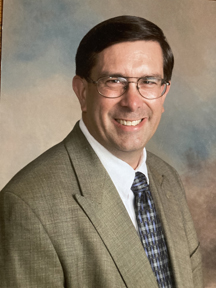
PASTOR’S CORNER, David Hoffman, First Church of the Nazarene, Liberal
Life is full of crossroads, or in Joshua’s case a “crossing over.” At times obstacles or intersections will challenge us on our path, or journey throughout the unknowns of life.
In the Hebrew language, there is no such word as “bridge.” Joshua depended on the Lord’s supernatural intervention to make a way for him and the nation of Israel to cross over the flooded Jordan River as recorded in Joshua 3:1-17 in order to possess the Promised Land.
An Obstacle is an Opportunity for God to Act on Our Behalf
Think of how often you have encountered an obstacle in your life that you thought was uncrossable. We know God specializes in things that others determine are impossible. For example,
• A doctor’s report of a terminal disease or illness such as cancer
• Relationship difficulties with a neighbor, family or a coworker, etc.
• Financial hardship, bankruptcy, or fraud
• Employment difficulties or career change
An inspirational chorus from years ago offered hope. The lyrics went like this –
“Got any rivers you think are uncrossable? Got any mountains you cannot tunnel through? God specializes in things thought impossible, and He can do what no other one can do!!”
The historical context of Joshua chapter 3 is the Jordan River was at flood stage due to the spring rains and the snow melting from Mount Hermon just north of the river in Israel. Lots of flooding occurred in east and south Texas in recent years as well as the Mississippi River several years ago.
While living in Durango, Colo. in 1993, I witnessed the Los Animas River at flood stage after 125 inches of wet snow fell in just six weeks during the winter. Authorities calculated a total of 66,000 cubic feet per second of water rolled down into the Los Animas River from multiple sources.
I recall conducting a graveside memorial service for a family from New York because their son attempted to swim across the flooded river while under the influence of alcohol. His body was finally found 10 miles down river several months later after he drowned and was swept away.
God told Joshua to prepare the people to cross the Jordan River. They camped for 3 days on the river bank. God wanted them to see firsthand the power of nature, but more importantly His stronger power to conquer and subdue nature at His will & command.
He gave Joshua instructions for the Ark of the Covenant to be carried by the Levites, who were special priests. The Ark of the Covenant contained Aaron’s rod that had budded, the Ten Commandments, and a gold jar with manna saved from the desert or wilderness for 40 years. It represented God’s presence Himself and His throne as sovereign (God has final say or last word).
God’s will never leads us where His grace cannot keep us
God’s presence precedes and protects us. The Levites lead the procession carrying the Ark on their shoulders. They were 1,000 yards ahead (length of 10 football fields). Joshua said, “Then you will know which way to go, since you have never been this way before.” (3:4)
When the soles of the Levites’ feet stepped into the water’s edge of the swollen and flooded Jordan River, God caused the water upstream to pile up for about 20 miles “at a town named Adam in the vicinity of Zarethan, while the water flowing down to the Sea of the Arabah (the Salt Sea [Dead Sea]) was completely cut off. So the people crossed over opposite Jericho.” (3:16) The river receded from the necks of the Levites, as they stood on dry ground in the middle of the Jordan (v. 17), then everyone was able to cross over the river on dry ground.
Remember how God acted sovereignly when He told Moses to stretch out his staff over the Red Sea. God parted the waters with an east wind so the Israelites could walk over on dry ground. As soon as they crossed over, the Egyptian army and Pharoah were drowned as the Red Sea swept over them. Archaeological evidence proved the existence of chariot wheels on the bottom.
The Jordan River crossing is significant! The Canaanite and other pagan people in the Promised Land believed that the LORD was solely a desert god and that Baal was the god of rain, storms, fertility, and the crop harvest. They falsely thought Yahweh did not have the power to control nature. That’s why Rahab later commented to the two spies in reconnaissance at Jericho that the pagans feared God and knew they would be defeated as the walls of Jericho later fell.
God is Our Constant Companion
The Lord reassured Joshua He would be his companion. Joshua 1:5 says, “No one will be able to stand up against you all the days of your life. As I was with Moses so I will be with you; I will never leave you nor forsake you.” (also 3:7) God told Joshua to be strong and very courageous! So, He told the people in 3:10, “This is how you will know that the living God is among you and that He will drive out before you Canaanites, Hittites, Hivites, Perizzites, Girgashites, Amorites, and Jebusites.” The Ark, or God’s presence, went ahead of them.
We also must consecrate ourselves as they did according to Joshua’s command in verses 4-5. In the Hebrew mindset, one must “walk backwards into the future (west) with one’s hand in God’s hand.” The joy of obedience is finding out what God had in mind from the beginning!
Proverbs 3:5-6 says, “Trust in the LORD with all of your heart and do not lean on your own understanding. In all of your ways acknowledge Him, and He shall direct your paths.” That verse became my philosophy, or guide, for life at the age of 12. The Lord has been my life’s companion through many major decisions as well as my daily journey.
At the end of his life, Joshua challenged the nation with the words of Joshua 24:15 – “Choose you this day whom you will serve, but as for me and my house we will serve the LORD.” A new depth of dedication in the midst of uncertain challenges is required. No regrets, no reservations, no going back! God will make a way in your life’s crossings.