

ROBERT PIERCE
• Leader & Times
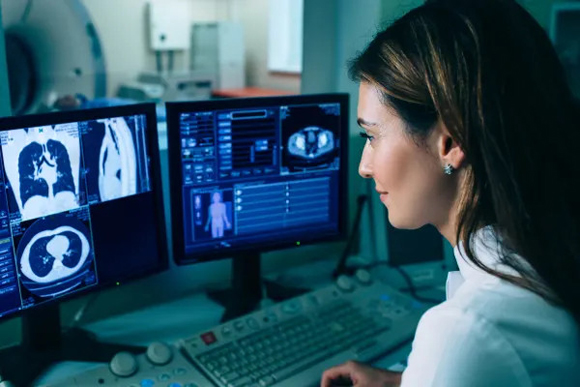
Saturday, Southwest Medical Center is hosting the 17th annual Community Health Fair at the Seward County Activity Center, and among other screenings, people can get clinical breast exams from the hospital’s Diagnostic Imaging department.
DI Director Kelly Denton said practitioners will be on hand to check women for physical lumps and changes to breasts,
“They’re looking for discoloration, dimpling, retractive nipple, the sort of things that would indicate there’s a problem with the breasts,” she said.
Denton said the breast exam booth averages about 75 to 90 visitors during the health fair, and she said that number, mostly women, depends on the flow of traffic at the health fair.
“Every once in a while, we get a male who may have a question or issue they want them to look at, and that’s absolutely fine too,” she said.
Denton said breast cancer now has one of the highest survival rates among cancers, and she credited that to the improved mammography technology in recent years.
“We have such good early detection that breast cancer is more survivable than almost any other kind of cancer,” she said.
Denton said SWMC now has a new partnership with a radiologist from Wichita Radiology who now reads exams.
“Wichita Radiology also owns and operates Cypress Breast Center, so all of our breast imaging now is being read by the doctors who work at Cypress Breast,” she said. “If women were traveling to Wichita to be done at Cypress Breast, you can have your study done here and not travel, and you’re getting the same care because it’s those radiologists reading it. Sometimes, if we found something on their screening, we’d decide to go to the breast center for follow-up.”
Denton said while patients can still do this if they wish, the partnership makes it the same as being at Cypress Breast.
“We’re doing their images,” she said. “We’re sending them to them. They’re looking at them, and if the woman is coming in with problems, they are talking to them that day, and they’re leaving with their results.”
The Community Health Fair runs from 7 a.m. to noon, and for Denton, those hours are fun.
“I like seeing the people,” she said. “I like trying to bring them into the booth. I get a lot of no’s. I get a lot of turn downs. They’re like, ‘Oh I just got it done. I just had this done.’ It’s definitely tough on the feet. I don’t sit for that.”
Denton said the five hours of the health fair are just part of the day for vendors.
“By the time we clean up and unpack our booths, it’s more like six or seven hours because we have to haul it all back,” she said. “The feet are definitely tired, but I really enjoy the people and visiting with the people.”
Part of what Denton likes to do is stand in the doorway and hallway at the Activity Center and recruit people into her booth to get an understanding of breast care, She added over the years, DI workers have found a number of lumps or areas of concerns at the health fair booth.
“A few of them ended up being nothing, but there’s a few that ended up being cancer,” she said. “For those women, that’s a huge change in their lifestyle. They wouldn’t have come in because they didn’t have the means or the access to come in and not be, ‘This is a big problem or an issue. We need to get it checked out.’ Would they have gotent checked out, and would we have found that in a later stage, which would’ve affected their life a lot more?”
Denton said most patients at the booth do not have problems, but she said for the people who do have something, that something can be life altering to them.
Denton likewise said many f the women who come to the health fair have not had their annual mammograms.
“They do educate everybody on the importance of the mammogram,” she said. “The point is to find the areas of concern and possible cancers before we feel them. Find them at the earliest stages before we ever feel them. That is the goal with mammography, and if we start to feel them, maybe it’s a little more progressed than we wanted it to be.”
Carcinoembryonic Antigen (CEA) tests are also administered at the health fair. Denton said CEA is one of the lab values that indicates for a woman if there is some cancer brewing somewhere in the body.
“If that lab is elevated, it can be an indication that there’s something somewhere,” she said. “It doesn’t mean it’s in the breasts. It could be the breasts. It could be the colon. It could be the pancreas. It could be anywhere, but when that’s elevated, we need to start doing some digging to figure out what and where.”
For those for whom something is found and have insurance, Denton said providers will write an order for a mammogram and ultrasound.
“We like to have a name of a provider for that report to go to,” she said. “If you don’t have a provider, it can go to that provider, and you can follow up with them in the clinic – the person who did your exam – and find out the results of the ultrasound and mammo.”
For the uninsured, Denton said the best step is to go to Genesis Family Health.
“Genesis Health assists with the state program called ‘Early Detection Works,’” she said. “Even if we find something at the health fair, to get into ‘Early Detection Works,’ you have to go to Genesis Health and see their provider. Their provider can order the exams.”
Denton said patients can apply for the state assisted program, and if income requirements are met, GFH will pay for a mammogram, ultrasound and the next steps as needed.
“It’s a wonderful program for the uninsured and the people who need it, but the first step for that one is Genesis,” she said.
In past years, Denton said patients could be deferred through Early Detection Works, but now, they can go through GFH, which is considered a low-income clinic.
“They start it, and they get you applied to the program and the orders and move you through the system,” she said.
When the health fair starts Saturday morning, Denton said many people will be in line for lab tests, so getting to the DI booth will be a little slower. However, after a couple hours, the wait will be less, and there are two rooms curtained off with exam beds similar to a clinic.
“We have the paper gowns like you have in the clinic,” she said. “The women will undress from the waist up, put the gown on. They let us know when they’re ready, and the provider will come in and do their exam, talk to them about breast health, if they’ve had a mammogram, answer any questions they have. They will feel both breasts for lumps. They’ll look to see if they have any changes or dimpling in the breasts, the skin. Usually, it takes maybe five minutes, and they’re dressed and able to live.”
Denton said sometimes, women do not check their breasts as often as they should, and breast experts have backed off the use of self breast exams at home.
“The reason is they felt that created more false positives, meaning women were coming in for lumps that maybe were just changes in their breasts with normal hormones, like when they menstruate,” she said. “The thing I promote personally is still feeling your breasts, but knowing you’re looking for change. You’re not necessarily looking to see if it’s changed from last month. If it has changed, are you currently menstruating or very close and maybe checking two weeks after your hormones have gone through that cycle, is it still there?”
Denton said providers are looking primarily for change, and if women are not checking their breasts at home, DI workers can teach them how to do it.
“The providers can show you what they’re doing, and you would do something similar every month at home to check yourself,” she said.
Denton said patients are advised to stand in front of a mirror, put their hands on their hips and bring their shoulders back to check themselves at home.
“Make sure we don’t see any change, any dimple in the breast,” she said. “Lean forward, do the same thing. Check for any dimpling, and we’re feeling the breast any way you can do it so you can pay attention to where you’re at.”
Denton said patients can also go up and down and in a clock manner, all the time feeling the whole breasts at different depths – light, medium and deep – where they are almost feeling the ribs all the way around and not forgetting to go up into the axilla or the arm pit.
“That’s where our lymph nodes go, and we want to look to see if we have any inflamed nodes,” she said. “The last thing would be to check your nipple for change and check your nipple for discharge.”
Denton said the DI booth is an important booth to visit for women at the health fair.
“Breast cancer is one of the most survivable cancers when we find it early, and that takes us feeling our breasts,” she said. “It takes us doing our mammograms to find that early so we have the best outcome possible.”