



EARL WATT
Leader & Times
The Seward County Commission worked throughout 2026 on a Conditional Use Permit between Seward County and Thresher Wind Energy, and that 76-page proposal was made public Nov. 3.
One of the key components of the agreement was a financial commitment to Seward County, and a release from Seward County that accompanied the proposal stated that Seward County’s maximum return would be about $4.5 million over a 10 year period beginning in 2029, for an average of about $450,000 per year.
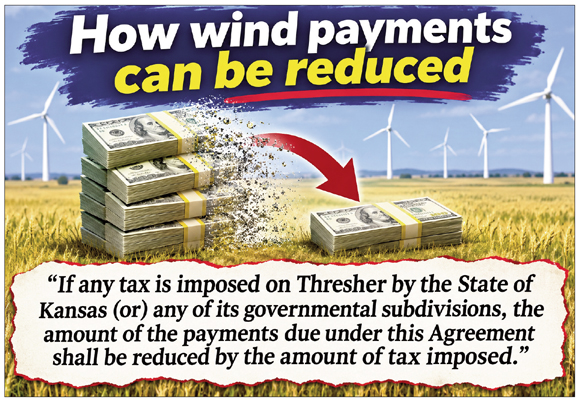
But Exhibit D of the proposal states that number could be reduced if the State of Kansas imposes any other fees on the project.
The agreement states, “If any tax is imposed on Thresher by the State of Kansas (or) any of its governmental subdivisions, the amount of the payments due under this Agreement shall be reduced by the amount of tax imposed.”
Late in the last legislative session, SB 534 was introduced in the Senate that would have imposed a nameplate tax based on the megawatt listing of the turbine and a kilowatt per hour tax.
While the law did not pass and was based on a five megawatt turbine, if a similar bill is introduced and passed in 2027, or even 2028, then the payments due to Seward County could be substantially reduced or likely completely erased.
Similar laws are already in place in Nebraska and South Dakota with taxes imposed on wind in Iowa and other states.
For example, the taxing rate applied by Kansas to the proposed towers, if their megawatt nameplate is included, would be $18,000 per tower. For the 22-tower project, that would total $396,000 in state taxes per year.
In addition, the bill also proposed a kilowatt per hour tax, and if that rate was applied to the proposal for Seward County, and considering only 40 percent usage time which is a low number for Western Kansas turbines, that would equate to another $400,000.
Both of these numbers would total about $800,000 in new taxes imposed by the State of Kansas. Since the highest amount Thresher would contribute to Seward County in 2029 would be $401,742, the terms of the agreement would reduce that contribution to zero.
That is just if the Kansas Legislature proposes and passes a bill similar to the one introduced late in the session last year. It is highly likely that a similar bill will be proposed earlier in the next legislative session, and since most of the revenue generated for Kansas will be coming from out-of-state corporations, it has a high chance of receiving support.
There are still other charges and fees that are also included in the proposal that could result in reductions in the contribution to Seward County, and it is likely that many of them will be utilized either annually or at some time during the 10-year scope of the agreement.
Other reductions include:
Property taxes — real or personal property tax due on property in Kansas, owned by Thresher Wind and associated with operating the facility.
Specified sales or use taxes — Kansas taxes due on purchases for construction or enlargement of the facility, and specified machinery or equipment used in production or handling its output.
Other Kansas state or local taxes — taxes imposed on the facility’s income, operations, or property, excluding Kansas income tax, franchise tax, and sales/use tax from this category.
Changes to specified tax benefits — amendments after the agreement date to the Kansas laws or regulations named in § 2(d) that reduce benefits available to Thresher Wind or the facility.
Mortgage registration tax — listed in section 2(e).
Should any of these occur, Seward County’s income from the project will be reduced dollar for dollar, meaning the estimated $400,000 per year could be zero before the first wind turbine is installed depending on what may happen at the state level, or purchases made by Thresher that fit one of the categories of deductions.
One of the driving factors for supporting the wind project was to bring in additional revenue, but it is highly likely Seward County will see only a fraction of the “maximum amount” highlighted in the agreement and could quite likely see no revenue at all depending on the language of the wind and solar taxes being considered in Topeka.