



ROBERT PIERCE
• Leader & Times
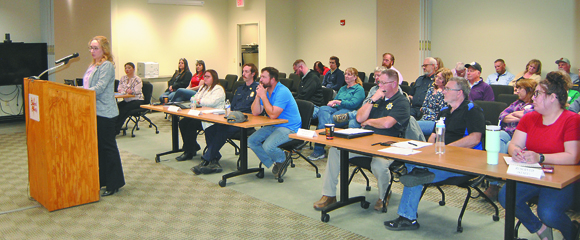
Following the debriefing on the mid-February fires on March 2, the Seward County Commission hosted its regular meeting, and like many recent meetings, the board heard from several citizens during the citizen comments portion of the meeting.
Former Emergency Management Director Greg Standard took the podium first to talk about the recent controversy surrounding a video of a phone call between Commission Chair Steve Helm and former Fire Chief Andrew Barkley in which Helm asked Barkley to provide Administrator April Warden with a radio.
“There’s been a lot of talk for some reason, and I’d like to put a little clarity out there for people who are wondering what was going on,” Standard said. “In my experience over the last 26 years, the Seward County administrator has never been a weather spotter or ever acted as a weather spotter in any situation. Seward County has had a very small emergency management department and relies on support from other county agencies to support the emergency operations center (EOC).”
Standard said the administrator has acted as support to response activities for 15 years, providing public information, inter-agency coordination, tracking and arranging mutual aid resources, organizing food and water for firefighters and other responders, requesting support from local heavy equipment operators and water haulers offering to deliver water to the scene.
“She’s tracked the units deployed from anywhere and everywhere so we know who’s actually there at the end of the day,” Standard said. “That’s important for a lot of reasons, safety primarily, but equally, if you don’t know, you can’t bring them under your wing and utilize them to their full capacity, interjurisdictional coordination with the cities of Kismet and Liberal.”
These are all things, Standard said, Warden has done which aided the operations of the EOC and the command to take part of the load.
“She’s done an excellent job in information gathering, volunteer coordination, providing information to the elected officials of the county and cities of the county,” Standard said. “Many years ago, the county administrator was provided a radio to use for these purposes by Emergency Management most recently.”
Standard said the intent of this was for Warden to be able to provide that coordination and assistance with the EOC.
“That’s why that took place, and it was a successful program throughout the years,” Standard said. “Ultimately, real time communication saves lives, and it saves property. If you can’t alert people to changing situations or get people to respond to the area where they need to be because you can’t communicate with them. You contribute to the chaos of a bad situation.”
Standard said this fact has been proven over and over for decades through the unnecessary loss of life and property in emergency response situations.
“Lack of inoperable communications costs lives and property,” he said. “The fact has been so well proven the federal government has spent billions of dollars to provide a platform that allows seamless communication between departments, agencies, government officials and other supporting responders. States have spent tens of millions. Cities and counties, including the City of Liberal and Seward County have spent more than a $1 million to provide adequate communications to protect the responders and the public. Communications are a vital part of successful emergency responses.”
Resident Carolyn Huddleston then spoke about information she found about raises asked for by Juvenile Correction and Prevention Services Director Chelsea Droste and whether employees of that agency and Cimarron Basin Community Corrections are state or county employees.
“Megan Milner, the deputy secretary for Juvenile and Adult Community-Based Services, provided documentation JCAPS staff are Seward County employees and supposed to be following all policies and procedures of the county,” Huddleston said. “The pay for staff at Cimarron Basin and JCAPS clearly hasn’t been in accordance with the county pay plan for some time, so why aren’t these people in trouble with the KDOC (Kansas Department of Corrections)?”
Huddleston said she believes this is because the raises given were approved by the commission or Warden.
“KDOC will defer to anything the county chooses to regarding the pay of their employees,” Huddleston said. “Two weeks ago, Chelsea claimed the pay of corrections staff is comparable to the market. I’ve checked that out by looking at the pay directors have been getting in Southwest Kansas. If you’re doing two jobs, you’d expect to earn more than if you were doing one job right?”
However, Huddleston said many judicial districts have one community corrections agency that provides services to both adults and juveniles, and she feels these directors are doing the jobs of both Droste and CBCC Director Kayla Janko.
“Interestingly, according to information Chelsea provided, there are only two other judicial districts in all of Kansas out of 31 total that do it like we do here with adults under one director and juveniles under another,” Huddleston said. “One of those judicial districts has its corrections programs based in Barton County District 20, and the other is up near Topeka District 2.”
In Finney County, Huddleston said one individual not only operates corrections services for both adults and juveniles, but they also run a juvenile detention center serving an entire region.
For three directors, Huddleston said pay came from the county, and in each case, the pay for the sheriff in the host county was more than what the directors were getting.
“Further, these persons were doing the jobs of both Kayla and Chelsea and in more populated judicial districts too where one would expect a larger total workload for the agencies, yet not one of them had as much pay as Kayla,” she said. “Both Kayla and Chelsea want the maximum, the top of the line for the step they are on in this OJA (Office of Judicial Administration) pay matrix, and the pay grade they are taking is the same one that would be used by directors who supervise both adult and juvenile services or those doing even more like that lady in Garden City who was over the detention center.”
Huddleston added Droste had also claimed the director of Reno County Community Corrections got his pay from the OJA pay matrix, but she said that, too, is not true.
“The supervision offices are on the OJA pay scale, and I was told that pay isn’t excessive when compared to the county pay plan,” Huddleston said. “Allowing them to use it doesn’t seem like a biggie. In any case, the commissioners have retained control of the director’s pay.”
Huddleston said in Ford County and Finney County, wages for supervision officers and lower level corrections staff is set by the county.
“I do not know what they are making now,” she said. “In Barton County, neither director got as much as Kayla. Their commission is allowing the corrections staff to use the OJA pay matrix.”
At OJA pay grade 44, Huddleston said Droste would be currently overpaid by about $2,000, and this is before the county’s pay plan would be considered.
“As for Chelsea’s statement she wouldn’t be able to get another raise for four years if she got this one, that’s completely false since she could ask for the cap pay from the Fiscal Year 2026 pay schedule next year, which Kayla just got and the cap pay from the one expected to be coming out of June of this year for Fiscal Year 2027,” she said. “The $110,000 which Chelsea calls the current pay for step pay grade 50 is what they expect for Fiscal Year 2027, which is actually the Fiscal Year 2026 amount plus 2.5 percent.”
Huddleston asked the commission to align the pay for JCAPS and CBCC with wages in Finney County and Ford County to get staff under the county’s pay plan with its other employees.
“At this point, that would mean not approving these raises, and HR can decide what pay grade is appropriate for them on the county pay plan,” she said.
Commissioners are in the process of considering an amended comprehensive plant grant application for JCAPS, and the board was scheduled to have a special meeting at 5:30 p.m. tonight in the commission chambers in the Seward County Administration Building to further discuss the matter.
Hillary Franco, executive assistant for Warden, reminded commissioners to consider all viewpoints, both from county staff and constituents.
“I think it’s important to remember while I know how much we appreciate our constituents doing all of this research for us, you guys have entrusted someone to hire people who actually know what their job is,” she said. “It is their job to provide you with the information you ask, and I think it’s important the information those individuals who are hired to do that job provide you is taken as seriously as the information that’s provided by the individuals doing the research.”