


ROBERT PIERCE
• Leader & Times
Conservation districts in three area counties recently hosted a Local Work Group in Liberal to help make recommendations to the Kansas Natural Resources Conservation Service state conservationist to address resource concerns at the local level.
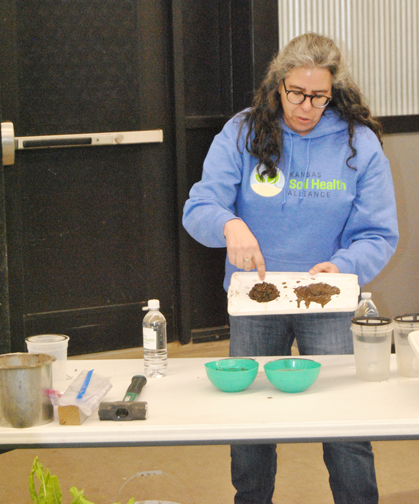
The day also featured a Soil Health Workshop hosted by the districts in Seward, Stevens and Morton counties, and this featured a presentation from Kansas Association of Conservation Districts Soil Health Specialist Candy Thomas, who talked about what makes good soil and what needs to be done with soil.
Oklahoma State University Assistant Professor and Cropping Systems Specialist Dr. Josh Lofton was part of the workshop as well, along with two of his students.
“They talked a little about grazing and what we need to put into the soil for grazing,” Stevens County Conservation District Manager Sheena Shuck said.
In the afternoon, Shuck and Stevens County District Conservationist Keri Morris ran the Local Work Group, which Shuck said was beneficial for anyone using Morris’s programs with NRCS or state cost share programs with Shuck, Morton County Conservation District Manager Shala Larue or Seward County Conservation District Manager Patti Amerin.
“It’s really beneficial for those people who do those programs in contract with us to tell us what their resources are,” Shuck said. “Every year, NRCS comes up with a list of what are resource concerns and what we are able to pay out on them, practices we need to help producers with.”
Water is always a concern in Western Kansas, and Shuck said it was one of the big topics brought up by producers during the LWG.
“Anytime we go to any kind of meeting in this area, water management is always a concern,” she said. “If you go to groundwater meetings, a lot of people are invested in that right now, which makes me realize we should have somebody from groundwater come and talk to us sometime.”
One of the things area NRCS offices help with to help with water conservation, Shuck said, is renozzling.
“We do engineer a lot of things,” she said. “Keri was saying if you want to do a whole farm or just one land, you can have those two options.”
Part of the work NRCS offices do with this, Shuck said, is engineering a way to be more efficient with water management.
“That seems to be the number one priority right now in this area,” she said. “We also fund a lot of grazing. I’m seeing a lot of producers doing graze management, so we’re putting up pipelines and stock tanks and helping with the transition of crops and grazing.”
Many people think soil health only affects the growth of a plant, but Shuck said it can also indirectly affect cattle and other livestock.
“The understanding I’m getting from producers, and what I’m seeing is the cattle eat what’s put into that,” she said. “One producer was telling me before they do the grazing, they’s always make sure they test it.”
Shuck said one of Lofton’s students talked about testing plants before putting cattle out to graze on them.
“It’s very important you are managing the plants if you’re grazing,” she said. “It will affect the cows. It’s just very important you’re able to control that as well. The soil does affect your livestock as well if you’re not maintaining your plants.”
Shuck said area producers who know about conservation practices and programs take advantage of them, and for her, this is a good thing.
“We’re in a hard position right now because we have so many people laid off,” she said. “What we’re struggling with as a department right now is Keri is having to train new people. I’m new, so I’m still learning.”
Shuck said this means area NRCS officials are not able to provide the fullest help possible to producers.
“We’re getting the word out there for people to come in, and we’re getting people excited to come in to take advantage of these programs, but we don’t have enough staff or help or the knowledge yet to help these producers,” she said. “We can’t engineer. We’ve been going to some classes trying to learn about the water management and the irrigation. We have our hands tied, and on top of all this, not only are we having to take care of all this, but Keri’s also having to do field checks and CRP and stay on top of that.”
With much Conservation Reserve Program land in the three counties, Shuck said NRCS workers often run behind due to helping out with other programs too.
“We’re having to figure out how to meet deadlines because of this,” she said.
As for the workshop and LWG, Shuck said she felt everything went well.
“We had really good feedback,” she said. “The producers got what they wanted. It gives us some ideas. We have some ideas of who to bring in and what producers are wanting to hear about.”
Shuck said the biggest concerns discussed during the day were water and soil, and she said this seems to be a common theme at many similar workshops.
“We have people who are concerned about how much they’re paying into output,” she said. “Overall, the workshop, the Local Work Group were a success. We’re really happy we did both in one day.”
Shuck said this kept producers on hand for both the workshop and the Local Work Group.
“We were able to get both of those done at the same time to get feedback,” she said. “A lot of people enjoyed the speakers. They enjoyed Candy’s presentation. They liked seeing the visualization of the soil and how to test it. Josh gave some really good pointers about soil. He did a game and talked about what producers are wanting here. That was interesting.”
Shuck said she also heard much of the way of good feedback from state leaders who liked the idea of having both events in one day.
“It’s hard to get producers to come to the Local Work Group,” she said. “They don’t realize how important it is. It helps NRCS make decisions on what the resource concerns are in our area, and if producers are not happy with what projects or practices we have, they need to go to these.”
Shuck said attending both the LWG and the Soil Health Workshop is important because even if producers learn just one new thing, it makes everything else work better.
“Learning and educating yourself continuously is important, but the Local Work Group is really important because if the producers are not happy with the practices we have, they need to tell the state this is not what’s working in this area,” she said. “We need to highlight these resource concerns. They don’t realize that’s their voice. If they have any complaints or concerns, they have to come to the Local Work Group. I thought it was really good we did our workshop in the morning, had lunch, then did the questions.”
Shuck said she would like to see more discussions of what ag producers and leaders are seeing and what needs to be done to make things better.
“We want to make things better for everybody to make everyone’s operation work well,” she said. “We’re here to help, and that’s what’s important. We care about making sure everyone operates right.”