



ROBERT PIERCE
• Leader & Times
Wind energy continues to be a hot topic of discussion locally, and while much of the conversation centering around the potential installment of turbines in Seward County has focused on the opposition, some voices in favor of the project are beginning to be heard as well.
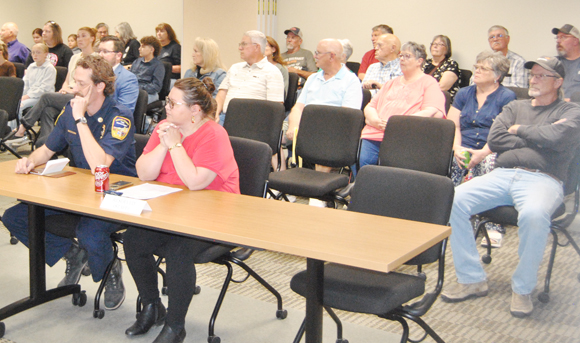
Monday during the citizens comments portion of the county commission’s regular meeting, Ryan Martin, a strong opponent of turbines in the county, again spoke, saying numerous videos, documentaries and even surveys have been put about the concerns about the project and any future wind projects in the county.
Martin said one survey showed about 70 percent of respondents speaking out against turbines in the county, and he added the project is not about economic development.
“I fail to see where the economic development is in this,” he said. “This county was based on many industries – oil, gas, irrigation, agricultural and cattle – and each one of those industries spawned other industries and many self-made millionaires were formed out of those industries.”
“We’re not going to have a company come and set up a roof and a business because they paint windmills or anything like that,” he said. “They propose four employees, and that’s what’s been told to each county. It isn’t like Seward County’s going to get four, and Gray County’s going to get four. The only people I see getting any economic benefit are the ones who have a windmill lease, and it’s not just the windmill lease. That’s pennies on the dollar. Of those getting windmills, many of the people in the proposed lease are absentee landowners. They’re not going to be driving back to Liberal to spend their money here. I find this very miniscule.”
Martin said he knows county leaders have a tough decision to make, but even so, the majority of constituents do not want wind energy in Seward County.
“It’s that plain and simple,” he said.
Martin said discussions have gotten to the point of looking at who has had experience with wind energy and who has not.
“It’s ironic to me whenever I look at a map of the leased areas and I look at the names on the leased areas, how I can see how somebody has this quarter leased, and they’ll have all their quarters leased except for one section, a half section or a quarter section,” he said. “Ironically, when you zoom in on the map, that just happens to be where their farm is or where their house is at, and it turns into what’s not good for me is good for my neighbor out of this. It’s pretty ease to be for it if you don’t live in this state.”
Martin would later leave the meeting, but he had sent a suggestion card with similar thoughts to Administrator April Warden, who read it and some expressing comments in favor of wind energy.
“Over the past eight months, members of the community have consistently voiced serious concerns regarding the proposed wind turbine development,” Warden said reading Martin’s suggestion card. “The volume and consistency of these concerns should make your decision clear. A survey conducted within the county indicated approximately 75 percent of respondents oppose wind turbines. While it has been suggested the survey was later influenced by outside interest, including individuals outside the county and even the state, the underlying sentiment remains evident.”
In the suggestion card, Martin said if any doubt exists as to whether a large majority of county residents oppose wind energy, it should go to a formal public vote.
“As elected officials, your responsibility is to represent the will of your constituents,” Warden said as she continued reading Martin’s card. “Ignoring such a clear majority risks further eroding public trust in the local government. Economically, the benefits of this project to the county appear minimal. A small number of landowners may receive lease payments, but many of those landowners reside outside of the county. Beyond that, there is little evidence of meaningful long-term economic growth.”
Martin said the county has historically relied on strong industries such as oil and gas, agriculture, irrigation and cattle to support local businesses, create jobs and build generational wealth.
“In contrast, wind turbine development does not appear to foster similar economic ecosystems,” Warden said reading from Martin’s card. “Even projected employment is extremely limited, with estimates suggesting only a handful of jobs across multiple counties.”
Martin said equally concerning are potential impacts on the health of residents and their quality of life.
“Community members have raised legitimate concerns about noise, vibration, shadow, flicker and other effects,” Warden read from Martin’s card. “One resident speaking on behalf of a special needs daughter presented thoughtful and serious concerns to the Planning and Zoning board.”
Martin said dismissal of concerns without consideration is deeply troubling
“The health and well-being of our citizens should never be treated lightly,” Warden read from the card. “There is no shortage of information available on both sides of the issue. However, it is important to recognize many of those opposing wind turbines are individuals with direct life experience of their impacts, whether related to health, livestock or property values. Their voices deserve careful consideration at a time when public confidence in local government is already strained.”
Martin said decisions such as this carry even greater weight than others.
“Listening to and respecting the concerns of your constituents is critical,” Warden continued reading. “In closing, I urge you to either reject this proposal or allow the citizens of this county to decide through a public vote.”
Warden would also read from a few constituents in favor of wind energy, including Joseph Frydendall, who said he did not know why people do not want turbines in the county.
“It’s a win for everyone,” Warden said reading Frydendall’s card. “Think about all the money that will be going into the school system for the kids, all the money that will generate in the communities in Seward County. All of the farmers who own land will profit. So do you. I am a landowner, and I live off of Social Security. This will definitely help me out. You are taking money out of my pocket if this is not okayed. It’s a win for everyone.”
Resident Tina Webster said wind energy is one commodity readily available in Kansas, and she feels harnessing wind can bring many benefits to Seward County.
“The income will help to improve roads, utilities and schools,” Warden said reading Webster’s card. “This income will help small farmers be able to pay to farm as costs continue to rise. This energy is infinite, unlike water, coal or oil. Through over irrigating the land, many farms have shut down or been forced to dryland farm. With climate change and global warming, it gets harder to make a living in Southwest Kansas.”
In turn, Webster said the income would supplement small area farmers.
“Wind energy has always been a source dating back to when people started using the windmills,” Warden read from Webster’s card. “This would create a better way to harness that wind energy. Wind energy is very important to our country as we try to find better ways to provide energy.”
Constituent Douglas Frydendall advised the county to approve the Invenergy wind development project.
This is the best use of my farmland, which is not productive for many reasons,” Warden said reading from Douglas’s card. “I am a disabled veteran on Social Security. I am counting on the wind energy to carry me through. I planned on this for years. We don’t have any ducks, pheasant, geese or quail.”
With Southwest Kansas having drought parched land, Douglas said the area is blessed with reliable high winds ideal for contributing to the nation’s energy grid.
“As a child, youth and adult, I have always wished some good could come from what is at many times a plague – straight line winds, tornadoes,” Warden read from Douglas’s card. “Please don’t nix the progress. That is our destiny. Nothing comes without change.”