



ELLY GRIMM
• Leader & Times
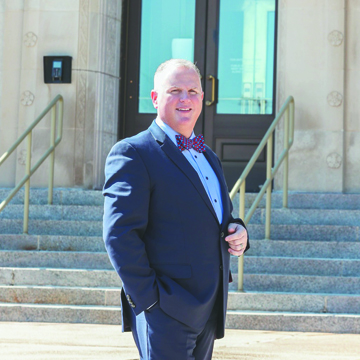
Many Kansans have been expressing their discontent with their representation in the federal government, and U.S. Senate candidate Jason Hart could help change that after the coming election.
Hart, who hails from Southwest Kansas, said his past experiences make him qualified for the office.
“I am a lifelong Kansan, husband, father, foster parent and I grew up in Dodge City,” Hart said. “My family had been a foster family growing up, so we had kids anywhere from two nights to two years over the course of when I was 5 years old to 12. That was pretty formative for me. I knew I wanted to grow up and do work that made safe places for children, so I went to law school and eventually became a prosecutor. I went out and practiced out in Dodge City for a little bit, and then I took a job in Shawnee County prosecuting in a family law unit, and I was very good at that. I later moved into sex crimes and major felonies. I then was hired by then-Kansas Attorney General Steve Six to head up their cyber crime child exploitation unit. I was there for a little bit before I got picked up by the US Attorney's office, where I've been for the last 16 years prosecuting child sex crimes and other similar offenses. It became apparent the current administration didn't care about kids because they were deprioritizing those types of offenses. I decided rather than be apolitical as I have been pretty much my entire career as a public servant and prosecutor, I should take my skills to prosecute the misconduct in Washington DC. So I quit and turned around and started running.”
Like other candidates, Hart said multiple recent events were the final catalyst for his decision to run for office.
“I would say the moment that was the most earth shattering for me – and I've been in law enforcement now for 21-plus years – was the shooting of Alex Pretti. There had already been a shooting out in Los Angeles and then the incident with Renee Good. And while that both of those are a single officer doing something wrong, and in my view, they were both bad shoots, as law enforcement might refer to them,” Hart said. “There was also the situation with Liam Ramos and his family, which is absolutely not something those law enforcement officers should have done. But when the Alex Pretti situation happened, it was at that moment I started thinking ‘This is not a case where this administration has lost its way, and I can't be a part of this anymore.’ And so then I began the process of exploring how I could sort of divorce myself from the Department of Justice, and there was also the question of should I run or do something else? I also had to consider if I should just wash my hands and essentially say ‘This can be somebody else's problem.’ There is a lot of misconduct in Washington DC right now, and I have a particular skill set I think would be useful in this moment. This is a different form of public service, and that's how I decided to run instead of just walking away.”
Hart added so far, the campaign trail has been a bit of a learning experience.
“It's sort of the opposite of jury selection. I really enjoy talking with folks, but jury selection is you're meeting with folks, you're learning what their experiences are, and then you're deselecting people,” Hart said. “When I talk to folks at my events, I always joke how I don't want to deselect any of them. I want everyone to come with me. Campaigning also features me talking about myself, which has never been my strong suit because as a prosecutor, you're talking about someone else and someone else's experience, so this is a little bit of a shift in perspective, and I'm still adjusting to it. I really enjoy getting out and talking to folks. One of the things I did for the U.S. Attorney's office during the time I was working there was doing outreach to schools, to community groups, etc. When this administration came in, one of the early straws that broke the camel’s back, so to speak, was they put a moratorium on any assistant US attorneys going out and doing public speaking events, so we couldn't go out and talk to communities. We couldn't go do training for law enforcement. That was a significant shift in the approach that had always been taken, because previously, it had been an expectation that I would do that, and I loved doing that. But this administration put a moratorium on that and required permission from the Executive Office of the United States attorney, and they very clearly said ‘You're not likely to be granted approval.’ It's really nice to be back out and talking to folks again.”
Hart said he has multiple goals should he ultimately get elected.
“First and foremost, one of the things that I think we have to do is there's been a lot of misconduct, whether it is relative to the Epstein files or using crypto currency activity in the background to accumulate wealth, the insider trading, all of those things that have been going on. I also think civil rights violations, these things, all need to be investigated,” Hart said. “I think in these next two years, we also need to have those investigations, because the Department of Justice is no longer doing its proper function. I know there are also all the conversations about it being weaponized earlier, but having been there and having worked under multiple administrations, I didn't see weaponization of the Department of Justice until this administration took the reins. In terms of policy, there's not a whole lot of daylight between me and the rest of the candidates on the Democratic side. We’re all pretty much aligned with expanding Medicare and Medicaid coverage, and we’ve got to stop the tariffs. Stopping the tariffs and reopening our trade markets with our allies and rebuilding those relationships is extremely important because the dissolution of USAID and rolling back SNAP has absolutely killed our farmers and ranchers.”
Hart also offered encouragement for constituents to get in touch with him if they have questions or concerns.
“If anyone wants to reach out to me, one of the nice things is when people call, I answer,” Hart said. “If people want to call, they can, of if they want to request a visit, they can go online and make that request. I grew up in Southwest Kansas, so I'm used to driving long distances to get to anything. If anyone wants to invite me for a meet-and-greet, I'm happy to come and talk to people. People can also look for my social media pages and send me messages there and again, I’ll be happy to have a conversation with anyone.”