

ROBERT PIERCE
• Leader & Times
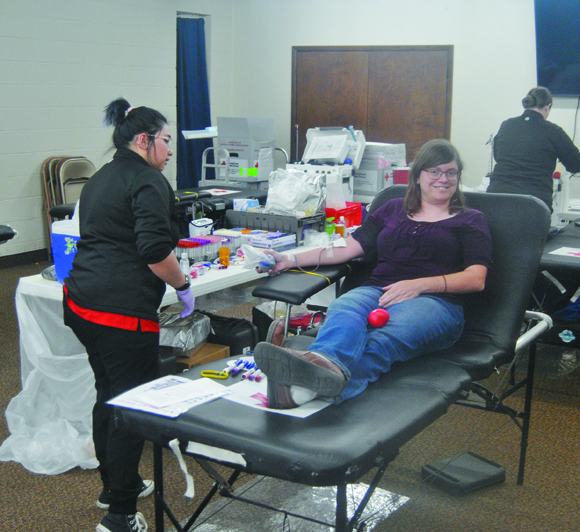
The need for blood remains at a constantly high level, and Tuesday, some of those who work to save lives on a daily basis took some time to help save more lives by giving a pint of blood at Liberal’s First Southern Baptist Church.
Residents of Seward County and beyond were invited to take part in LifeSave Kansas’ Battle of the Bases Blood Drive, and donors showed up in a big way, as only two time slots remained open as of Monday afternoon.
As part of their National EMS Week celebration, LifeSave competed against nine of its sister aid medical bases across the Midwest to see which location could support the American Red Cross with the most blood donated.
With blood donations declining nationwide, the need for the lifesaving resource is growing, and the availability of blood is important to LifeSave because its industry-leading crews carry blood on board their air medical plans and can administer it in flight, greatly increasing the chances of survival for those suffering from severe blood loss.
Red Cross spokesman James Randall emphasized the critical need for blood in America.
“We’ve had wildfires throughout the country, severe weather, and people are constantly needing it, especially cancer victims,” he said.
LifeSave Flight Nurse Kelly Cowan said having the people who give blood to critical patents donate blood is important as well.
“We do encourage all health care professionals and emergency medical personnel to come in and donate for this cause,” she said.
Fellow Flight Nurse Nikki Scarnati said she and Cowan see firsthand how important a blood supply can be to saving a life.
“We encourage anyone who’s ever needed blood or had family members who have required it to step up and give blood,” Scarnati said. “If you think you can’t get on the aircraft and save a life or you may not be a provider, nurse or a medic, you can still do something to help, and that’s donate blood.”
Located in Liberal, LifeSave is an air medical transport company, transporting critical patients from emergency rooms and intensive care and medsurge units to higher levels of care in larger cities.
“We are under a corporate company, AirMethods, which is the largest air medical company in the United States,” Scarnati said. “We have bases in 48 states. We have 300 bases, 400 aircraft, and we transport more than 100,000 patients a year.”
Scarnati said this LifeSave’s first year of doing the Battle of the Bases, and she hopes the event will become an annual one as they compete with other bases in the region.
“We’re trying to compete to get the most donations,” she said. “We have a good number so far to possibly put us in the lead. We are taking walkins. It’s going to depend if the community shows up, but we’re expecting everybody who signed up to be here and quite a few walkins. We think we have a good possibility to win.”
Scarnati said this Battle of the Bases will remain in Liberal due to the community being the home of LifeSave.
“We really want to give back to this community, and LifeSave is really trying to get our name out in Liberal to let them know we’re here,” she said. “We don’t require memberships. We are here for everybody in the community. We want them to know that. We want them to feel our support here. We’ll probably continue to do the blood drives here locally, and the other bases will do theirs wherever they’re stationed or located.”
Cowan said the impact LifeSave makes is greater due the rural area it serves.
“The closest Level One trauma facility is in Amarillo or Wichita. We take a lot of patients to Denver, Colorado Springs, Kansas City, Oklahoma City,” she said. “It’s very rural. We’re hours away from a higher level of care. For us to pick up a patient from here, we can have them in Wichita to a higher level of care in 50 minutes. It’s just a quicker way to get them the help they need.”
Likewise, Scarnati said blood drives such as Tuesday’s will make a great impact as well.
“There’s a lot of rural communities out here,” she said. “Some of your rural ERs don’t even carry blood. We are able to carry blood, and our providers are able to administer blood in route. That’s a big asset for our rural communities. Each donation can save three lives, so if we have 40 donations today, that’s 120 lives saved. We’re hoping to get more than that, but if we can hit that, that’s a lot. It can make a big impact here.”