

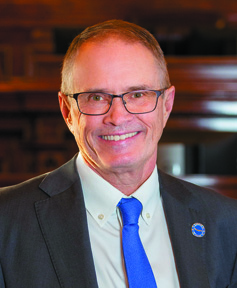
GUEST COLUMN, Shannon Francis, 125th District Representative
Doug Knudsen, Government Instructor at the Fellowship Baptist Academy, brought 6 students to the capitol this week to page. They did a great job, and I enjoyed visiting with them about Kansas and the Legislature. Thanks so much for coming. They are amazing members of our community.
The Page program is designed for students in middle school, junior high or the first years of high school. Working as a page in the Kansas Legislature is an excellent way to learn more about the legislative process. If you or someone you know is interested in serving as a page, please contact my office for more information.
Katie Horyna and two of her classmates stopped by to talk about issues facing the occupational therapists in our state. It’s always great to visit with someone from home.
John Resman
This Week Representative John Resman unexpectedly passed away. John served as my vice chair for four years on the Transportation and Public Safety Committee. We became very close and because of his career in the military, corrections and law enforcement he was an invaluable source of knowledge, experience and wisdom on the committee. He was a good friend and a good man. I will miss his calm demeanor and the experience and wisdom he brought to policy issues in the legislature,
Too often the focus of the media is on highly controversial legislation. If you base your thoughts on what’s in the media or on social media, you might think the Kansas House is a deeply divided body of people who can’t stand one another, but that couldn’t be further from the truth. The House can be a lot like a family. We disagree, sometimes passionately, we do get irritated with one another but at the same time being squeezed together in the peoples’ house day after day, year after year, leads to family-like bonds being formed. When we suffer a tragic loss like the loss of Representative Resman, it’s something felt by every member of the House. On Monday we took a break from running legislation on the House floor and let members come to the well and honor John. Members of both parties one by one came up to share their memories of John Resman. It was a sobering reminder of what is truly important in life.
House Bill 2427
House Bill 2427 creates a fiscal integrity officer position in both the House and Senate, for the purposes of identifying waste, fraud, and abuse within the Kansas budget, but just as importantly, providing some oversight for Kansas agencies and making sure their expenditures are consistent with legislative intent.
This improves our current process because it creates a dedicated, continuous auditor position to protect taxpayer dollars, and identify off-budget or re-directed spending, as well as unauthorized expenditures to make sure agencies are implementing appropriations exactly how the Legislature intended.
House Bill 2644
House Bill 2644 instructs county appraisers to apply additional scrutiny to properties whose appraised value was lowered by the appeals process if the property’s value increases by more than 5 percent in a single year for the five years following the appeal (excluding new construction, change in use or change in classification) the county appraiser must either:
• Adjust the valuation using information from the prior appeal
• Order an independent fee simple appraisal conducted by a Kansas-certified real property appraiser
Stopping improper property tax hikes is a priority for Kansans and this bill helps that initiative by making sure that sharp increases of valuations are subject to a second look, and proper evaluation, rather than simply relying on the mass-appraisal system.
HB 2712
HB 2712 removes unnecessary red tape by having counties seeking to levy local sales taxes go straight to the voters for approval, without the drawn-out legislative approval process that has largely become a routine rubber stamp. Currently, many counties must first come to the Legislature for approval before they can place a proposed county sales tax on the ballot, and this bill reduces the cost and use of taxpayer funded resources and takes the issue straight to you, the voters.
SB 33
SB 33 changes the apportionment formula for undedicated county-wide sales taxes. The change is for the portion based on total property taxes levied to be changed to total assessed valuation. This creates a more consistent and fair allotment system for county-wide sales taxes.
Under current statute, county-wide sales tax is apportioned between counties and cities in that county partly based on the population and partly based on the total property taxes levied. This means that levying more property taxes resulted in receiving a larger portion of the sales tax revenue, and vice versa, which disincentivizes the lowering of property taxes.
The purpose is that cities and counties that work to lower their property taxes can do so without fear of also losing out on sales tax revenue as a result, clearing the way for much needed tax relief.
Special Education funding is always a hotly debated topic in Kansas, and Republicans understand the importance of investing in the education of the next generation. That's why the Legislature is in full agreement with Governor Kelly when she says that “Kansas students are the future of our state. That’s why we’ve fully funded public schools for seven consecutive years.”
During budget debates however, Democrats still assert that Republicans are not fully funding special education. House Republican understand the importance of special education, and spend over $1.2 billion dollars of federal, state, and local funds annually to ensure that it is properly funded.
Recent increases in state funding:
• State support for special education has grown by over $100 million in the last five years.
• Appropriations have increased from roughly $490 million in FY 2019 to more than $610 million in recent budgets, with additional increases approved in the House version of this year’s budget.
• State-funded specialized schools:
• Kansas funds Kansas State School for the Deaf and the Kansas State School for the Blind, providing statewide institutions that serve students with specialized needs.
• These schools receive about $30 million annually in state funding and provide education and outreach services to students across Kansas.
• Local funding authority (LOB):
• Kansas law allows districts to raise additional revenue through the Local Option Budget (LOB), which authorizes property tax levies partly based on special education enrollment.
• Recent legislation now requires that funds generated under this authority for special education students be spent specifically on special education services.
• Federal funding:
• School districts receive federal support through the Individuals with Disabilities Education Act, which helps fund required services for students with disabilities.
• Districts also received temporary pandemic relief funds through the American Rescue Plan Act (ARPA) of 2021 to support special education services and student recovery.