

ROBERT PIERCE
• Leader & Times
Another school year has begun, and along with that, the Seward County Community College/Conestoga Innovation Center – West Campus (SCCC/CIC) continues to grow as the school’s newest facility.
SCCC Vice President of Career Technology Education Dr. Amber Randles said an additional instructor has been hired for the school’s truck driving program, and she added school leaders are working to increase enrollment not just in Liberal, but also at the school’s satellite location in Garden City.
“We’ve installed, through grant funds now two simulators in Liberal and one in Garden City,” she said. “We’re hoping to incorporate some duel credit CDLs in the oncoming year.”
Randles said the addition of a new instructor, as well as new trucks and trailers, should allow SCCC to increase truck driving enrollment.
“We’re working with partnerships with multiple entities to see if we can do some on the job training for different entities,” she said.
Prior to the start of the school year, Randles said the West Campus project was scheduled to be to the completion of Phase 2 as early as Labor Day.
“We’ll have classes for adult education moved over there,” she said.
Randles said SCCC has hired an executive director for both adult education and Business and Industry, Nikki Cole, who will help coordinate combining those departments and improving services the school can offer in those realms.
“She’s doing a fantastic job and has hit the ground running on a lot of things working on Phase 2 and finalizing grants and continuing partnerships Dr. Katie Reck had started,” Randles said.
Former B & I Director Norma Jean Dodge recently took over the position of registrar at SCCC, and Randles has been assisting B & I workers Sarah Thompson and Jennifer Farmer with that department.
Likewise, SCCC finished its annual Kids College this summer. Randles said with more than 100 participants, that event went well, and she said the school is also looking to keep its short courses, including energy courses through the Southwest Energy Institute, going.
“We provide short courses that don’t just apply to the energy industry, but it starts next week,” she said. “Even local entities can participate because there’s things like valves and compressors and line locating parts specific to the energy industry. It could be applicable in municipal needs. They’re very inexpensive. You don’t have to send someone out to get trained. It’s something we find to be beneficial.”
Randles said SCCC too is looking to bring back its class for EMTs.
“We’re not sure of the exact start date yet, but we have an instructor, and we’re looking to get that,” she said. “I know there’s people in the area who need that.”
Other SCCC programs, Randles said, have gotten some updates recently.
“Most of them are already finalized to help meet industry needs, provide some short exit points,” she said. “We’ve done some alterations to some existing programs like drafting and natural gas.”
Modifications likewise have been made to SCCC’s welding and surgical tech programs, and Randles said the maintenance tech program, introduced a few years ago, is expanding as well.
“There’s a lot of students who have started that,” she said. “We’re hoping to get those students through and completed. We’re working with USD 480 a lot in that realm.”
In addition to tech, allied health, B & I and adult education, Randles’s role also encompasses that of Title IX coordinator, and she said SCCC has been working on updating ist policies and reporting.
“We did apply for a few grants we’re hoping to hear back on,” she said. “We’re really excited for an intergraded academic grant and some other opportunities. We’re waiting on that process to see how things stand out.”
For those seeking certifications and degrees in tech programs, Randles said SCCC definitely has the capabilities to do just that.
“There’s opportunities for scholarships where you can work on that and work on a technical certificate as a duel credit in a similar fashion,” she said.
Randles said she strongly suggests looking at a tech field for those who may show an interest in the industry.
“I feel sometimes, you just hope the message here is the right person who’s had that itching to go back to school or to start school,” she said. I think there’s been a little bit of a negative connotation in the media of whether or not school is worth the investment, but if you look at the numbers, every degree you earn adds income in your future. It’s a direct correlation. If you get a GED, you’re increasing your salary not only your salary, but fewer people are unemployed the higher they’re educated.”
Randles added getting a degree or certification in a tech field does not have to look like how many have pictured higher education looking like.
“It doesn’t have to be a four-year bachelor’s or master’s degree,” she said. “You can get an associate’s degree and go to work doing the things you have always dreamt of doing. You can go into a health care field. You can go into industry.”
When it comes to the industrial tech side of things, Randles said many think those fields are dirty jobs, which they are not.
“You can go into drafting, and you’re not in a shop at all,” she said. “Corrosion tech, that’s a huge opportunity.”
Randles said starting salaries for these jobs are as much as $80,000 to $90,000 a year.
“You’re talking about two years of investment, which is next to nothing compared to what you’re going to be making,” she said. It’s similar for natural gas, our welding and our drafting. These are well paying where you have technical schools other people don’t have, and it can be tailored to what you want. It can be a short certificate where you’re only going a couple semesters, or you could be finishing a two-year going through the diesel or HVAC program.”
Randles said maintenance technology feeds into many of SCCC’s other programs.
“You get to see those, and it’s one or two semesters, and you’re done,” she said. “You can go from there into industry working for National Beef or Seaboard Foods working technician wise, making good money, but also have opportunities to see ‘I’d really like to go into natural gas or welding.’”
Randles said SCCC has opportunities local communities need.
“We need to educate and get people ready for careers that change their livelihood,” she said. “It changes the money they make. It changes their families and not just this generation.”
Randles said SCCC is always looking for chances to expand and grow.
“With HVAC, we’ve got some grant funds so we can start expanding and offering that for more people,” she said. “That’s a program that is pretty much historically always full. With diesel tech, we’re looking at a timeline to see if we can build that shop and get them moved over to West Campus.”
Likewise, Randles said SCCC looks for opportunities to provide services in other communities, including Garden City, Colby, Dodge City, and adult ed services are now offered in Dodge City and Gray County.
“We’re working with truck driving in Garden City, but we also have stuff going on here where Garden City students can get their certified medical assistant licensure through Garden City while they’re at the SCCC campus,” she said. “We’re always looking for ways to be nimble and adjust to the needs of not only our region, but of the people and provide as many opportunities as we possibly can. If somebody’s interested in a particular program and they want to move forward, we hate for them to not be able to do that. If we can expand truck driving or diesel, we always look for opportunities to do that.”
Randles said the trucking industry is in great need of drivers, and she said SCCC consistently looks for ways to expand.
“We are doing best on trying to provide that and looking for ways to expand,” she said.
Randles said trucking students can get a CDL in as little as seven to eight weeks.
“You’re not a professional at that point, but you’re given the skills that’ll make sure you have a successful career,” she said. “You’re being taught by veterans in that industry, and they go from making minimum wage to getting paid great. It completely changes their family dynamic.”
Randles said SCCC’s corrosion program has a few openings, as do surgical tech and drafting, but for the most part, the school is seeing an increase in enrollment for its technical program, something she said is not just an anomaly to the local college.
“We’re seeing that across the board, across the country,” she said. “People are going back to school or going to school. They tend to be going for that workforce related career opportunity, and I think it’s about time.”
Randles said many of SCCC’s tech programs have 100 percent placement rates.
“Before they’ve graduated, they’ve got a job,” she said.
Randles said with many questioning the worth of going through a tech program, the message is clear.
“Not only is it a good investment, but it’s not lengthy,” she said. “You’re looking at a short turnaround on time. Your financial obligation isn’t huge, and your lifestyle changes. Your return on that investment is not just beneficial but quick.”
Randles came to SCCC five years ago, and she said under the leadership of President Brad Bennett, all students are excited to come to school for the services the college provides.
“Not a lot of schools you can say, not just in the state of Kansas, but across the country, community colleges that you provide a mental health professional and a physical health professional, to provide services for students,” she said. “That isn’t an expense. It’s something we provide our students.”
Randles, though, said she is still baffled by the number of people who do not know what SCCC has to offer.
“They still don’t know all the opportunities, and it’s not because their head’s in the sand,” she said. “They read the newspaper. They listen to the radio, but they just don’t realize.”
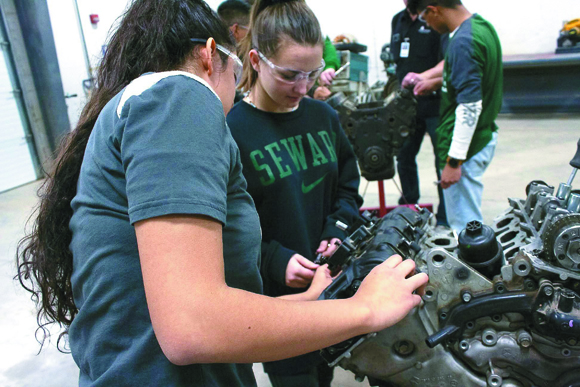
Randles said few schools other than SCCC offer programs such as auto body, auto tech, corrosion tech, natural gas compression, HVAC, truck driving, diesel tech, welding, allied health, surgical tech and med lab tech.
“This is stuff we should hang our hat on and say, ‘We’re not just Seward County. We’re not just a little town in Kansas,’” she said. “We have opportunities for our community that aren’t offered anywhere else that other people reach out to us and say ‘Can we have an extension site at Manhattan?’ It’s pretty exciting. We have students in Florida who are going through our med lab tech program. It’s something we should be so proud of. We have these unique opportunities for not just our community and for our students, but for the future we provide for our community.”
Randles said SCCC faculty and staff love being part of the community, and they do what they do because they care.
“I think it’s super exciting where we’re going,” she said. “I think people who don’t realize the benefit of education don’t probably realize what we have at all. This is real life applicable stuff.”