


ELLY GRIMM
• Leader & Times
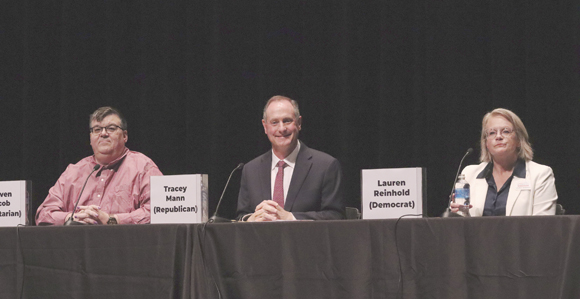
Constituents of the Big First District got to hear from candidates during a special forum at Fort Hays State University earlier this week, and one of the many topics covered was immigration.
One of the questions about this topic concerned the candidates’ thoughts on streamlining worker programs to help address shortages in agriculture and meat processing.
“I am supportive of measures to streamline the process for those programs. Step one when any talk of immigration comes up is to make sure we secure the border,” candidate Tracey Mann said. “President Biden and the Washington Democrats had a wide open border and let 15 million people into the country unvetted, so again, that first step is to secure the border, which President Trump has done. We now need to codify some of those changes so they can’t be done away with. And now that that’s done, we need to have a serious conversation in this country about how many people do we want to allow to become U.S. citizens per year and how do we go about enforcing that. Another big issue is the workforce, and I’m for that aforementioned visa program because I’ve talked to many ag producers who make use of that program and speak positively about it. Some changes could be made in the future, just like anything else.”
“I’ve also talked to a lot of farmers and ag producers who need that visa program to be streamlined, some ease in filling out the applications, and a reduction in fees,” candidate Lauren Reinhold said. “A lot of those operations need year-round assistance, like dairies, feedyards and facilities like that. This needs to be part of comprehensive immigration reform. I used to practice immigration law from 2005 to 2009, and before that, I was advising international students at the University of Kansas. When I did that, I would watch those bills come through – I remember watching what Dennis Moore was doing and what Nancy Boyda was proposing when it came to comprehensive immigration reform. This can has been kicked down the road for decades, and now, that’s why we have a crisis and so many undocumented folks and so many employer needs unmet. Comprehensive immigration reform is a big priority of mine, and will continue to be as your congresswoman. I will use my expertise in immigration law to help fashion an ideal bill for us.”
“There’s the line I’ve been hearing a lot lately, ‘We’re all on stolen land,’” candidate Steven Jacob said. “I’m for securing the border, that maybe got out of hand a little bit. We probably do need some form of amnesty program, the current one needs disbanded so something new can be developed. Generally speaking, 32 percent of men in this country of working age are not working, so who’s helping pay many of those people to stay home? Those workers. We definitely need to come up with a plan for amnesty. If you’re proven to be a good person, why shouldn’t you have the American Dream? My ancestors did, they came off a boat and helped build churches in Ohio, and we’ve all been successful. Your skin color shouldn’t matter when it comes to achieving the American Dream.”
The candidates were also asked about the economic impact of international students and scholars and what aspects would be included in legislation to help them.
“I used to work in legal services for international students at the University of Kansas, so I worked with a lot of them on immigration matters and tax matters. I’ve also talked to a lot of universities in the state lately who are seeing declining enrollment from international students,” Reinhold said. “It’s very problematic because a lot of those students are choosing other countries to go and study in. When it comes to the more complex and technological fields, we want to draw and retain the best, and we’re creating a ‘brain drain’ for ourselves by deterring international students from coming. That’s also creating a loss of income for our universities, both private and public. The system needs to be reformed. Thankfully, there are no visa caps on international students, but we certainly need to create a more humane immigration tone overall in our policy to help attract the international students and scholars we need to attract. We also need to reform the H1B system – President Trump is currently threatening a $100,000 fee, and we need those specialized workers, and we need students to stay and work in the U.S.”
“I Uber in Lawrence, and I do get to talk to a lot of international students, and they love it in the U.S.,” Jacob said. “There are kind of caps already on how many international students can go to pharmacy school or medical school, so there are already some of those caps in place. But I think they are important to the workforce, and hopefully, they end up staying in the U.S. I know KU has foreign exchange agreements with some countries, and I know there are some students in the U.S. who go to other countries because their colleges are less expensive.”
“In the Big First District – and many people might not know this – we have more higher education facilities in this district than any other district in the U.S. with the University of Kansas, Kansas State University, Fort Hays State University, Wichita State University, etc.,” Mann said. “I spend a lot of time working with Pell Grant programs and things like that to help make sure college is affordable to young people in the U.S. When you look at this through the lens of what’s best for the country, I think it’s in the country’s best interests to allow students from certain other countries to come and study in the U.S. because it’s good for the economy and those institutions where they end up studying.”