



ROBERT PIERCE
• Leader & Times
EDITOR’S NOTE: This is the final story recapping the debriefing of the recent fires in the area last week with the Seward County Commission. This story will discuss the recent controversy concerning Commission Chairman Steve Helm asking former Fire Chief Andrew Barkley to give Administrator April Warden a radio as well as drills the county does to help prepare for emergencies.
As last week’s debriefing on the mid-February fires came to a close, some last issues were discussed, including the opening of shelters for those evacuated and a controversial video of a phone call between Seward County Commission Chair Steve Helm and former Fire Chief Andrew Barkley.
Seward County Health Department Director Brie Greeson said the Liberal Area Coalition for Families, in the past, has done a great job helping with shelters in the past, and she had recently talked to LACF Director Sarah Mersdorf-Foreman about what to do in situations such as the fires.
Greeson said Crosspoint Church is centrally located for many in Liberal, and she said that church and others in town could be worked with in the future for shelter needs, a point she said she would bring up at the next meeting of the Local Emergency Planning Committee.
Another big help in the past has been the Liberal Ministerial Alliance, but with the loss of several key pastors over the years, Greeson said that support has dwindled.
“They used to do a lot of stuff when things like this would kick up so they could open the churches up and let them go in there until they subsided,” she said.
The Activity Center was briefly opened Feb. 17, the day the area fires kicked up, and Greeson said the county needs to look at alternate locations with which the county has a memorandum of understanding.
Administrator April Warden said officials with the City of Liberal reached out to let her know the Recreation Center would be open, and USD 480 officials told her Liberal High School was open as well.
“They had several teachers who teach for our district who were involved in the evacuations in the Oklahoma area,” she said. “They did open up the school for evacuated people as well. They had a number of people in Council of Governments. They reported they had 20 to 30 people, displaced teachers who showed up and stayed at that evacuation point until they knew they could go home or it was safe to go home.”
With the fires happening on Pancake Day, USD 480 students were out of school, and the fires started in mid-afternoon, which meant other area schools were done or nearly done for the day. Greeson said a point not brought up previously is if school had been in full session at the time.
“Working with the schools and whether they’re evacuating and not evacuating and do they stay, do they go, is this the location, that needs to be talked about too,” she said.
Greeson said officials with the Turpin, Okla., school district were asking if buses were going to be sent with one of the fires happening in the Stateline community just a few miles south of Liberal on U.S. Highway 83.
“If we would’ve been in school and it wouldn’t have been Pancake Day, we would’ve had another element to this situation nobody did address,” she said.
The debriefing then turned to the subject of the video in which Helm asked Barkley to supply Warden with a radio to help with the situation. The video was shared to the Leader & Times Facebook page and sparked outrage amongst followers, with some asking why Warden needed a radio and others saying Helm was interrupting Barkley’s pursuit of the fires.
At last week’s debriefing, Commissioner John Mettlen asked why Warden could not have a radio.
“Is it against the law? Is it against the rules?” he said.
Interim Fire Chief Braden Steckel said this needs to be part of conversations taking place in regards to better communication during emergencies.
“Some of those pieces are already in place,” he said. “The radios are in place. I don’t necessarily have a problem with people communicating on our county fire.”
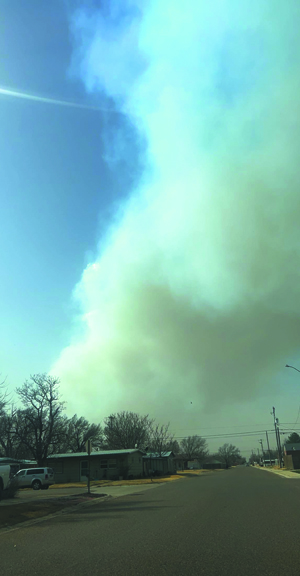
The commission was scheduled to meet the evening of Feb. 17, and Mettlen had come to the Administration Building for the meeting that night. As smoke was rolling through Liberal from fires in the surrounding area, many people were concerned about the conditions, and Mettlen said Warden’s phone was blowing up with calls from county residents.
“She came out and said there’s three farmers with disks at 83 and whatever highway or road south of here where they need to go,” Mettlen said. “Whether it’s right or wrong, people were calling her. I don’t see why it would hurt for her to say, ‘We’ve got these disks. Where do you want them?’ It doesn’t make sense to me. I think this deal’s got way blown out, and I don’t know if she had a radio before and it was taken away from her, but I don’t see what it would hurt.”
Warden has been the county’s administrator for 15 years, and until recently, she had been supplied with a radio for such emergencies.
“They took my radio,” she said. “They took several radios, and when they came back, we only had weather watch on our radios.”
Mettlen said he felt Warden needed a radio in order to let people know where to take equipment and supplies.
“April’s nowhere near the fire,” he said. “I was out there with the water truck, but I was nowhere near the fire. They called for water. I brought water. They’re calling her.”
EMS Director John Ralston said keeping a radio in the administrator’s office started with former Administrator Mary Bloomer.
“I believe that’s the first one we issued to the administrator after her, and they were programmed with the state template,” Ralston said. “This was prior to us setting up our top groups for a local asset for the state, and they were programmed with that. In the reprogramming of those radios, it was just programmed for weather watch. That’s the only frequency they put in it.”
Not having the state template in the radios, Ralston said, handicapped the ability to hear due to lack of repeaters in the county’s 800 megahertz system.
“It’s very much like a cell phone tower, and you can have so many talk groups on it, but you’ve only got six repeaters,” he said. “Those repeaters, the computer will keep control of all those frequencies that are on there and the talk groups and make sure the talk groups link up.”
This, Ralston said, is an easy fix.
“We’ve just got to get the radios reprogrammed to where they’ve got the state template,” he said. “Then we can identify those frequencies.”
A newer system, Ralston said, brings in outside assets.
“If they’ve got the state template, they can turn to that,” he said. “It’ll be on our tower, and they will have a talk group there. We can identify that.”
Ralston said with this in mind, much of the plan to attack the fires could have been coordinated at a designated emergency operations center.
“You’ve got one person to call as opposed to I’m going to call her, and she’s going to call this guy and let the EOC coordinate that,” he said. “They’re not out there involved in the actual attack, and they can do command from there. They’ve got one person to call.”
Warden said her staff is trained for the workers who were on scenes at the fires, and an EOC has been used for similar situations in the past.
“We are part of that,” she said. “I myself have been public information officer in the past, and I’ve also been the one who coordinates all of the resources coming in.”
Warden said having a radio had to do with her talking on the radio to have communication.
“It was to be able to hear where the command sites were, where we needed to send the water tankers, where needed to send the farmers with the disks, and unfortunately, we didn’t have anybody doing that,” she said.
Assistant Administrator Brock Theiner said the situation mainly lacked direction.
“There was a lot of terrain down there that was very hard to navigate, especially at night,” he said. “Getting the resources to a centralized location in the field and dispersing it from there is what we really lacked. We made it through it, but could do better.”
With multiple fires happening Pancake Day, Theiner said county workers were dealt a bad hand, but they did what they could to get things done.
“Did everyone do perfect?” he said. “No, but we managed to get through it. It could have been a lot worse, and it wasn’t.”
Sheriff Gene Ward said county first responders do have drills to practice how to handle situations such as the recent fires.
“Usually, they’re off radio unless you have something different,” he said. “We do tabletops.”
“We’ve got to designate one and let dispatch know this is only a drill, and everyone knows this is only a drill and don’t panic,” Steckel said.
“We’re required to drill at least once a year,” Ralston said. “The hospital, they’re required to drill two times of year. One has to be an actual drill, and the other can be a tabletop. We go through those, and the process of doing that is just there. When you write down a drill and you plan for it, you’re almost planning for what can we handle, and then you get thrown this one.”
Ralston said, though, he does not recall any drills for situations of the magnitude of the recent fires.
“The airport has to have a drill, and we’ve done those too,” he said. “Nursing homes have to have drills, and we run through those every three years.”
Helm and Steckel said despite everything, everyone who helped and those in the line of the fires were kept safe throughout.
“The most important thing is we had no equipment damaged, maybe minor, that I’m aware of,” Helm said.
“We had some fire truck damage, but our guys took care of it,” Steckel said.
“To my knowledge, there were no injuries in Seward County,” Helm said. “All across the board, we may need to make some improvement, but it worked okay.”