



ROBERT PIERCE
• Leader & Times
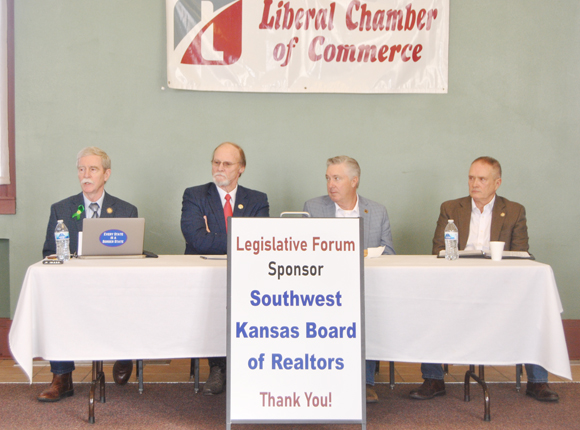
After tackling the issues of the state’s budget and wind energy, four area lawmakers moved on to other concerns from the crowd at the Liberal Chamber of Commerce’s Legislative Coffee March 14 at the Depot.
Kathleen Alonso, a community organizer for New Frontiers, asked about Senate Bill 452, which she said would ensure federal law enforcement could not be sued for intentional or negligent harm while engaged in immigration law enforcement activities.
Kansas 39th District Senator Bill Clifford said the bill had a recent hearing, and he said the bill primarily refers to Immigration and Customs Enforcement (ICE) officers being put under the immunity of state and local law enforcement.
“They would be treated like our local law people,” he said.
Clifford said while protection of protesters is a high priority, so too is the protection of law enforcement.
“It sets limits on how people can approach or not approach agents who are doing their jobs,” he said.
Alonso likewise talked about concerns about Senate Bill 254 prohibiting illegal immigrants from receiving state or local public benefit in accordance with applicable federal law. She said her concern was mainly due to clauses referring to the removal of in-state tuition for students not legally in the United States.
Kansas 119th House District Representative Marty Long said the bill first came to the House, where an amendment was put on it to remove the in-state tuition portion.
“That amendment did pass the House, and the bill went over to the Senate within a few days,” he said. “The very next day after we passed it out of the House, the attorney general came out with a statewide opinion that said we were breaking federal law.”
As of Tuesday, SB 254 had conference hearings in both the House and Senate, and both chambers voted in favor of the bill, with the Senate voting 22 to 18 and the House voting 78 to 46. Long said he looks for the bill to follow federal law.
Kansas 115th House District Representative Gary White said he, Long, Clifford and 125th House District Representative Shannon Francis were all in favor of in-state tuition,.
“We in Southwest Kansas, we get it,” White said. “We understand. We like our immigrants, and we do everything we can to protect them because they are an asset to our communities, but when Attorney General Kris Kobach came and gave us the what for on this is federal law, we had to listen.”
Clifford said the youth the bill impacts had no choice of where they were going to be.
“They aren’t criminals,” he said. “They are here because somebody brought them at a young age. They are among us, and I feel very strongly we should educate our kids. If they ultimately have to go back to Mexico or Honduras, they got educated in America, and I think that’s a positive. All of them have to be on some pathway to citizenship. They have to have applied for something, but the federal government is dealing with this. They have to solve immigration. We can’t. I voted for this, and I’d vote for it again to keep it in.”
Ultimately, Clifford said by representing the people, his decision on the matter lies there.
“I think of our employers, our schools, our community colleges who would lose revenue if this were to occur, and that’s who I’m voting for,” he said. “It’s a standoff in a way.”
Long said his thought process immediately went to trade and tech schools and young people going into mechanics and other similar jobs.
“Those are in high demand, and a lot of times, employers will even pay for that school for those students,” he said. “We don’t want to put that burden on the employers or the kids.”
Francis said the bill technically says any benefits denied to an American citizen must also be denied to an illegal immigrant.
“In Kansas, if our community colleges go to a system where everybody gets in-state tuition, it’s not an issue,” he said.
Some on hand for the March 14 update were concerned about the use of data centers, particularly when it comes to water usage, which is always a concern in Western Kansas.
Clifford said the state’s obligation when it comes to water is to put it to its best use.
“We can’t be hurting people who’ve done the right thing,” he said.
Long said data centers are on the tips of everyone’s tongues in the state and in the nation.
“In Kansas, we started looking at it last year heavily in our commerce committees and our utilities committees,” he said. “What are we going to do about the taxes on them? What are we going to do about the water on them? What are we going to do about permitting them? They make some noise.”
Long said the state’s commerce and utilities committees were bombarded about data centers.
“My fear is when we’re forced to do something at break neck speed at the statehouse, we usually come up with extremely bad policy,” he said. “I’ve seen it a million times, and so have you. We need to throttle back, take our time.”
Long said moratoriums could happen in some counties, but he is still concerned about passing legislation lawmakers will later regret.
“We’re trying to be careful,” he said. “We are talking. We are speaking up in our committees representing Western Kansas.”
White said his concerns lie with conserving water for future generations.
“Do you want your grandkids here or not?” he said. “We’re not going to be able to put a propane tank in our backyard and fill it with water. It’s going be a lot different when we run out of water here.”
White said the issue of water conservation is important for longtime residents of Western Kansas, and water can be saved for generations to come.
“We have the technology to do that,” he said. “I don’t want Topeka to dictate. That’s the last thing I want to do.”
The conversation later turned back to wind energy, and Francis said the perception of people across the state has changed in recent years when it comes to that topic.
“I believe at one time we were in favor of that in this area,” he said. “I think there are economic development things for wind. They pay $16,000 to the landowner on those things. I think there’s people who want them. I think it’s really important to have local control so people can make those decisions.”
White too said locals should have a share of the profits from wind energy and the decision making process.
“We have to look at those windmills,” he said. “We should be paid for it. It’s as simple as that.”
Long said windmills started with a lifetime property tax exemption, and that also has changed over the years.
“It went to 10 years,” he said. “The attitude with this bill is they’re not exempt. They’ll pay their property tax from day one.”
Clifford said issues have risen over the years about being able to drive in the areas where windmills ar located, and he said the turbines should be placed high enough to allow for driving.
“Cattle can still graze there, and grass can still grow there,” he said.
Seward County Treasurer Mary Rose brought up concerns about Senate Bill 404, which would create a vehicle services modernization task force, provide limitations on expenditures of country treasurer motor vehicle fee funds and authorize county treasurers to charge certain increased fees for vehicle registration transactions.
Francis said the concept of the bill is setting up an independent commission to do away with sales tax exemptions.
“Some sales tax exemptions we have are things like when you go to the beautician, when you go to the nail salon,” he said. “You don’t pay sales tax on your utility bills for a residence. You pay it on corporate utilities.”
With the money saved from sales tax exemptions, Francis said some at the state want a constitutional amendment to protect these funds and invest them in a similar way to what is done with money from the Kansas Public Employees Retirement System.
“The income off of that would be used to first buy down your vehicle taxes,” he said. “Once it grew to be enough money, it could be used to buy down the 20 mills the state collects for education.”
Francis said an amendment can either delay a sales tax exemption or do away with it altogether.
“The reality is when everybody in this room starts paying sales tax on their haircut or on their prescription drugs, they’re going to be mad, and they’re going to say ‘Why are you raising my taxes?’” he said. “That’s the way it’s going to look to you guys. There’s also going to be frustration when we get an economic collapse like what happened in 2008, and we’re trying to figure out what the heck to do.”
Both Francis and Clifford said SB 404 sounds like a great concept and something that could pass on a ballot, but ultimately, what citizens think matters.
“404 is about raising fees for plates and car registration,” Clifford said. “You do it for the state. We should have state DMV laws, and there are several in some locations. My county is paying to do it. Greeley County, which is my smallest county with 1,600 people, it was costing them $30,000 a year to do the service.”
Initially dead, Clifford said county treasurers started contacting lawmakers about the bill.
“A couple of us went with the majority leader in the Senate who didn’t like the bill,” he said. “He’s in Sedgwick County. He’s waiting in line, so he’s really mad at DMV and the process in Sedgwick County, but he heard from enough members.”
Clifford said the Senate majority leader said rural areas have figured out the process, and he added it works well in Finney County, his home county.
“We ran it, and it passed 35-5,” he said. “We’re going to get that fee increased for you so the counties won’t be paying to do this for the state.”
Francis said another idea for the bill was to allow for facility fees with online renewals.
“You didn’t pay a fee if you did it online,” he said. “You only paid it if you went into the treasurer’s office.”
Should SB 404 be put into place, Francis said vehicle renewal fees would increase by $15, and he estimated for every $5 the fee is increased, the state gets $15 million.
One of the last issues brought up at the update is a bill that would bring equity to local pharmacies.
“In rural Kansas, we’re starting to lose our Ma and Pa pharmacies,” Long said. “It’s costing them money to fill prescriptions because they’re contracting with pharmacy benefit managers (PBM). They’re not getting the same deal as the big chain stores. There’s a bill that came out of the Senate, and it fixes that. We’ve talked about PBMs in my district for two years. It’s on the tip of everybody’s tongue.”