



ROBERT PIERCE
• Leader & Times
Feb. 17, high winds and dry conditions resulted in wildfires in several locations across Kansas and Oklahoma, and several of the fires continued throughout the week.
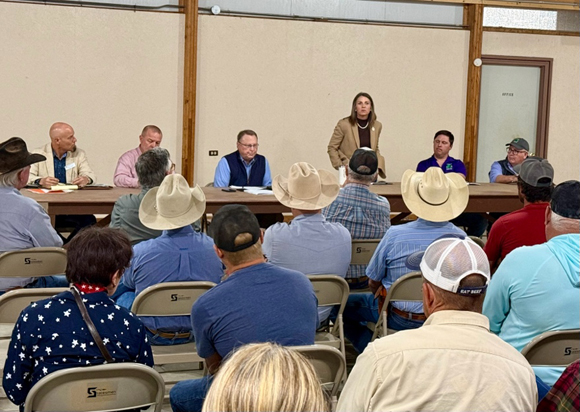
Many of these wildfires resulted in agricultural, including livestock. Last week, U.S. Senator Dr. Roger Marshall convened a meeting between Kansas agricultural leaders and local farmers and ranchers who lost livestock, hay, grazing stock and structures to the recent fires.
Producers from across southwest Kansas filled the Meade County Fairgrounds to ask questions and provide feedback in person as they work through government program applications to recover some of their losses.
Agriculture agency leaders travelled from across the state to give overviews of available relief programs and take questions directly from producers, and many local Farm Service Agency and Natural Resource Conservation Services directors were present as well.
In a press release, Rebecca Swender, director of Dr. Marshall’s Washington D.C. office, said the senator’s office has been fielding questions from producers and assisting in the wildfires the swept across the region Feb. 17.
“Sen. Marshall was in Southwest Kansas and witnessed the wildfires firsthand,” Swender said. “He arrived in Ashland that evening as firefighters and producers worked against strong winds and high fuel loads.”
The press release included a link to emergency response resources and cost share assistance for landowners. The page did say the list will continue to expand and adapt as needs are made known. Resources include:
Emergency Response Resources
• Kansas Department of Health and Environment: assistance with emergency disposal/burial of animals.
• U.S. Department of Agriculture Farm Service Agency: assistance with recovery related to loss of livestock and related assets.
• USDA FSA: Livestock Indemnity Program website
• USDA FSA: Livestock Indemnity Program 2025 Fact Sheet
• USDA FSA: ELAP Program website
• USDA FSA: ELAP Disaster Assistance Program 2025 Fact Sheet
• USDA Natural Resources Conservation Service: assistance with technical assistance and financial assistance related to recovery.
Cost Share Assistance for Landowners
KDA’s Division of Conservation has developed a Wildfire Recovery Initiative to provide $151,000 of KDA–DOC financial assistance to landowners in eight counties (Barber, Clark, Comanche, Finney, Meade, Rawlins, Seward and Stevens) for cover crops, temporary watering facilities and temporary electric fence. Landowners can receive up to $5,000 in cost share funding through this initiative.
Tax Relief for Recovery
SALES TAX
On and after July 1, 2022, all sales of tangible personal property and services necessary to construct, reconstruct, repair or replace any fence that is used to enclose land devoted to agricultural land shall be exempt from sales tax. (K.S.A. 79-3606d) The purchaser must provide form ST-28F, Agricultural Exemption Certificate to the retailer from whom the purchases are being made.
Contractors and repairmen providing the service to construct, reconstruct, repair or replace any fence that is used to enclose land devoted to agricultural land may use this certificate to purchase the materials and labor necessary to construct, reconstruct, repair or replace fencing.
No sales tax shall be imposed upon the service of installing or applying tangible personal property in connection with the original construction of a building or facility or the original construction, reconstruction, restoration, remodeling, renovation, repair or replacement of a residence.
Original construction means the restoration, reconstruction or replacement of a building, facility or utility structure damaged or destroyed by fire, flood, tornado, lightning, explosion, windstorm, ice loading and attendant winds, terrorism or earthquake. (K.S.A. 79-3603(p))
PROPERTY TAX
K.S.A. 79-1613 provides for an abatement or credit against property tax levied upon a homestead or building or improvement destroyed or substantially destroyed due to an earthquake, flood, tornado, fire, storm, or other event or occurrence which the governor has declared a disaster.
Application for relief must be made to the board of county commissioners where such property is located. The application does not provide an automatic rebate. The application can be found on the PVD Web site at: /www.ksrevenue.gov/pvdforms.html.
EO Allows Relief from Transportation Restrictions
Gov. Laura Kelly has signed Executive Order 26-02 to waive certain requirements through March 25 for commercial motor vehicle carriers and drivers that are assisting in providing relief from the wildfires impacting parts of Kansas.
The emergency proclamation waives certain hours of service requirements for commercial motor vehicle carriers and drivers under the conditions of providing direct assistance during an emergency. (Note: EO 26-01 was replaced by EO 26-02 to extend this relief from transportation restrictions.)
Motor carriers participating in restoration and relief efforts must still obtain the requisite over-dimension permits as required by the Kansas Department of Transportation, but fees associated with these permits have been temporarily waived.
Donations and Assistance for Affected Communities
Hay and Fencing Donations
Donations of hay and fencing supplies are being accepted at various collection sites. To donate, call the Kansas Livestock Association office at 785-273-5115 and they will help coordinate a drop-off.
Cash donations can be made through the Kansas Livestock Foundation by going to www.kla.org. If you are in need of supplies, please call KLA.
Assistance for Ashland Community
Many of the opportunities to help in the Ashland community have been compiled in this letter from the Ashland Veterinary Center, including fencing supplies, money, pasture, hay and feed. Ashland Assistance Letter
Recommendations in a Wildfire Emergency
Keep Records
In the early stages of wildfire response and recovery, it is recommended that you record and document as much as possible. Photos, receipts, records of losses will be critical later in your efforts to obtain assistance and reimbursement.
Start Local
Local officials will be able to provide access to resources and current, accurate information. Contact your local offices first. Links to some of those offices are below.
Ask for Help
Do not hesitate to ask for assistance, whether that means shelter for your family, feed for your animals, or counseling for those impacted by loss. Find mental health resources at KansasAgStress.org.
Wild West District K-State Extension Agent Nancy Honig likewise advised everyone to be prepared to evacuate in the event of a wildfire.
Honig’s March column in the Sunday Southwest Living section of the Leader & Times on March 15 talked about dealing with the situation, and she said much of the work that needs to be done concerns records.
“Ideally store important documents either in a safety deposit box, an external drive or on the Cloud to make it easy to access during a disaster,” she said in the column.
Honig said people can also create boxes or bags to put important information in such as:
• Copies of: Photo IDs, birth certificates, Social Security cards, insurance policies, sources of income (to maintain payments and credit), tax statements (to provide contact information for financial and legal providers and to apply for Federal Emergency Management Agency disaster assistance)
• Medical Information: Physician information, Copies of health insurance information, Immunization records
• Physical Medications and a list of medications
• Medical devices such as: Prescription eyeglasses and contact lens solution, hearing aids, C-Pap machines.
• Consider keeping a small amount of cash at home in a safe place to take with you in an emergency.
• Cell phone with chargers and a backup battery
• Flashlight and battery-powered or hand crank radio and a NOAA Weather Radio with tone alert
• Pet food and extra water for pets
Honig said other things to plan for include:
• Identify several places you could go in an emergency such as a friend’s home in another town or a motel. Choose destinations in different directions so that you have options during an emergency.
• Keep a full tank of gas if an evacuation seems likely. Keep a half tank of gas in it at all times in case of an unexpected need to evacuate. Gas stations may be closed during emergencies and unable to pump gas during power outages. Plan to take one car per family to reduce congestion and delay.
• Come up with a family/household plan to stay in touch in case of separation; have a meeting place and update it depending on the circumstance.
• Secure the home by closing and locking doors and windows.
• Leave a note telling others when leaving and where you are going.
• Try to make sure everyone is wearing sturdy shoes and clothing that provides some protection such as long pants, long-sleeved shirts and a hat. A change of clothing for everyone if possible.
Honig said this is by no means a complete list of possible things to bring.
“The idea is to start thinking and preparing for an emergency before it happens,” she said. “You may think since you live in town instead of the country this may not be necessary, however there can be a variety of natural disasters, and they don’t let us know where and when they strike. Being prepared is a big step towards erasing fear and concerns about severe weather. We are headed into the time of year severe weather can happen any time, so be prepared.”