


ROBERT PIERCE
• Leader & Times
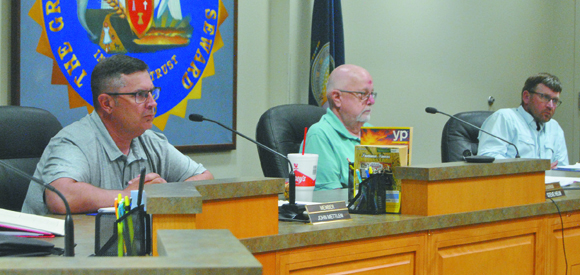
Monday, Seward County Administrator April Warden responded to criticism she received after sending an e-mail to commissioners in which she said bringing new leadership to what she called a “house on fire” would strongly hurt the county.
In the e-mail, Warden said she had asked Human Resources Director Angela Johnston to provide turnover rates, specifically for 2026, and the administrator presented those numbers at Monday’s meeting.
“We have lost 28 employees since Jan. 1,” Warden said. “It’s a 14 percent turnover rate. We did do research with the U.S. Bureau of Labor Statistics that says the national average employee turnover rate across all industries is 3.3 percent monthly for government. It is around 1.75 percent with state and local government. It was reported at 1.3 percent in February 2026.”
Warden said the e-mail outlined her perspective on workplace morale and employee turnover, and it was intended to provide internal information to the commission.
“I completely understand the correspondence may be subject to open records requirements, but I was surprised an e-mail that was sent to only commissioners made its way to the local media in less than two hours from when an open records request was sent to our county clerk,” she said. “Although I’m not disputing the public nature of the record, I was concerned about the decision to elevate internal personnel and workplace culture matters into the public domain so quickly.”
Warden said these types of discussions are typically handled with discretion in order to allow leadership the opportunity to fully understand and address concerns constructively.
“Involving the public at an early stage can contribute to misunderstanding, which it did, unnecessary negativity, which it did, and division within the community,” she said. “My intent with sharing that information was so we could improve the workplace conditions and not create public controversy.”
Warden said she feels it is important for county leaders to remain mindful of how and when sensitive internal matters are communicated externally in order to maintain trust both within the workforce and with the public.
“I feel I need to support the employees when I say I’ve had the privilege of serving the county for 25 years, and I’ve always taken pride in both my role in the county and the services we provide to our community,” she said. “Throughout my tenure, I’ve consistently believed every employee in this organization plays an important role no matter what position they’re in and contributes to our shared mission.”
In the past, Warden said even during challenging times, the county workplace has felt like a supportive environment, one where employees rely on one another.
“They understand what their purpose is,” she said. “They remain committed to serving the public. That sense of teamwork and shared purpose is a significant reason why many of us have remained dedicated to the county thorughout the years.”
Warden said although her recent email was not intended for public distribution, she has received an overwhelming amount of support and appreciation from not only employees in response to its message, but also constituents who live within the community.
“It’s not always easy for staff to voice concerns, particularly in the environment where they fear retaliation or public scrutiny because it’s been hot and heavy for a year,” she said. “In many cases, employees turn to their administration department or their human resources department for guidance and support. During these times, I want the employees to know I stand alongside them, and I’m committed to supporting their growth, advocating for a positive work environment and helping ensure they feel valued and they feel heard.”
At the same time, Warden said she believes it is important to recognize unresolved issues, if not addressed, can have a broad and lasting impact on the workplace culture.
“I respectfully ask the commissioners to partner with administration and identify solutions, strengthen our organization and establish a clear path forward,” she said. “With thoughtful leadership and collaboration, I’m confident we can restore a positive and productive environment for our employees and the community we serve.”
Warden then gave some more turnover data to commissioners.
“Public sector employees leave voluntarily at a lower rate than private sector employees – approximately 9 percent annually versus 27 percent for private,” she said. “Primary factors are burnout and aging workforce nearing retirement and competition. With the private sector, wages are key contributors. Entry level positions tend to experience higher turnover, which we are seeing compared to overall averages.”
Warden said it is also important to recognize many commonly held assumptions about workforce demographics are often overstated across generations.
“Employees consistently value meaningful work, competitive compensation, a work life balance, and key priorities include teamwork, recognition and flexibility,” she said. “Notably, 90 percent of employees indicate they would remain with an employer long term if provided with consistent raises and opportunities.”
Warden said she was challenged to come up with ideas to address turnover and strengthen workplace morale.
“We need to develop a comprehensive retention plan,” she said. “I think it would be a great idea to engage employees through surveys and direct conversations to better understand their concerns and opportunities. We need to maintain competitive compensation and benefits even when the adjustments are necessary.”
Warden said this year saw changes to benefits, and she added raises have not been given for a few years.
“At some point, it has to be addressed,” she said. “We can’t just keep kicking it down the road. Consider implementing stay interviews. That’s when we can better align employee goals with organizational direction, ideally supported by a clearly defined strategic plan.”
Warden said this is something new commissioners Jairo Vazquez, John Mettlen and Clay Louderback have not had the opportunity to do, and she feels it is an important thing to do for employees to have a clear direction in how they contribute to the direction of the county.
“To strengthen our hiring practices, we need to clearly communicate what our organization values and long-term goals are,” Warden said. “Those are listed on our Web site, and I would encourage you to look at those and see if you feel those need to be adjusted at this point.”
Warden said she feels it is also important to highlight positive employee experiences, adding this strengthens our community to improve recruitment efforts.
“It used to be people wanted to work for Seward County,” she said. “They could see what the atmosphere was like and what it was like to work for Seward County, and that speaks volumes when you’re trying to recruit people or visiting with people. We need to be able to highlight some positive employee experiences.”
Warden said the county likewise needs to leverage available HR tools and platforms.
“It does allow us to expand outreach while ensuring we are effectively telling our story,” she said. “Our program, Clear Company, does hit many sites, allowing us to reach a greater number of people when we try to hire.”
Warden said although county leaders made the decision to do away with travel training, this makes it difficult to encourage engagement with employees when there are no opportunities for professional growth.
“I think we need to evaluate the impact of limiting training and travel, as these restrictions hinder employee development and long-term retention,” she said. “I also think we need to regularly check in with our high-performing employees to address their workload burnout and what their career goals are.”
Warden said department heads need to be empowered with authority and clarity needed to effectively manage their teams and contribute to the success of the organization.
“I understand why you guys wanted all hiring decisions to come back to you and for you to be able to set the hiring wages, but we do miss out on opportunities to hire employees during that period of time,” she said. “It also has made the department heads feel they can’t be trusted to make the decisions within their budgets and to hire people.”
Warden said while turnover presents both financial and operational challenges, it also provides an opportunity to evaluate internal practices and strengthen our organization with a focused and collaborative approach.
“We can improve retention, enhance workplace culture and better position Seward County for long-term success and what we used to be known for,” she said.
Due to confidential content contained in it, Warden said a report on county turnover cannot be made public, but she did confirm, the county has lost 28 employees since the beginning of the year.
“We are down to 209 total full-time employess as of April 30,” she said. “We’d been up to 250 prior to all of this.”