



- Details
ELLY GRIMM
• Leader & Times
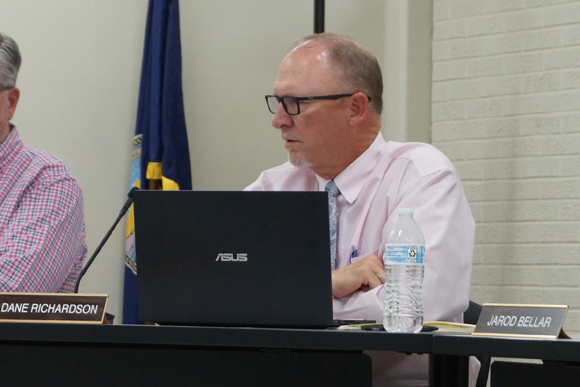
The USD 480 school board made rather quick work of its agenda at its most recent meeting Monday evening.
Up first in the meeting was the announcement of the latest Educator of the Month, Sylvia Villa from Cottonwood Elementary School, who will be officially recognized at the board’s November 9 meeting.

- Details
ELLY GRIMM
• Leader & Times
There could be some changes in enforcement coming to building and fire codes after some discussion by the Liberal City Commission at a recent work session Tuesday afternoon.
“Historically, with a home of wide-frame construction, floor joists above a basement supporting the first story floor were going to be 2x10, 2x12 or something like that to carry that weight,” Code Enforcement Director Keith Bridenstine said. “If there was a fire that broke out in the basement, it takes quite a while for a fire to burn through a 2x10 or something similar. As construction types have differed throughout the years, certain trusses became more common and the nominal choice while the under the floor joists became less common. It was discovered the trusses are mostly 2x4s with special press-in plates to help hold everything together, so if a fire starts in the basement, those plates pop out, the 2x4s disconnect and burn through quickly, meaning the floor falls in. There was a fire in town 2016 or 2017 where a fire started in the residence’s basement and the fire department got delayed at the railroad tracks. Had the fire department shown up without that delay, the firefighters would have just made it into the house when the entire floor collapsed into the basement. It is a huge safety issue for fire personnel and the residents of that home. In 2012, the International Code Council put in fire protection of floors, but it only qualifies if you’re using those engineered trusses that were mentioned earlier – if the home still has the joists, you don’t have to do that. The City of Liberal was under the 2009 codes when I started back in 2015 and then in 2017, we adopted the 2015 codes. This was in those codes, and after everything got approved and processed, that’s what I started enforcing.”
Read more: Commission discusses building and fire code during Tuesday work session
- Details
EARL WATT
• Leader & Times
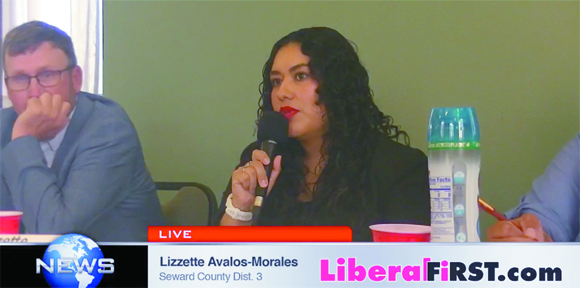
Out of the three commissioners who were appointed by the Republican Party precinct men and women in January, two are seeking to keep those seats in a public election Nov. 3 — Clay Louderback and Jairo Vazquez. John Mettlen chose not to seek election after the January appointment.
Louderback and Vazquez each have a challenger, and tow other candidates are seeking to fill the upcoming vacancy that will be created by Mettlen not seeking election.
To better know why all the candidates are running, they were asked what was the driving force that made them decide to run during last week’s candidates’ forum provided by the Liberal Chamber of Commerce.
“I don’t have an agenda,” Dist. 2 Commissioner Louderback said. “I’m just trying to work with the other commissioners to try to unify and bring forward a positive reflection of the community. I want to keep property taxes low. I am a conservative. But we have to address issues and improve our roads, our infrastructure. We have to address the employees. They need raises, and we need to take care of county buildings.”
- Details
EARL WATT
• Leader & Times
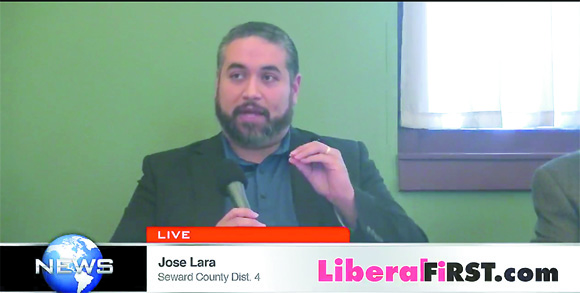
At the end of the 2026 Kansas legislative session, a bill was passed to limit local tax increases, but it was vetoed by Gov. Laura Kelly. Reluctance at the local level to set limits has led state leaders to consider statewide limitations, and the responses of the candidates seeking three seats on the Seward County Commission might indicate why local units aren’t interested in limitations, and the state may be the only way to enact spending limits.
Candidates were asked if they support a tax cap in any given year, and if so, how much during the recent Seward County Commission Candidates Forum hosted by the Liberal Chamber of Commerce.
- Details
EARL WATT
• Leader & Times
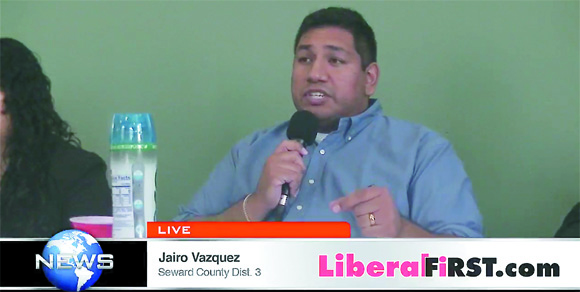
Advisory votes are not uncommon in Kansas or Seward County. In 1997, Seward County had a vote to rescind corporate hog farming, and it passed 72 percent to 28 percent.
Recent polling has shown similar opposition to wind farming in Seward County, and despite claims that advisory votes are not allowed or difficult, counties continue to use them as a tool, including Pottawatomie County where that county commission is asking local voters about adding a new town in the county. The county established the requirements for the voters which included living within the area affected, being 18 years of age and having a driver’s license.
Similar claims are being made about the opposition to corporate wind farming that were made about corporate hog farming 30 years ago, including statements that the opposition is being overstated. But the public vote dispelled that claim.
Read more: Candidates differ on allowing a public vote on wind farms
More Articles …
Page 18 of 110