
EARL WATT
• Leader & Times
At the end of the 2026 Kansas legislative session, a bill was passed to limit local tax increases, but it was vetoed by Gov. Laura Kelly. Reluctance at the local level to set limits has led state leaders to consider statewide limitations, and the responses of the candidates seeking three seats on the Seward County Commission might indicate why local units aren’t interested in limitations, and the state may be the only way to enact spending limits.
Candidates were asked if they support a tax cap in any given year, and if so, how much during the recent Seward County Commission Candidates Forum hosted by the Liberal Chamber of Commerce.
Dist. 4 candidate Fred Bloom said he would need to have a better understanding of the budget before making a decision.
“Without working through the budget, I don’t have a real clear decision on that,” Bloom said. “We have to make our county functional. I am not for taxes. I pay a lot of taxes, but you have to pay taxes to keep it going or we have to cut what we offer. You have to cut services if you don’t. I am not in favor of a cap.”
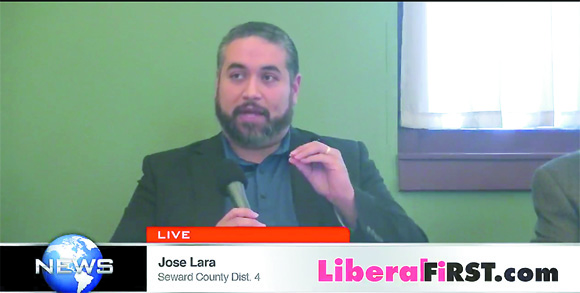
Dist. 4 candidate Jose Lara explained there are two different ways to provide caps, and one was better than the other.
“Legislation has been going around discussing valuation and tax caps,” Lara said. “I am not in favor of a valuation cap. That creates issues for seniors and new home buyers. I am ok with going back to a 3 percent cap, and if you want to go over, you must take it to a public vote. I believe that would be fair and allow budgets to exist and stability to exist for the population. I don’t like tax increases, but I voted for a 3 mill increase and recently a 2 mill increase. The county was going to do 1 mill. I would cap myself at a 2 mill increase.”
Dist. 2 Commissioner Clay Louderback said a cap had to be reasonable.
“Do I think there should be a hard number? If reasonable, yes,” Louderback said. “If only 1 mill at a time, that’s not practical. It has to be to a point you can get to a budget, provide raises and take care of infrastructure.”
Dist. 2 challenger Kay Burtzloff said the question was tricky.
“The question is a trap,” Burtzloff said. “I remember the first George Bush saying no new taxes and it crucified him. I can’t say I won’t raise taxes. In this economy, to provide the services we want, we have to look at the tax structure. Do we do 17 mills? Absolutely not. We have to balance what we are willing to burden the taxpayers and what we need for essential services. Ambulance services are not considered essential. You do not have to have that as a county government. Think what that would mean for our community.”
Dist. 3 Commissioner Jairo Vazquez thought the number had to be reasonable, and that a statewide limit isn’t the right solution.
“If we keep growing and we have more homes, more jobs, I would see that happening,” Vazquez said. “If it was a mill at a time, I don’t see how that could work in the situation we are in at the county. If it were statewide, I’m not sure that works, either. Each community is different and costs are different. It’s a complicated question and the answer is more complicated.”
Dist. 3 challenger Lizette Avalos-Morales believed local governments need flexibility to meet local needs.
“I don’t want a tax cap because every year is different,” Avalos-Morales said. “Setting a definite number could be bad for our community. It’s not a black-and-white answer. There is a lot of gray in there. We can also see the cost of supplies that have increased in a lot of departments. It is more expensive. Putting a tax cap would not be looking at a holistic approach to the budget.”
Lara added that government budgets aren’t the same as a home budget, and caps shouldn’t cause fear.
“It’s not as scary to put a cap on government budgets,” Lara said. “If you cap but grow your valuation, your dollars are increasing while taking one or no mill increases. It’s not scary as long as we are growing our tax base.”