


EARL WATT
• Leader & Times
Advisory votes are not uncommon in Kansas or Seward County. In 1997, Seward County had a vote to rescind corporate hog farming, and it passed 72 percent to 28 percent.
Recent polling has shown similar opposition to wind farming in Seward County, and despite claims that advisory votes are not allowed or difficult, counties continue to use them as a tool, including Pottawatomie County where that county commission is asking local voters about adding a new town in the county. The county established the requirements for the voters which included living within the area affected, being 18 years of age and having a driver’s license.
Similar claims are being made about the opposition to corporate wind farming that were made about corporate hog farming 30 years ago, including statements that the opposition is being overstated. But the public vote dispelled that claim.
According to the Sept. 17, 1997 edition of the Southwest Daily Times, both sides expected the vote to be close, but the wide margin provided clarity the day after the election with 72 percent voting against corporate hog farming.
Then Seward County Clerk Dee Malin said the issue had a 49.1 percent voter turnout. Current election turnout has been in the low teens.
“We have had people my age who have lived in Seward County all of their lives who registered to vote for the first time,” Malin said of the interest in the issue.
While 72 percent of registered voters polled earlier this summer believe a public vote should take place prior to approving corporate wind farming, the decision to allow a vote rests with the Seward County Commission, and those currently sitting on the commission that are up for election opposed a public vote while challengers supported it.
A petition has already been filed within the proposed district by landowners who do not want the project that was certified and will force a super majority vote of the Seward County Count Commission in order to approve the project, meaning it will take a 4-1 vote to approve corporate wind farming.
Despite the opposition, current commissioners up for re-election do not want a public vote.
District 2 challenger Kay Burtzloff said the commission should be seeking public input however they can get it.
“I’m always open to more feedback from the public than I am from less,” Burtzloff said. “I understand information came out today that we can’t take advisory votes. I need to check into that. If we can take an advisory vote on anything, we need that.”
Dist. 2 Commissioner Clay Louderback said he opposed a public vote.
“I do not support a public vote,” Louderback said. “After the information we’ve been given, it will be a catastrophic thing for our clerk’s office. She can’t use state equipment. It would be a hand-written vote. You have to count it by hand. No way you can validate the people voting. You will have to take their word they are registered. It turns into a poll.”
Dist. 3 challenger Lizette Avalos-Moreno said the conversations so far have been private, and a public vote is one way to gauge public interest in the issue.
“I think the difficult part is there is a lot of information current commissioners have access to that we don’t as the public,” Avalos-Morales said. “Most of them have been private conversations. I am in support of getting feedback from the public, from an open forum, surveys, polls, a public vote. Get feedback even if not through a formal public vote.”
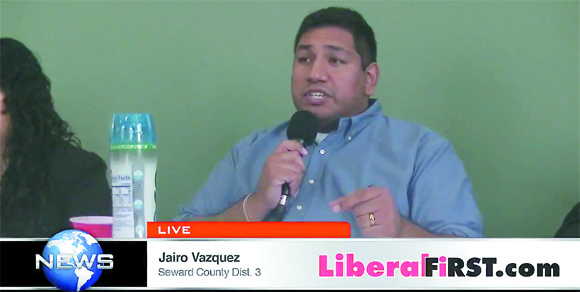
Dist. 3 Commissioner Jairo Vazquez believed he provided the public a chance to participate when he chaired the Seward County Planning and Zoning Committee prior to being appointed to the Seward County Commission.
“Public input is super important,” Vazquez said. “When I was chairing Planning and Zoning, I pushed back twice to get public input, and when I became a commissioner, (Zoning Director) Edgar Ortuño pushed for more public input. We’ve had a lot of public input. We got that information recently — we had people check into (a public vote). We are human beings. We are flawed. If we had a normal poll, I’m concerned it could be corrupted by outside entities either way.”
Dist. 4 candidate Jose Lara said a public advisory vote is critical on this type of issue.
“I will always be in favor of getting the public’s opinion on an issue that will affect so many,” Lara said. “More work is never an excuse to not do something in government. We need to make sure we can do this legally. The decision will still be up to the commissioners. Corporate hog farming was put on the ballot and still affects us today. It would be nonbinding, but I see no reason the public should not have a say. The city does polls and surveys. You should get as much input as you can.”
Dist. 4 candidate Fred Bloom was instrumental in the fight against corporate hog farming, and he said that effort was to try and get in front of the issue.
“We did vote on hog farming,” Bloom said. “It was brought up ahead of time. A lot of communication is what we need. We need to communicate what is being brought ahead of time. What is economic development looking at instead of behind the doors so we wouldn’t have to go to a public vote. I was proud of what we did with hog farming, so I guess I am saying I support it, and we should have done it a long time ago.”
Vazquez added in the rebuttal period that residents should attend planning and zoning meetings to understand what is being presented. However, planning and zoning also conducted multiple executive sessions on the issue.
“Planning and zoning is close to my heart,” Vazquez said. “That is where I got started. Those meetings are very important. They give you an opportunity to have your voice heard. Go to those meetings, they share a lot of information.”
Wind farming passed Planning and Zoning by a single vote and now must be decided by the five commissioners.
Louderback added he has received little concern from the public about the issue.
“During the process we had what is called the official record,” Louderback said. “Only 60 people, pro or con, spoke up on this issue. In the nine months I’ve been on here I have had less than 20 phone calls on this issue. It doesn’t seem to be everyone in the community like it was with the hog farms.”
Lara added the public doesn’t always show up, and it is necessary to seek input on issues like wind farming.
“Everyone has an opinion on whatever government is doing,” Lara said. “Rarely will people speak up. Currently we’ve been working on the water park at the city. I’ve received two emails. But we’ve touched more than 300 people on what to do with the water park. It’s important to get as many people as possible.”