


ELLY GRIMM
• Leader & Times
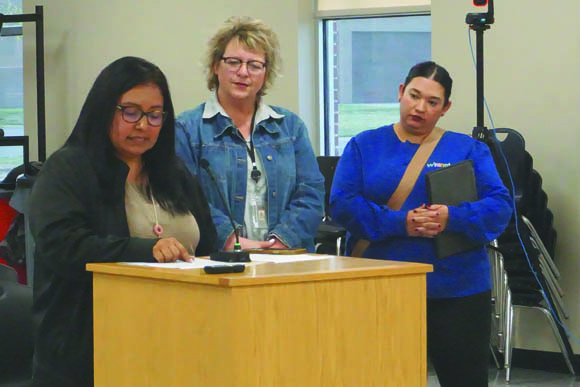
The school district’s dual language program has seen much success since its implementation and Monday evening, staff from Prairie View Elementary shared some of that progress with the USD 480 school board.
Prairie View Elementary School Principal Louisa Gonzalez started the presentation by giving some of the program’s history.
“Dual language began in 2005 in the kindergarten classrooms with two teachers who co-taught two groups of half-day classes at McDermott Elementary School. There wasn’t a curriculum for the program – Ms. Emma Diaz translated the curriculum that was being used for the English kindergarten classes and then the principal at that time, Kathy Fitzgerald, contacted Success For All after researching various programs,” Gonzalez said. “Success For All is a schoolwide reform program that featured materials in English and Spanish, and they were looking for dual language schools to participate in a research project. The research project’s goal was to track Spanish-speaking students in kindergarten through 3rd grade to determine if there was an academic difference between students in a dual language classroom compared to a typical English-only classroom. After approval from the school board, McDermott Elementary School became a research school for Success For All in 2006. The dual language program grew each year beginning with kindergarten in 2005, and one grade level was added at a time until the program reached students in kindergarten through 6th grade. One of the requirements for the research was for dual language kindergarten had to be a full-day program – Success For All would provide the materials for both the English and dual language classrooms for the entire school, they provided ongoing training and support, and testers were brought in twice per year to do more in-depth testing. Unfortunately, however, the research never fully materialized due to a lack of students nationally who continued in the dual language program for the four years necessary to collect the data. There was no cost to the district for the first four years of the program in terms of training, support and materials provided from Success For All.”
Eventually, Gonzalez said, changes were needed.
“USD 480 didn’t want the dual language program to benefit only students living in the McDermott Elementary School area, so after the first year of the program, it was decided to open half the spots to at-large USD 480 students and the other half to McDermott Elementary School students,” Gonzalez said. “Although Success For All targeted native Spanish-speaking students, USD 480 wanted the program to be offered to native English-speaking students as well, leading to the decision to make dual language a 50/50 program, with half the content being taught in English and half the content being taught in Spanish. Another goal was to reflect 50/50 Spanish/English speakers. Originally, there was a first come, first served approach to participate in the program based on the time a student enrolled. I remember when we did enrollment, the conditions were insane – if everything was scheduled to start at 8 a.m., we’d have a line that had been started at 5 a.m. outside the building. It is typical to have at least twice the number of parents interested than the number of spots available. Before dual language went schoolwide, we accepted 40 students in the lottery each year – 20 from within the McDermott Elementary School boundaries and 20 from outside the school boundaries. The remaining students received English-only instruction.”
Some of the more major changes are more recent, Gonzalez said.
“When we started dual language schoolwide with kindergarten in 2019, we changed the lottery and only took 21 out-of-boundary students, which was split into seven English students, seven Spanish students, and seven bilingual students,” Gonzalez said. “All in-boundary students started receiving dual language in kindergarten. If a lottery student left kindergarten before the end of the first semester, that opening would be filled by a student on the waiting list created at the time of the lottery, and there was definitely a waiting list. Prior to 2019, we had a single track of dual student classes, but as positions opened up after the kindergarten year, the openings would be filled with students who staff felt would benefit from the program. There are many students who have participated in the dual language program who were in their first year in an English-speaking school, and the program ended up being a perfect fit for those students because they were able to hone their English while still learning content and other skills in their first language. The program was also a good fit for students who needed additional academic challenges. From 2005 to 2025, the dual language program used Success For All to teach reading in English and Spanish. From 2022 to 2025, staff had specific dual language training, and we strictly followed that immersion model. The fall of 2025 saw the beginning of the implementation of the CKLA reading program in English and Spanish, but the students in 2nd grade through 5th grade remained with Success For All. Starting next year, all kindergarten through 5th grade classes will be using CKLA to teach reading and follow the USD 480 alignment.”
Goals for the program have also changed over time, Gonzalez said.
“The goal of when we started the dual language program schoolwide was to have 91 percent of all 5th graders reading at grade level in both English and Spanish by 2026,” Gonzalez said. “In looking at the data, we have seen a bit of a decrease since the school went to the program schoolwide. When we first started, we had 33 Certified teachers and one interim who had finished the program and had his degree but was lacking the test. Now that we’ve had an entire group of students go through kindergarten through 5th grade schoolwide, we’ve reflected on the data to figure out where we are right now.”
While there has been much success, Gonzalez said, there is still work to be done.
“Due to the dynamics of our current staffing, current data and the new reading curriculum resource, we feel it’s time to consider a new dual language format or model that would best meet the needs of the students at Prairie View Elementary School,” Gonzalez said. “We know, through research and the guiding principles of the dual language program, there are multiple models that have proven successful across the U.S. We have taken steps to speak with teachers, we created a dual language program task force, we’re reading a lot of research, we’re currently in a group study, we’re working with district leadership, and we’re planning to seek feedback from parents as we look to modify our program and figure out what best fits the students. We want to figure out what best fits Prairie View Elementary School where we are at this point in time. In terms of student achievement not being quite where we’d like, there are multiple factors that could be contributing to that. To be transparent, however, we started out with 33 certified teachers to teach in English and in Spanish – to teach in English, that uses the PD4, and teaching in Spanish, it’s more or less you have the resources and just do it. We need to make sure there’s that bridging in between. Right now, there are 11 certified teachers at Prairie View Elementary School, compared to the 33 we started out with, and being an interim in the classroom can be overwhelming. Multiple interims have families, they’re taking classes and we’ve got them on our program, and they’re still required to perform their regular responsibilities as a classroom teacher. All of that combined can be really overwhelming. We have surveyed our staff, and some of them our fairly worn out, so we’re listening and trying to figure out ways to ease some of that workload. We also want to make sure we have available, within the school, what’s best for the students – i.e., if dual language isn’t what’s best for everyone, what can we provide for those students?”
After some more brief discussion, others also praised the work done before the presentation was concluded.
In the meeting’s new business, the board approved an invoice from Linq in the amount of $23,433.41 for cafeteria software renewal and bid from Apple Specialties Inc. in the amount of $15,991 for plumbing fixtures at Sunflower Elementary School and Cottonwood Elementary School. The board also approved a bid from Southwest Glass in the amount of $28,680 to replace doors at the Redskin Field fieldhouse and bids for exterior work and repairs at multiple schools throughout the district. To conclude the meeting’s new business, the board approved a quote from Pur-O-Zone in the amount of $19,721.89 for custodial supplies and an early graduation application from Jorge Castillo-Salazar.