



ROBERT PIERCE
• Leader & Times
Some Seward County 4-H youth live in either Liberal or Kismet and would like to be able to show livestock at the Five State Fair and other events, but they do not have the space available at their homes to raise them as children in rural parts of the county do.
Thanks to a recent memorandum of understanding unanimously approved between the Seward County Commission and the K-State Extension Wild West District, steps have been taken to remedy that problem.
K-State agents Summer Stafford and Jade Greene first brought the idea to the commission at a work session in early April. Stafford said officials with the Extension office were tasked with finding a place for kids to house the animal projects.
“We are more suburban than the other two counties we serve,” she said. “We do have kids who live in Liberal who would like to have animal projects but don’t have a place to house them.”
Stafford said there are many things that could be done to accomplish this.
“Luckily, we’ve got some facilities out there already. Jade and I have taken a really close look at those facilities, and what we’re finding is it may be more useful to utilize what we have as opposed to erecting a brand new space,” she said.
Stafford said ultimately, she and Greene wanted to get permission and allowance to house animals on the fairgrounds and for children to have the ability to do projects.
“We do know education is huge for their future, and the things they gain from it are invaluable,” Stafford said.
Greene said K-State officials also reached out to FFA leaders to see if any youth in that organization would be interested in having a town farm.
“They could also house there as well,” she said. “They’re getting their own facility, but until that time, we’ve talked to their instructor and told them 4-H and FFA all could use the facility if they have kids, but strictly Seward County kids.”
Greene emphasized the fairgrounds would not be utilized by out-of-county kids, and she added using the fairgrounds would not be for year-round projects.
“We would only go the 4-H livestock season,” she said. “Cattle have to be owned 120 days before fair weigh-in, and small animals, which are sheep, goats and pigs are 90 days. Nothing would be wintered on the grounds.”
Commission Vice Chair Todd Stanton said use of the fairgrounds as a town farm does not cost the county anything.
“These funds will come from donors and donor sponsors, grants, and they’re just needing the permission to undertake one of these options,” he said. “You’re leaning toward rehabilitating the two pig barns, rather than new construction.”
Stafford said the hog, poultry and rabbit barns near the show arena receive little use at this time, and all are in poor shape. She said a contractor has looked at the building, ruling it quite unsafe.
“It probably needs to come down,” she said. “I don’t know when those buildings were put in or the biggest chunk of maintenance was last done.”
Stafford said Activity Center Director Linda Johnson and her crews do a great job taking care of the barns and other buildings on the fairgrounds, and with the buildings being older, she hopes to see more use of them.
Stafford said the contractor was specifically talking about the poultry and rabbit barns, though.
“The head space and some of the crossbeams are a little tricky,” she said. “We had discussed possibly reroofing the two hog barns and doing a lean to that would be right where the chicken barn already is. That would be the extent of that.”
While the barns are in bad shape, Stafford said they still are not likely to fall down soon, and having been utilized long term, rehab is about not just aesthetics but also having facilities both 4-H’ers and the county can be proud of in the future.
“We house both the 4-H and the Five State Fair, and Five States come in, bring their animals,” she said. “We want to have the facilities to match that event as well.”
Stafford said adding concrete to the barns raised flooring about two to three inches more, making roofing closer to the floor. She said Extension officials are happy to find the money to make repair projects possible.
Stafford said a quote was received on work for the poultry, rabbit and hog barns.
“If we erected a brand new roof, if we took all of the upright structure, all of the drainage floorings, concrete floorings and erected a brand new roof with the lean to, all of that would be $250,000,” she said.
Stafford said Extension leaders are looking at means to fund the upgrades.
“We know it’s costly,” she said. “Whether it’s $250,000 or $400,000, it’s a lot. I think we have the ability to get quite a bit of funding. I think we have some opportunities with Cooper Clark and few other local donors who have mentioned wanting to pour into the community in this way. We haven’t had that for 4-H in Seward County in a long time either. We’re thankful for that. We’re going to press on those avenues for sure.”
Above all, Stafford said the project should be feasible for everybody.
“What we’re thinking of doing is utilizing the chicken poultry area,” she said. “This is why we want to raise the roof. The roof structure should come up because it won’t just be for poultry and rabbits. Half of it is being utilized for that right now, and it would stay that way more than likely.”
On the other hand, Stafford said the building’s other half is the target to be used for a town farm due to its dirt structure.
“That is more feasible for town projects,” she said. “We don’t want them on concrete all the time because you have to change out bedding. That’s why we think that structure needs a little more attention.”
Administrator April Warden said former commissioners had considered that space, and county leaders checked with Planning and Zoning to see what guidelines would need to be followed to build a new building.
Greene said fees paid by 4-H youth would help cover some of the costs of upgrades.
“If you want to work that in that agreement, it does state a money amount, and it’s based on the months they’re going to be there, how long they think they’ll be there,” she said.
Stafford said using the same space for both fair and town farm animals would be the most ideal.
“That way, we can do some upgrades for that one space,” she said. “Jade thinks it may be too small compared to the three barns. That is the only concern. We really are open to what’s workable for everybody.”
“We want a space for the kids,” Johnson said. “We wouldn’t have a lot of space if you were behind the horse barn.”
Warden said approval of the MOU would come with a review from Counsel Forrest Rhoads, as well as the clerk’s office and the treasurer’s office
“We can get the proper line items set up to track the money that’s coming in and to know it’s supposed to be applied towards the fairground utilities,” Warden said. “We can get that set up upon approval of this if that was the case. It won’t have a separate checking account. It’ll be within our accounting system set up within the line items.”
County Clerk Stacia Long said this would be done as a reimbursement. Commission Chair Steve Helm said if upgrades are made, he likes the idea.
Greene said the idea has already gained popularity amongst 4-H youth.
“If we told them yes, we have 10 more kids who would love to put animals,” she said. “I think it’d be good.”
Helm said electrical and plumbing work would need to be approved through Planning and Zoning. Stafford said any work done would be done by a licensed contractor.
“The contractor we’ve talked to already goes through Planning and Zoning all the time and has engineers to make sure everything’s done correctly,” Stafford said.
Commissioner Jairo Vazquez said he also likes the idea of a town farm.
“It’s a good thing for all the kids,” he said. “They’re busy doing something productive and getting skills they can hopefully use in the future.”
As a former 4-H parent, Warden said now is the time when youth need to buy their animals to get them ready for the fair.
“If somebody doesn’t have a place to go with them, it would be difficult for them to get their projects ready for the fair,” she said.
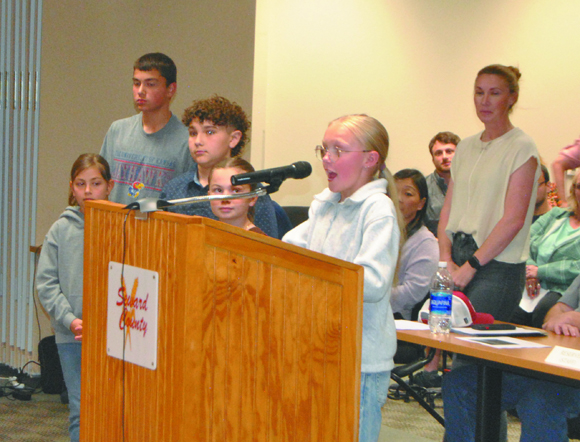
At the commission’s April 20 meeting, 4-H youth stated their reasons for wanting a town farm.
Emily Rotelo said feels it is important to keep animals at the fairgrounds.
“I could walk four blocks from my house to the fairgrounds, and I don’t ask my parents to drive me all they way to the farm that takes 15 minutes, and I could wash my steer,” she said. “I can practice in the arena. I could feed water or hang around in the pin with my animals, and I think it would be a really good idea to agree.”
Ian Holcomb said with his family not being able to find a house in the country, he still has the dream of owning a fam animal, raising it and showing it at the fair.
“Having the town farm would give me and my siblings that opportunity,” he said. “We live very close to the fairgrounds, and I am excited for this chance to take on this responsibility. Raising animals like goats and cows would also teach me more skills about responsibility and help prepare me for a future I dreamed of having.”