



ELLY GRIMM
• Leader & Times
Those looking for a good show about one of the beginning eras of Earth will soon have just that opportunity later this month thanks to PBS.
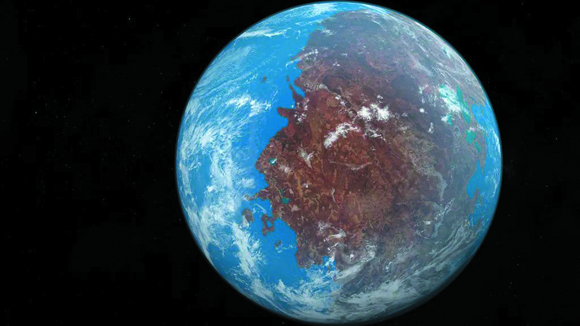
“Eons: Life and Death on Pangea,” an upcoming six-episode series from PBS Digital Studios and Complexly, will explore the “Great Dying,” the most catastrophic mass extinction in our planet’s history. Set during the Permian Period, the show will transport viewers to a world shaped by the supercontinent Pangea. The episodes will include “How The Formation of Pangea Changed the World” (July 29); “How Eating Plants Shaped Life on Land” (July 29); “The Rise and Fall of an Ancient Reef” (Aug. 5); “A Tale of Tusks and Saber Teeth” (Aug. 12); “That Time Almost Everything Died” (Aug. 19); and “Who Survived the Great Dying (and Why)” (Aug. 26).
Series creator Kallie Moore said the series has been a long time in the making.
“We've been thinking about doing some type of big broadcast show for quite some time. This has been in the works for years, and we’ve spent a lot of time trying to figure out what the narrative was going to be, how we were going to attack it, how long the series would be, and then filling that in,” Moore said. “It has gone through a lot of iterations, and I'm very, very happy with the final product. I think it's going to be very interesting to viewers to have such a deep dive into this time period that is often overlooked. We think about dinosaurs a lot, everybody wants to talk about dinosaurs, and this whole series is pre-dinosaurs, basically – I think we mention dinosaurs at the very, very end, like the very last episode, and I was really excited to talk about a time period that is not often represented in media, and that's really what we try to do with this series.”
Moore said there were a lot of discussions prior to the series going into production.
“PBS approached Eons and basically said ‘We think you need to do something bigger, would you want to do a long form series?’ And, of course, the entire Eons team was totally on board,” Moore said. “And then the second part of that was figuring out what are we going to talk about because everyone had some different ideas, so we had to finalize what this series was going to be about. Ultimately, what rose to the surface was talking about Pangea, the last supercontinent our planet had experienced, and the time period that this spanned over. Pangea came together at the very end of the Carboniferous period and split apart at the very beginning of the Triassic period, but during that whole middle part, the Permian, there was this massive supercontinent, so I think we all wanted to introduce the general public and us paleo-nerds to this other time period and these extremely important, but also very weird critters that were living on Pangea. We wanted to focus on something a little different, and everybody agreed that Permian has some of the weirdest animals that are just absolutely bizarre, and we are very excited to introduce them to to the public.”
With the series completed, Moore said she and her team are very excited for it to air.
“This is a secret we've been keeping for about two years now. This series took a very long time for development, script writing, fact checking and deciding what everything was going to look like,” Moore said. “Crossing the finish line now, there's overwhelming excitement for everybody to get to see how amazing and beautiful this series is. Everything looks amazing, everything sounds amazing, and all of the experts we talked to were wonderful on camera. Putting that all together in a package is such a great feeling, and we are all so excited for people to see this. I would want to mention Kansas also has some very important pieces to the overall Pangea story and the Permian story did we ultimately ended up not using, but I did pitch some places right in the Sunflower State.”
Moore said she hopes many people tune in for the series.
“If you are even remotely interested in the natural sciences or the history of our planet, you should just definitely check this series out,” Moore said. “Like I said, it's going to introduce viewers to a not well-known time period. People will see all sorts of cool critters, beautiful places, and hear from a lot of really, really smart people who really understand this time period, these critters, and how we've learned about all this over time. Our planet has gone through so, so, in its 4.5 billion years of history, and we're just talking about a tiny little segment of it, so I hope people get this kind of understanding of change over time.”