


ELLY GRIMM
• Leader & Times
Students and staff at Liberal High School will see some changes in scheduling starting this coming school year.
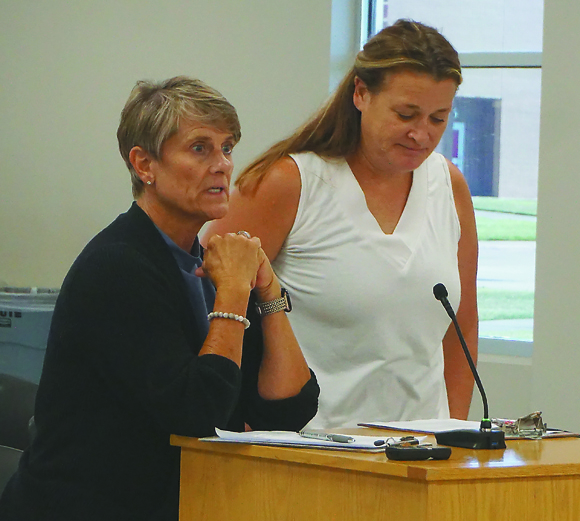
The USD 480 school board’s most recent meeting began with LHS Principal and Assistant Principal Darla Forney and Brandi Fowler talking about the changes set to come.
“When I started at LHS, FlexMod scheduling was what was being used, and I was inundated almost immediately by people asking if that was going to change. I didn’t have any idea what they were talking about because that was never put before me,” Forney said. “I found value in FlexMod scheduling, actually – it’s great for individualized schedules and getting the students where they need to be in their pathway. It also helped with the graduation rate, because LHS had the highest graduation rate ever this past year. It really allowed time for students to get where they were going, so I did find a lot of value in it. There were some aspects we did find that needed fixed or looked at differently, and a big thing was safety. My concern, coming from Texas, is we have almost 1,400 students moving throughout the school at any point during the day. To me, that made safety hard with everyone who was coming in and out. Another issue for me was, if a parent called and needed to get their child[ren] out of the classroom for a doctor’s appointment or something like that, there was a chance we wouldn’t be able to find them because they were doing Personal Learning Time (PLT), which doesn’t look very good on us. I love the idea of PLT, but that’s something that definitely needs looked at. We also discovered we were missing out on some funding, and we’re a business, and funding is very important in order to keep going.”
Overall, Forney said, she and staff knew there would need to be some changes made.
“We knew we needed to make some changes while keeping FlexMod in mind and all of its positive attributes. In March, we’d started talking about looking into more viable options to incorporate FlexMod while also giving some extra structure and security,” Forney said. “We got a committee together and looked around at other schools close to our size, including a few back in Texas I knew about, and we also had the teachers involved since they’re there on a daily basis. Over Spring Break, we got into PowerSchool and played with a few things because we wanted to know things were working so we could officially decide what we wanted to do. We played with PowerSchool a lot – we went in, mocked up some schedules and looked at several different potential options.”
“We came up with multiple different options, and there is no such thing as a perfect schedule for a school – if there was, every high school in the U.S. would adopt it and be using it,” Fowler said. “The option we landed on is a great combination of the strengths of FlexMod and regular scheduling.”
The final result, Forney said, should be beneficial to everyone.
“We took some of those options to the committee, which they took a look at, and they landed on the one we will officially be using and was built in PowerSchool. We know there’s no such thing as a perfect schedule, and we know there will probably be some bumps in the road, but if there are, we can fix them. Just like every other year, schedules have been approved, and we know there will be some aspects that will need some tweaking, but we think we’ve got a pretty good start. In fact, when we were mocking up some schedules, it scheduled something like 68 percent of the students already, so that cuts out a lot of work for our schedulers so they can focus on what they should be focusing on. We’re calling this new scheduling modified block because the main courses – the maths, sciences, social studies, ELA, etc. – will be offered every day in the same period, and the students will have the same teacher every day for those subjects. That will help the teachers really build relationships with those students, and they’ll be able to help more in terms of making sure homework’s done and the students are actually understanding the curriculum. Classes will be 50 minutes long, so there won’t be overlaps and no students coming in in the middle of class. On Wednesdays, classes will be 45 minutes since we get out early. We want the students to have those 50 uninterrupted minutes so there can be that focus on Tier 1 instruction and improvements. I can’t tell you how many times students who appear to be failing have done the work, it’s just either in their backpack or hasn’t yet been submitted.”
Another benefit to the changes, Forney said, should be increased consistency and accountability.
“Hopefully, these changes will give teachers ample opportunity to get through their lessons, adjust where necessary, and watch the students do their work. We’re banking on that, and we think that will help in terms of consistency in instruction and improved student accountability. That means students will be assigned to every one of their classes, they won’t just have free reign to go to different classes,” Forney said. “This will also help with teacher accountability in terms of taking attendance – instead of taking attendance 20 times a day, they’ll only have to do so eight times a day. This change in scheduling will also help with campus safety and supervision, and we’ve talked to administration about this – students can leave if they absolutely have to, but they’re not going to have free reign to go through every classroom door. There are specific doors they’ll be able to get through with their ID, and there will be times when certain doors will shut for the day.”
“There will also now be more predicability for teachers. When we were in FlexMod, teachers might have one group of students on one day and then a different group of students on another during the same time period, but this way, the teachers will know what they’ll be teaching every day and they know they’ll be with the same group of students,” Fowler added.
Overall, Forney said, she hopes the changes will be a help to everyone.
“Overall, the major benefits from this scheduling change will be increased academic support, stronger accountability and consistent monitoring, and more purposeful use of instructional time,” Forney said. “We’re also wanting to improve communication between students, teachers and families and increase the likelihood of students remaining on track for graduation. Again, we know this isn’t going to be completely perfect, but we think this is a good start.”