



ELLY GRIMM
• Leader & Times
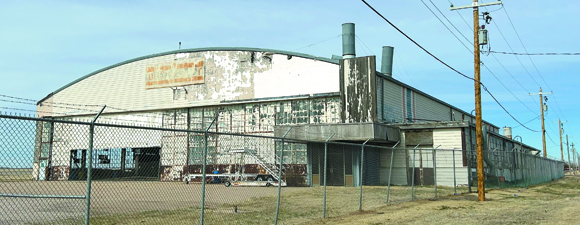
Work and discussions continue about what to do with the B-24 hangar at the Liberal air field and recently, those discussions took another step forward.
“Last year, we engaged with the Mid-America Air Museum Foundation to enlist LK Architecture and MKEC Engineering to help us with an overall assessment of the Skyhawk hangar,” MAAM Foundation member John Smith said. “They were here before Christmas, and they did a great job taking photos and visiting with us for several hours and putting together an extensive overview of that facility. This report was jointly funded by the City of Liberal and the MAAM Foundation with the intention of providing guidance on how to move forward with the structure. One aspect of the report that should really see some consideration talks about temporary measures of securing the building, and that includes suggestions like repair the exterior walls to eliminate further deterioration, temporarily cover the roof to prevent further weathering and deterioration, have the building checked for hazardous materials, asbestos, lead paints, etc., remediate with a licensed hazardous materials contractor, check out electrical services and repair as necessary to eliminate any fire or short circuit fire hazards, remove all interior walls in the hanger area that are not part of the original building, rebuild the north end of the building to eliminate exposure to wind and rain events, and have a general contractor prepare an estimate of cost prior to authorizing the items covered in this report. Some of the work could be done in-house, but that’s something that would need to be discussed and later approved.”
With the hangar being such a big part of Liberal’s history, Smith said many conversations are necessary before anything concrete happens.
“This hangar is rather an icon of the history of the Liberal airport, and our first real conversations about this project took place at a budget session, and that was understandable due to the fact that it wasn’t the foundation’s responsibility to either ask for grant funding or look for what was necessary to initiate that dialogue,” Smith said. “That hangar is a city building on City of Liberal property, and we were just representing the community in sharing concerns about moving forward with either saving it or whatever the final decision might be. Since then, we’ve gotten feedback from the community in terms of the city’s airport advisory board, the MAAM Foundation Board, the Focus on the Future Committee, the Convention & Visitors Bureau, the Seward County Historical Society, and multiple other civic organizations. They’ve all been very positive in their feedback and support of the idea of the hangar needing attention and the community being interested in preserving it.”
Smith then went into more detail about the recent reports themselves.
“This report has an architectural component and an engineering component. From the architectural standpoint, the roof structure is stable notwithstanding the covering in some spots, mainly the north end where some spots have been blown off and are cause for some concern,” Smith said. “There are also some drainage issues, particularly on the west side where that grassy area is, and there needs to be work done to make sure there’s no water coming in from the sides. There’s also some cleaning up that needs done in the interior with trash and all of that. The larger of the two paint booths in there from the Beech era may have some reusability and might be marketable if approached correctly, and the smaller one could be reutilized not as a paint booth, but possibly as an exhibit to talk about Beech’s history in the community. A lot of people don’t know how many people came here because of that hangar, the number of people who came to work there basically doubled Liberal’s population, which is just staggering for that time period, and there’s just a lot of heritage there.”
Like any potential big project, Smith said there are many questions to be answered.
“I know a big question with this would be the cost, and something we’ve been working on is getting some official costs and nailing down some of those numbers so things can be made more concrete depending on what path forward is decided upon,” Smith said. “Potential reuse is also always a question, and there are a lot of factors to consider like whether or not the building would be restored to original condition and could the building be placed on the State Historical Preservation Organization (SHPO) list. And if the SHPO was a possibility, what would be the pros and cons of being on that list? There would also have to be the consideration of restoring the building to house static displays for the Mid-America Air Museum (which is currently almost full to bursting) and using aircraft from the 1940's when the hangar was actively used or using it as a large event venue. Another option that was put forward was to put together a focused committee similar to what happened with the bond project in 2014, but there are also multiple factors to consider with that in terms of personnel and funding and finding grants and all of that. However, it’s still an option to consider. If the decision is made to restore the hangar, it could be an extremely great resource to the community.”
Smith added he and the rest of the MAAM Foundation are more than willing to collaborate with the City of Liberal.
“We want to be a cost-sharing partner in this, this is not us saying to the city ‘Go do this,’” Smith said. “This is feedback we heard when the building was on display during the AirFair in October, and there’s definitely a desire to see something done. The foundation wants to be a participant and be involved, we’re not just handing out orders. I think this report is a good first step, we’ve got something to build on and work from together.”