


ELLY GRIMM
• Leader & Times
USD 480 uses many federal programs and Monday evening, the USD 480 school board got to hear an update on some of them.
“As the board might be aware, one of our strategic goals for this year had to do with federal programs, and this seemed like a great time to talk about how all of that work is going,” Superintendent Dane Richardson said. “One of the overall goals was to align USD 480 federal program funds to be used efficiently and be 100 percent compliant with federal guidelines. We want to make sure USD 480 aligns and monitors each expenditure to meet all federal guidelines, we want to make sure we align every expenditure based on the needs of each building according to the student population of eligible students and the schedule amounts assigned to the buildings according to the Kansas State Department of Education (KSDE) in the USD 480 Learning Continuity Plan (LCP) application. That was a tough task we needed to learn a lot about as we went through it. Another major part of that goal was to make sure USD 480 assigns expenditures to be used for salaries, improve instruction for students to the maximum extent possible, and we also want to be sure and submit all documentation and LCP assurances by June 5. Another major goal is for USD 480 to have an approved plan in place to meet all federal requirements by this past February and for USD 480 to use federal reports, audits and artifacts to measure these goals, which will be achieved by June 30.”
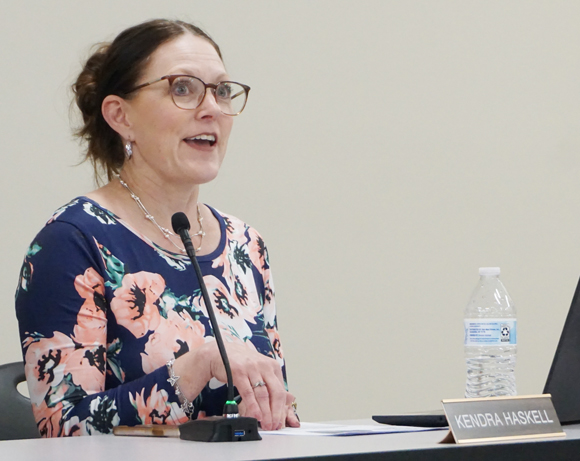
Director of Federal Programs Kendra Haskell then shared more details about the recent work, starting with Title 1.
“We do have a schoolwide Title 1 program in USD 480, and it’s a comprehensive reform model for schools. To qualify for that, the school has to have at least a 40 percent or higher poverty rate,” Haskell said. “Title 1 allows schools to use federal funds to upgrade the entire educational program rather than targeting specific students, so our federal Title 1 funds go to support all students in USD 480. The purpose of having a schoolwide program is it aims to raise achievement for all students, particularly the lowest-achieving students, by using those funds to help upgrade instructional strategies, reducing class sizes, improving technology, supporting professional development and enhancing other schoolwide resources.”
Like everywhere else, Haskell said there have been changes to take into account.
“This year, KSDE has amped up the federal requirements – in the past, KSDE basically said ‘Here’s what you have to do for federal funds, go do it,’ and then it got done. But this year, they are keeping really, really tight accountability to ensure every single building is using those federal funds and meeting those required pieces of the Title 1 schoolwide programs,” Haskell said. “Each school has to go in and update all of their documentation to show they are following those federal guidelines. At the district level, we’ve offered a lot of support dates for the buildings to complete these submissions. I do a lot of work at the district level and then provide the buildings with templates so they can make sure they have everything that’s required for those federal guidelines. We’ve had several training dates and several support dates. We had a submission to the state in November and then we have another Title 1 schoolwide submission due in May, which we’re working on right now.”
Work is also being done with parent engagement, Haskell said.
“This year, the district also has to turn in a district-wide parent engagement plan. We have district Site Council meetings this year, and we’ll be meeting April 16, which will include creating that plan,” Haskell said. “All of this is new from KSDE – even though they’ve long been federal requirements, KSDE is now requiring we turn all of this documentation in.”
Haskell also talked about funding.
“For our Title 1 funding, each building is allocated a different amount of funding based on their enrollment,” Haskell said. “82 percent of our federal funds for Title 1 this year are allocated for staff salaries, and that was one of our goals. This year, we have $1.3 million in building allocations. When I went through the staffing reports to see which positions we have that meet those Title 1 requirements, we are specifically using those Title 1 funds to pay for interventionists, paraeducators and parent coordinators who help those at-risk students and give them the extra support they need in order to be successful in school. Each building also received an additional $2,000 for required Title 1 parent and family engagement activities – if you receive Title 1 funds, you have to be providing those activities. The remaining Title 1 funds will be used to purchase Chromebooks for students.”
Haskell then talked about work with Title 3.
“Title 3 is another federal grant program that’s designed to ensure any English language learners attain English proficiency and meeting the necessary academic standards,” Haskell said. “This provides supplemental funding to districts for language instruction, professional development and family engagement. The purpose is to help the English-learning students achieve high levels of academic success. 98 percent of Title 3 funds are allocated to salaries this year, and they are funding two ESL paraeducators at each elementary school, one ESL paraeducator at each secondary school, and we have a full-time district translator for this year, which has been extremely beneficial. The remaining funds in Title 3 were used to purchase an online teaching program for our secondary ESL students and provide professional development specifically for ESL this year. We’ve been working with Maria Ortiz-Smith, who’s an ESL consultant from Sublette to ensure we have compliance in all areas of Title 3 we’re working in. We’ve been in every building, she’s offered professional development to every building twice, and we’re also going into each ESL classroom to see what’s going on and how we can align everything. We’re going to continue working and making sure our ESL program is strong and ready to go for next year.”
Haskell then talked about the district’s migrant funds.
“Currently, in USD 480, there are 119 migrant students, and 99 percent of our migrant funding is allocated to staff,” Haskell said. “Our migrant coordinator is Maria Martinez, and our migrant liaison, Luz Avalos, specifically works with the middle schools and Liberal High School and meets with those migrant students on a one-on-one basis. The remaining migrant funds are used to implement required summer learning for migrant students, which is a federal requirement. In November, we did host a migrant parent event at the Newcomer Center and served 21 families at that gathering, and we’re planning on hosting another event in May for all migrant families and kick off the summer programs.”
To conclude her presentation, Haskell then talked about the McKinney-Vento Act.
“The McKinney-Vento Homeless Assistance Act is a federal law that provides important educational rights and services to PreK-12 children and youth experiencing homelessness,” Haskell said. “Right now, in USD 480, there are 228 homeless students. The federal definition encompasses children lacking a fixed regular and adequate nighttime residence. Those children have to receive immediate student enrollment, and we also give them free meals, free transportation, and they have to have educational stability. With that program, we have to designate a liaison, and ours is Maria Martinez, to support those students. Any student who, if they’re living in a hotel, their car, or if they’re doubling up and living with a family member or friend, they qualify for this program. Through the Title 1 funds, we have to set aside $1,500 every year for those students and along with that, USD 480 received a grant in 2024 to help provide resources and services to students who qualify. We work very closely with the school social workers to assist families with specific students. There’s been a lot of work done to get everything in alignment, and I’m sure we’ll have more work to do in the coming weeks.”
For the meeting’s brief new business, the board approved a bid from Phil's Floor Care Specialist in the amount of $54,900 to remove and replace the stage floor in the Liberal High School auditorium as well as early graduation applications for Ailin Arellano Armendariz, Kelsey De la Torre, Braedin Gardner, Camille Queen Murillo, and Alejandro Rosales. To conclude the meeting’s new business, the board approved a proposal from Sports Design Group in the amount of $18,500 for design and project inspection for running track resurfacing at Redskin Field and the field at Seymour Rogers Middle School.