



ROBERT PIERCE
• Leader & Times
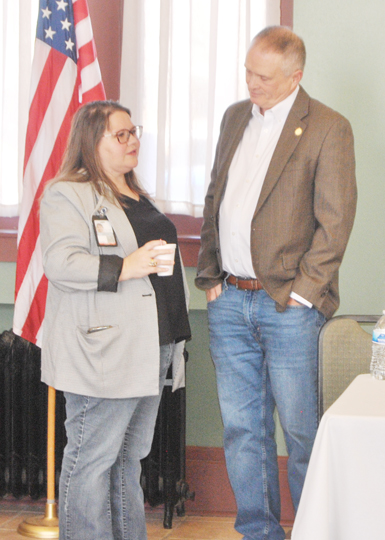
Four area lawmakers were in Liberal earlier this month as part of the Chamber of Commerce’s Legislative Coffee series for this year.
This month’s event was sponsored by the Southwest Kansas Board of Realtors, and as part of introductions by the group, Kansas 125th House District Representative Shannon Francis said many bills have been looked at and addressed during this year’s session.
“We’re getting to the point where things either get past the finish line or they don’t get past the finish line,” he said.
Francis said leadership in both the House and Senate is focused on finding $50 million to $60 million in cuts to the state’s general fund budget.
“We’ve got a long-term spending issue,” he said. “If we can cut another $50 or $60 million out this year, cut some spending next year, we’ll be able to reach a point where revenues equal expenses, and that’s what our big focus is. Unfortunately, that always creates a problem because everybody’s for more spending if it’s their spending, and everybody wants tax cuts.”
Kansas 39th District Senator Bill Clifford said the state’s budget is made up of about $11 billion of constituents’ tax dollars in the general fund, with federal funds, including Medicaid dollars, making up about $15 billion for a total budget of about $26 billion.
Francis said the budget likewise contains some dedicated funding such as fuel taxes, highway funds and other fees.
When it comes to the budget, Clifford said $50 to $60 million is not much. He added there will be a fight to see what gets cut, and officials with the programs that get cut will not be happy.
“Keep in mind, we have $4.2 billion in savings right now at the state level,” he said. “We’re always trying to get local entities to reduce taxes and revenue, but we’re holding on to $4.2 billion in the state. We have a rainy day fund that’s at $2 billion that’s locked away, and we can only touch it in certain circumstances. Our ending balance is going to be about $2.2 billion. Financially, yes, we’re spending, but we have a cushion there where even if we have a recession, things won’t get too drastic.”
Later, some constituents asked about wind energy, a subject of much discussion in Seward County with the possibility of turbines going into place in the county.
Some have suggested having county commissions such as Seward County’s put a moratorium on issuing new permits. Francis said this would require an application from the Kansas Corporation Commission.
Clifford said Senate Bill 417, promoted by Kansas Farm Bureau and the Kansas Livestock Association, would requirements for the development, construction, modification, maintenance, operation and decommissioning of certain industrial energy facilities and providing jurisdiction to the state corporation commission to control and permit such development, construction, modification, operation, maintenance and decommissioning of such facilities. The bill was referred to the Senate Utilities Committee in February.
The bill would likewise establish data centers throughout the state, which many are opposed to, but in his home county of Finney County, Clifford said $3 billion worth of solar and wind projects have been teed up with a data center.
“We’re going to take 2,000 acres of irrigated land,” he said. “A billion gallons of water is going on that ground, and by changing it over to this project, we’ll use a million gallons. It’s a big water solution for us in Finney County. You hear a lot about data centers chewing up a lot of water. There are some called hyperscalers. They have to be water cooled. We’re doing air cooled and closed loop cooling.”
With many Finney County residents upset about having to put a project on hold, Clifford said KLA and KFB leaders were told to take the data centers somewhere else to negotiate, and SB 417 is off the table at this time.
Clifford said there has been an amendment to put a moratorium in six counties discussed in the Senate recently. Among the counties were Sedgwick County, Ness County and Hodgeman County.
“It said if you had a drought emergency declared in your county, you can’t build a data center for three years,” he said. “I voted no on that. I don’t want the state telling me what to do in Finney County.”