


ELLY GRIMM
• Leader & Times
Statistics show nearly half of women and more than 1 in 6 men experience some form of contact sexual violence in their lifetimes, and more than 1 in 5 women and 1 in 31 men have experienced completed or attempted rape in their lifetime. Statistics also show more than 4 in 5 female rape survivors reported that they were first raped before age 25 and almost half were first raped as a minor, while nearly 8 in 10 male rape survivors reported they were made to penetrate someone before age 25 and about four in 10 were first made to penetrate as a minor.
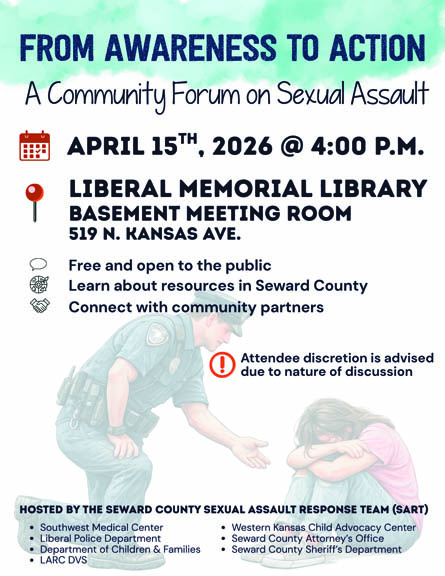
For those who experience sexual violence, there are multiple resources available to help, and soon, a community forum will help share more information about those resources.
Members of the Seward County Sexual Assault Response Team (SART) will be hosting a community forum starting at 4 p.m. Wednesday, April 15 at Liberal Memorial Library.
“We’ll start with what a sexual assault response team is, or SART, as we call it, and it is a group of different agencies in the community that work together for victims of sexual assault,” SART member Jandi Head said. “The team includes the hospital, the police department, the sheriff’s department, DCF, the Liberal Area Rape Crisis/Domestic Violence Services (LARC/DVS) and the Western Kansas Child Advocacy Center, as well as the Seward County Attorney’s Office. We meet once a quarter and just talk about how we can best improve our response to victims in the community. And because April is Sexual Assault Awareness Month and Child Abuse Prevention Month, we want to talk about what resources are available, what each of our agencies do when an assault occurs, and just let the community know what resources are available and what they can do if they have been assaulted, or if they know of somebody who’s been assaulted, and just let them know that we are available and they’re not alone.”
Head said she hopes for a large turnout to the forum.
“I am a strong believer abuse thrives in silence, so the more we talk about it and the more we educate ourselves, the less we are protecting the perpetrators that do the abuse,” Head said. “And the more we talk about it, the more we can help protect ourselves and protect children and anybody who could potentially be a victim. I would encourage the community to come to learn about the resources so they know what we have available, and then also to provide any input on what we can do to better prevent any types of abuse. We hope to have as many people as possible. We’ve done this for a couple of years in the past, but we haven’t had as much of a turnout as I would have liked to see. We hope the more people that we can communicate with, the more people who know about what’s available, the better off our community will be. We hope there are a lot of people in attendance to come and learn and educate themselves.”
A main goal of the forum, Head said, is education.
“A lot of times, people don’t really know what resources are available, and they may not know how each of our agencies work together to make sure that we’re providing the best victim centered response,” Head said. “I think letting people know about the different resources is a great opportunity for us to get together and have an open discussion about what we have available. And then any questions anybody in the community has, we’re happy to answer them as well. I hope people take away what the steps could be if they find themselves in a situation where they’ve been sexually abused, or if they know somebody who has been, so they know the proper steps to take to help best support that person. When a community understands the resources that are available, people are more likely to seek help when they need it. We know a lot of sexual violence goes unreported out of fear for reporting, out of fear of talking to the police, and fear of repercussions from the offender, among other reasons. I hope learning about the resources we have available will help people feel more comfortable reporting.”
Head then talked more about what happens when a client comes in for help.
“After an assault occurs, that victim has options. They can go to the police department to make the report, they can go to LARC/DVS for advocacy services, they can also present to the hospital to receive a medical forensic exam,” Head said. “And when each of us has contact with somebody who has experienced an assault, we will typically then work with other agencies if that person wants that to occur. I know for the hospital, we have very strict privacy laws, and if it’s an adult victim and they don’t want us to disclose or share any information, we won’t. As nurses, we have some different laws around mandatory reporting, so if it’s a vulnerable adult or a child who has experienced abuse, then we’re legally mandated to report. But outside of that, adult patients have the choice whether or not they want to talk with law enforcement, whether or not they want to receive an exam, whether or not they want to receive services from the LARC/DVS advocate. They have those options, and depending on where they decide to go, then each agency will then offer the different resources and availability that they have.”
Head added she feels the collaboration between the different entities in the area is great.
“We all work well together when it’s needed, with the hospital and LARC/DVS, and everyone else who ultimately ends up involved,” Head said. “We work together really well, we communicate well, and we do what we do what we can to meet the needs of the victim and of any family members who might be involved with that situation. And when we have our quarterly meetings, we discuss any necessary changes within our organization and any issues we may have experienced. We do work well together in so many different ways.”
Head also offered encouragement for anyone needing services to reach out for help.
“If you know anybody who has any questions, don’t hesitate to reach out to one of these agencies, because I guarantee any of us will be happy to talk about anything that may be available for our community,” Head said. “And as I said before, abuse thrives in silence, so the more we talk about abuse and the more we talk about available resources, the better job we do at protecting ourselves and children and those who are vulnerable. We encourage people to stay aware, to be knowledgeable about different kinds of assaults and crimes that can occur, and know what resources we have in our community.”